
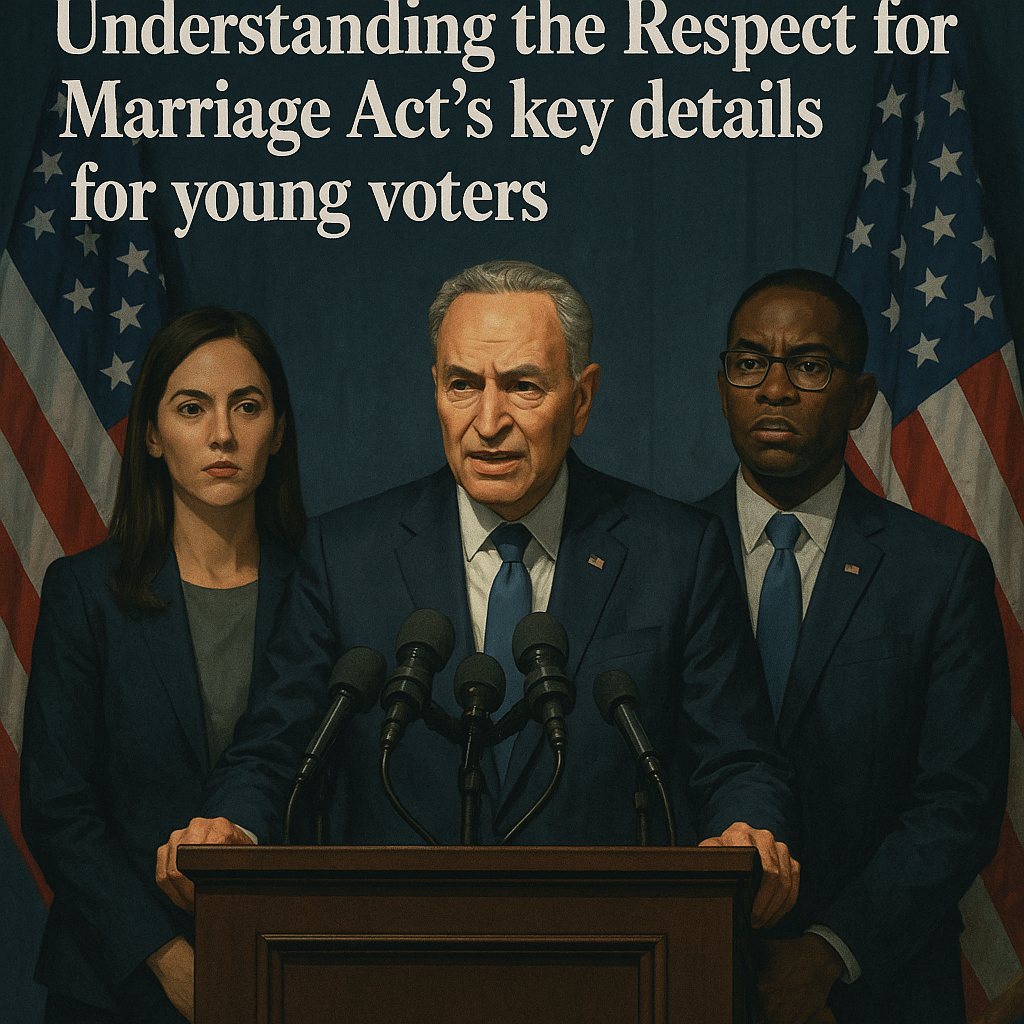

The recent unity demonstrated between Republican and Democratic lawmakers to safeguard same-sex marriage marks a significant shift in the American political landscape. Historically, these two parties have often stood on opposite ends of cultural and legislative debates, yet in this instance, shared concerns over the potential destabilization of marriage rights have catalyzed bipartisan cooperation. The image of legislators rallying to defend a core social institution highlights how power struggles in Congress are increasingly influenced by public sentiment and constitutional interpretations. This alliance emphasizes a recognition that values held by the people, especially around family and identity, remain deeply intertwined with political legitimacy.
At the heart of this debate lies the judicial activism of the Supreme Court, which has raised fears among advocates of traditional institutions and certain constitutional scholars who draw parallels to historical court overreach. Critics argue that the current federal judiciary may be veering away from the original intent of the Constitution, asserting that the Court’s role should be confined within a strict interpretative framework. Notably, constitutional theorists like Robert Bork and the originalists echo sentiments warning against unwarranted judicial expansion, emphasizing that marriage laws are culturally rooted and not merely legal constructs to be redefined at the Court’s whim. Consequently, the bipartisan effort to protect same-sex marriage acts as a bulwark against what some see as the Court’s encroachment into social fabric—the ultimate battle between judicial activism and popular sovereignty.
This power struggle has profound implications for the people’s sovereignty. When legislation is threatened by an overreaching judiciary, it reflects a deeper clash over who holds the ultimate authority: the elected representatives of the people or appointed judges interpreting law in a way that can upend societal norms. As seen in historical parallels such as the debates surrounding Brown v. Board or the Supreme Court’s decisions on civil rights, the outcome of such conflicts often shapes national destiny. Political leaders now face the challenge of balancing constitutional fidelity with the will of their constituents—each decision, each legislation, becoming a stroke on the canvas of history. The current bipartisan move to protect marriage rights echoes the age-old narrative: the struggle for control over defining societal values lies at the heart of political power.
In essence, politics remains the stage where destiny is written, a continuous interplay where power, ideology, and societal values collide and collide again. Today’s debate over marriage rights exemplifies how decisions in the corridors of power ripple outward, directly shaping individual lives and collective identities. Whether this unity persists or fractures under future political winds, the underlying truth endures: the battle for the nation’s soul is ongoing, and in that battle, history’s pen remains mightier than ever. Ultimately, politics is not merely a game of numbers or policy—it is the forge where the future itself is tempered, contesting the essence of what it means to be a society and a people destined for their own unfolding story.





