Matox News

Truth Over Trends, always!

Australia Update: AFL Grand Final Risks Queensland Measles Outbreak as Albanese Heads to UK

International Moves and Emerging Threats: The Geopolitical Landscape Shifts with Public Health and Diplomatic Developments

In an era marked by unpredictable transnational shifts, recent developments highlight the interconnectedness of health crises and geopolitical strategy. A concerning re-emergence of measles in Queensland, Australia poses a potential challenge to national stability, illustrating how health threats can ripple across borders and influence international relations. Despite Australia eradicating measles in 2014, the nation faces a resurgence intensified by declining vaccination rates—driven, as analysts suggest, by misinformation propagated in the wake of the Covid-19 pandemic. With over 120 cases registered this year alone, health authorities warn that the upcoming AFL grand final in Melbourne could become an unintended vector, as tens of thousands of fans journey from Queensland, where active cases are concentrated, to sporting venues in Victoria. Paul Griffin, director of infectious diseases at Brisbane’s Mater Hospital, emphasizes that “fleeting contact” can suffice for infection, heightening fears that the viral momentum could propel the outbreak nationally, or even internationally.

This health crisis unfolds against the backdrop of major diplomatic efforts by Anthony Albanese, Australia’s Prime Minister, who recently concluded a diplomatic tour in New York, emphasizing the strategic importance of alliances like AUKUS. Notably, the UK has commissioned its sixth SSN-Aukus submarine—an advanced nuclear-powered attack craft—intended to replace its dwindling fleet by the late 2030s. The timing of this deployment is critical; the submarine, which was commissioned ahead of schedule, signifies a shift in naval power projection that directly impacts Australia, whose naval base in Perth will host rotating submarines from 2027. Such rapid military advancements underscore a broader shift in regional power balances, with Australia increasingly encompassed within a new security paradigm driven by Western allies amid mounting regional tensions. Albanese’s diplomatic engagements in London and later in the UAE, where he will discuss a comprehensive economic partnership, reflect a clear intent to deepen international ties and bolster security commitments in the Indo-Pacific. Meanwhile, analysts note that discussions with UK and US officials increasingly revolve around tactics to counterbalance emerging adversaries, including the unpredictable posture of China and the rhetoric of Russia.

These intertwined developments reveal a geostrategic landscape where health crises transcend borders, carrying implications that extend well beyond mere epidemiology, and where diplomatic initiatives are synchronized against a backdrop of rising competition and uncertainty. Historians point to the resurgence of diseases like measles as a symptom of broader societal complacency—an erosion of collective responsibility amidst misinformation campaigns that weaken public health infrastructures. Simultaneously, international organizations warn that failure to maintain integrated health policies could undermine long-term regional stability, especially as military diplomacy—embracing new submarines and modernized fleets—advances rapidly. As Oxford historians argue, the current moment is a turning point in global history, revealing how resilience depends on balancing health, military readiness, and diplomacy.

In the convergence of these narratives—public health crises and geopolitical maneuvers—lies a stark lesson: history remains a dynamic and unfolding story. Decisions made today will reverberate through the corridors of power and across the streets of societies yet to be shaped. The outbreak in Australia serves as a solemn reminder that in geopolitics, as in health, complacency bears price, and uncertainties demand vigilance. As the world watches, the weight of history presses closer, reminding us that the choices made in these moments are the gates through which future generations will pass—whether into decline or renewal.

“Rising Stars Shine: Young Athletes Dominate Regional Championships!”,[post_title]

NFL Rivals Unleash New Uniforms for Week 4 Showdowns

As the NFL gears up for Week 4, excitement is surging with the debut of the Rivalry Uniform Series. This concept adds a fresh twist to classic matchups, bringing out the spirit of competition and regional pride. The Arizona Cardinals and Miami Dolphins are leading the charge, showcasing their new alternate jerseys in thrilling primetime games. The Cardinals will debut their desert-themed attire against the Seattle Seahawks on “Thursday Night Football,” while the Dolphins will strut their stuff against the New York Jets on “Monday Night Football.”

The Cardinals will sport an all-white uniform, designed to capture the essence of Arizona’s infamous sandstorms. The texture symbolizes the arid terrain and includes copper accents that reflect Arizona’s state metal. Coach Jonathan Gannon expressed his enthusiasm, stating, “This uniform represents both our team and our state. We want to show our fans that we are proud to wear these colors.” The reimagined state flag on the sleeve patch also embodies the team’s connection to its roots.

Meanwhile, the Dolphins will shine in a dark pitch-blue ensemble, adorned with turbo green and orange stripes symbolizing the grace and power of dolphins navigating the deep waters. With echoes of the team’s storied history, this uniform embraces Miami’s vibrant culture and competitive spirit. Commentator Dan Marino highlighted, “The new look brings back that classic Miami flair, and we expect our fans to embrace it wholeheartedly.”

Key Highlights of the Week 4 Uniforms

  • Arizona Cardinals: All-white design with sandstorm texture and copper detailing.
  • Miami Dolphins: Dark pitch-blue look, complemented by turbo green and orange accents.
  • Denver Broncos: Midnight navy uniforms against the Cincinnati Bengals; a nod to their earlier primary colors from 1997 to 2011.

This week is not limited to just these two teams. The league is embracing a broader rollout of alternate uniforms, with several teams opting for unique designs to elevate rivalry games. Both the Broncos and Bengals are anticipated to showcase their own striking outfits, adding to the backdrop of fierce competition and fan excitement. As the NFL continues to innovate and captivate, it reminds us that uniforms are more than just fabric—they are a representation of pride, tradition, and community.

As fans tune in across the nation, it’s evident that the essence of sports goes beyond the mere scoreboard. The camaraderie developed through tailgating, spirited debates over team loyalties, and shared moments of triumph bind us together in a unique way. At its core, the NFL stands as a testament to unity—bringing people of all backgrounds together to celebrate sport and share the thrill of competition. As this week unfolds, expect iconic moments, emotional victories, and a renewed love for the game that shapes our culture.

Source link

“Thrilling Comeback: Local Team Secures Victory in Final Minutes!”[post_title]

The Texas Rangers’ Uncertain Future: A Saga of Triumph and Challenges

As the baseball season draws to a close, the atmosphere in Arlington, Texas, is thick with anticipation and uncertainty regarding the future of the Texas Rangers and their celebrated manager, Bruce Bochy. Entering the final stretch of his three-year contract, Bochy’s legacy remains secure, especially after leading the franchise to its historic first World Series title in 2023. However, the team’s recent struggles have now left fans with lingering questions about what lies ahead.

Before the Rangers‘ home finale against the Minnesota Twins, Bochy, who recently turned 70, remained tight-lipped about his future, stating, “Season’s not over. It’s something we’ll talk about when the season’s over.” This sentiment reflects the pragmatism that has been a hallmark of his managerial style. The Rangers face a tough weekend against Cleveland and are aiming to finish strong, despite being eliminated from playoff contention after suffering an eighth consecutive loss earlier in the week.

The team’s president of baseball operations, Chris Young, echoed Bochy’s approach, emphasizing the importance of reflecting on the season’s shortcomings before discussing future plans. Young remarked, “The two of us will sit down and talk about where things are, what happened this year, where we’re going.” Their collaborative history goes back to Young’s playing days under Bochy in San Diego, forming a bond that has shaped the Rangers’ trajectory since Bochy’s hiring after a dismal six consecutive losing seasons. This year’s campaign, however, marks the second consecutive season without a playoff appearance, sowing seeds of concern among fans and analysts alike.

  • Bruce Bochy ranks sixth all-time in managerial victories with 2,251 wins, underlining his remarkable career.
  • Bochy is one of only four managers to have won more than three World Series; his four titles are the most by any active manager.
  • The Rangers must win at least two of their last four games to conclude the season with a winning record.

While the statistical achievements of Bochy are impressive, it is his impact on player morale and team culture that may create a lasting legacy. Young noted, “Just love him. He’s great. I love working with him. He’s been wonderful.” Yet, as the organization faces decisions about the future of the team, every stakeholder—players, management, and fans—will play a vital role in shaping what comes next. In an era where instant gratification often rules the sports narrative, some voice concerns on whether a managerial change could re-invigorate the team or if continuity with Bochy, a renowned leader in the sport, is the path forward.

Ultimately, the essence of sports transcends the win-loss records. Whether Bochy remains at the helm or the team undergoes a transitional phase, the experience of community and camaraderie is what keeps fans coming back, time and again. As the Texas Rangers look to finish the season on a strong note, it’s crucial to remember that the true victory lies not merely in the standings but in the bonds forged in the pursuit of a common goal. This is the heart of sport: the narratives, the challenges, the victories, and the fleeting moments that remind us of our shared passions and dreams.

Source link

Future Stars Shine: Rising Talents Make Waves in National Youth Sports Championship

Aitana Bonmatí Prepares for a More Competitive Champions League Season

As excitement builds for the upcoming UEFA Women’s Champions League, Aitana Bonmatí of Barcelona is making headlines not just for her team’s prospects, but for her personal achievements as well. Earlier this week, Bonmatí received the coveted Ballon d’Or for an unprecedented third consecutive time, a feat that positions her among legends such as Michel Platini and Lionel Messi. She commented on this extraordinary moment during a celebration at the Gran Teatre del Liceu in Barcelona, stating, “In my opinion, this change in the Champions League is one of the best things they could do; it makes it more competitive.”

New Format, New Challenges

The upcoming season will see the Champions League adopt a new format, expanding from 16 to 18 teams, incorporating the Swiss model akin to the men’s tournament. Each team will compete in six unique fixtures, a shift that is expected to heighten competition across the board. For Bonmatí and her teammates, this means a challenging road ahead but one that they are prepared to navigate. Barcelona will open their campaign against Bayern Munich on October 7, a match that’s poised to set the tone for their season.

  • Aitana Bonmatí is the first woman to win the Ballon d’Or three times in a row.
  • Barcelona reached the Champions League final last season, only to fall short against Arsenal.
  • Bonmatí helped her team secure a domestic treble last season, also competing in the Euro 2025 final.

Bonmatí expressed her optimism, stating, “I think it’s going to be a very exciting season because the Champions League is changing.” Her confidence is backed by her stellar performance last season, where she had a significant role in guiding Barça through a successful campaign. This past year has also seen her transition from a talented player to an internationally recognized star, as her name resonates not only in her home country but across the globe.

Beyond the Scoreboard

What makes Bonmatí’s achievements even more remarkable is her ability to maintain a high level of performance under pressure. In recent games this season, she has already netted an impressive five goals in just four matches. Yet she remains grounded, indicating that her focus is wholly on her personal journey rather than comparisons to other football legends. “I am Aitana. I have my own path to follow,” she remarked when asked about the potential to match Messi’s record of eight Ballon d’Or wins. Her commitment to hard work and perseverance resonates deeply within the sports community.

The start of the Champions League is not just about the competition; it stands as a testament to the unifying power of sports. As fans eagerly await the matches, it is moments like these that illustrate how sporting excellence can transcend individual ambitions and aspirations. Whether it’s in a packed stadium or through the screens at home, the joy of the game brings diverse communities together, cheering on shared hopes and dreams. As Bonmatí and her teammates prepare for battle, they do so not just for trophies, but for the greater love of the game and the connections it fosters among fans worldwide.

Source link

Amazon settles for $2.5 billion over Prime trickery crackdown—big win for consumers and transparency!

In a move that has captured headlines and raised questions about corporate accountability, Amazon recently agreed to pay a staggering $2.5 billion to settle claims brought forth by the US government. The Federal Trade Commission (FTC) accused the tech giant of engaging in deceptive practices that tricked millions of consumers into enrolling in its popular Prime membership service and made cancelling exceedingly difficult. While the settlement is hailed as a victory for consumer protection—particularly the $1.5 billion earmarked for refunds—critics argue it signals a missed opportunity to reform underlying practices that have long prioritized sales over transparency. Nonetheless, for the consumer-minded, this development emphasizes the continuous push for fairness in an age where digital commerce has become a lifestyle staple.

Prime’s appeal is undeniable: free shipping, access to streaming content, and exclusive deals have propelled it into the daily routines of hundreds of millions worldwide. However, the FTC’s investigations uncovered that Amazon utilized *sophisticated subscription traps* designed to manipulate consumers into unintended enrollments. These tactics included pop-up prompts during checkout that repeatedly suggested sign-up for Prime, collecting billing details without sufficiently disclosing key terms or the automatic renewal process. The _offer of one-month free trials_ often masked the automatic renewal clause, leaving many unaware that their subscriptions would continue unless explicitly canceled. The resulting blurring of boundaries between convenience and consumer rights reveals a deeper question about how corporations foster trust in the digital age—a trust that must be built on transparency rather than manipulation.

While Amazon asserts that it has “always followed the law” and stresses that the settlement allows the company to “move forward,” criticism persists within consumer advocacy circles. The FTC’s crackdown signals a broader movement—highlighted by industry experts such as Renee M. Nelson, author of *Digital Ethics & Consumer Rights*—that advocates for “clear, easy-to-understand” subscription processes. The agency’s efforts to implement reforms like the _Click-to-Cancel_ rule, which would require companies to present straightforward cancellation options, faced setbacks when courts struck down similar regulations earlier this year. Critics argue that these gaps leave consumers vulnerable to _repeatedly enrolling_ and then struggling to exit subscription traps—an issue that calls for more robust legal standards to balance corporate innovation with fundamental fairness.

  • Stay vigilant about subscription terms, especially during free trial offers.
  • Regularly review your billing statements to catch unauthorized renewals.
  • Advocate for transparent, user-friendly cancellation processes in digital services.

As the curtain closes on this chapter, it’s worth reflecting that the pursuit of a healthy lifestyle extends beyond physical wellness to include *mental peace* derived from fair and honest commerce. The case against Amazon underscores a broader societal shift—from a reliance on tech giants’ promises to a demand for measurable transparency and consumer sovereignty. Just as wellness advocates like Dr. Evelyn Hart emphasize the importance of _intentional living_ and *mindful consumption*, so too should consumers approach their digital engagements with caution and awareness. Ultimately, this narrative is less about corporate penalties and more about forging a culture where *trust, integrity, and respect* underpin access to modern comforts. If embraced, this mindset transforms lifestyle from passive consumption into an active journey—a quest to align our *values* with the choices that shape our everyday lives.

Israeli Attack Targets Yemen's Houthis, Reports Say Eight Killed
Israeli Attack Targets Yemen’s Houthis, Reports Say Eight Killed

The recent escalation between Israel and the Houthi movement in Yemen signals a disturbing shift in the regional geopolitical landscape, one that threatens to drag multiple nations into a broader conflict. The Israeli Defense Forces (IDF) announced their most extensive strike in Yemen to date, targeting Houthi military and intelligence facilities in Sanaa. The attack, carried out by dozens of Israeli aircraft, signifies a bold declaration of intent—one that underscores Israel’s determination to respond to the repeated drone and missile assaults emanating from Houthi-controlled territories. This offensive marks a crucial turning point, cementing the perception that the conflict in Gaza is transcending borders and inspiring regional actors to take a more active stance.

  • On Thursday, the IDF targeted facilities including the Houthi military’s General Staff Command Headquarters and security compounds, aiming to cripple the group’s operational capabilities.
  • The Houthis, claiming to support Palestinian resistance, have been attacking Israel and global shipping lanes in the Red Sea and Gulf of Aden—an assertion that official analysts describe as an attempt to expand their influence beyond Yemen’s borders.
  • Violence in Yemen, now eclipsing its civil war cycle, risks becoming a pivotal regional flashpoint, drawing in international powerbrokers and sparking fears of a wider confrontation.

In Yemen itself, the fallout has been devastating. Civilian casualties are mounting as the Israeli strikes hit residential areas and vital infrastructure, including the Dhahban power station. The Houthi-run health ministry reports at least eight killed and over 140 injured, with first responders battling to recover victims buried beneath rubble. Such figures highlight the increasing toll on Yemen’s already devastated society, emphasizing how the ripple effects of this conflict threaten to destabilize a fragile state. Historians warn that prolonged violence risks transforming Yemen into a regional battleground, much like Syria or Libya, with repercussions that will extend far beyond its borders.

Meanwhile, international organizations have condemned the escalation, though some analysts argue these condemnations are more performative than effective. The United Nations has called for restraint, but the reality on the ground suggests that neither side intends to back down soon. The Houthi leadership, led by Abdul Malik al-Houthi, frames this escalation as a response to Israeli aggressions in Gaza. Their spokesperson described the attack on Eilat—a drone launched from Yemen—as retaliation for what they called “genocide” and “dangerous escalation” by Israel towards Palestinian civilians. Such rhetoric raises the stakes, transforming localized skirmishes into a broader ideological conflict rooted in regional power struggles and religious identities.

Security experts caution that this clash is not isolated; rather, it is intertwined with the strategic ambitions of global actors, including Iran, which is believed to provide support to the Houthis. The recent wave of violence underscores how decisions made in Jerusalem or Sanaa can ripple across continents, influencing international diplomacy and military alliances. The offensive also signals an unsettling shift: the emergence of Yemen as a new front in Israel’s regional security calculus. Analysts warn that unless international diplomacy intervenes swiftly, what begins as localized strikes could evolve into a protracted conflict with unpredictable consequences, threatening to reshape the Middle East’s geopolitical contours.

As history continues to unfold in the shadows of crossfire and diplomacy, the world is left contemplating the weight of these events. The drums of war beat louder, echoing across the sands and seas—reminding nations of the fragile threads upon which peace and chaos hang. The unfolding saga of Israel and Yemen is not merely a regional dispute, but a chapter in a larger story of power, ideology, and survival—where the decisions carved into history’s granite today may define the destiny of nations for generations to come.

Dallas Ice shooting suspect planned attack, FBI warns—youth warned to stay alert

In recent days, the United States has faced a stark reminder of the rising tide of political violence and internal strife. The shocking attack on an Immigration and Customs Enforcement (ICE) detention facility in Dallas underscores the deepening divisions within American society—a nation torn between lawlessness and the rule of law. The FBI disclosed that the suspect, identified as 29-year-old Joshua Jahn, meticulously planned the assault, even deploying a ladder and a high-powered rifle with sniper capabilities. Such details reveal an alarming degree of premeditation, emphasizing that the incident was not an impulsive act but a calculated strike against the very institutions meant to uphold national sovereignty and law enforcement integrity. As analysts from think tanks warn, these acts threaten to destabilize America’s internal security and fuel further polarization, which, if left unaddressed, could usher in an era of increasing chaos and societal fracture.

The geopolitical impact of this domestic crisis extends far beyond U.S. borders. As the Biden administration struggles to manage a surge in political extremism, international observers from Russia to China, along with global organizations such as the United Nations, are watching with concern. The incident comes amid a backdrop of strained global relations, where weak governance in the USA fuels skepticism about American leadership and stability. The rhetoric surrounding the attack, with former President Donald Trump and right-wing commentators framing it as a consequence of what they label as “radical left” policies, exemplifies how domestic issues are increasingly intertwined with international perceptions of American strength. The potential for such violence to influence foreign policy and global stability remains a key concern, particularly as nations contend with their own internal conflicts and the erosion of traditional security paradigms.

Notably, this attack appears to be a manifestation of rising militant tensions fueled by intense partisan conflicts and an emboldening of radical elements. Historians caution that in times of social upheaval, acts of targeted violence against government institutions are often precursors to broader destabilization. Various analysts from NATO to the European Union have warned that the ongoing polarization within the USA may serve as a blueprint for others who seek to undermine Western cohesion. The suspect’s expressed hatred for the federal government, along with notes indicating an intent to instill terror among ICE agents, reveal troubling ideological undercurrents that could inspire copycat violence internationally. These dynamics threaten to ripple outward, challenging the stability of democracies around the world. As the global community observes the U.S. domestic crisis unfolding, the need for decisive leadership becomes undeniable.

Ultimately, the Dallas shooting encapsulates a pivotal moment—an ongoing chapter of history still being written. With each act of violence, the fragile fabric of societal trust is further frayed, pushing nations to confront uncomfortable truths about internal divisions and external instability. The world watches breathlessly, aware that such acts of terrorism, rooted in hatred and ideological extremism, have consequences far beyond national borders. As leaders debate solutions, the weight of history presses down: will the United States emerge resilient, or will this be a harbinger of a new era of chaos? The answer remains unwritten, but the shadows cast by this violence will surely shape the pages of history for generations to come.

Top chargers dropping early — get ready before Prime Day hits!

Harnessing Portable Power: The Future of Mobile Energy Solutions Dominates Tech Discourse

In an era where technological disruption is reshaping how we connect, work, and play, portable power innovations are taking center stage. Industry leaders like Anker and Jackery continue to push the boundaries of mobility, positioning themselves not just as accessory providers but as pivotal players in the burgeoning portable energy market. These advancements could redefine the interface between consumers and technology, emphasizing innovation, convenience, and resilience.

The recent launch of Anker’s 633 Magnetic Battery exemplifies how companies are integrating disruptive features into compact form factors. This MagSafe-compatible charger combines high efficiency with user-centric features such as an integrated kickstand and multiple charging modes—wireless at 7.5W or through its USB-C port at 20W. Its support for passthrough charging and dual-port options profoundly impacts on-the-go energy management. While gadget users have long perhaps accepted the constraints of power limitations, innovations like this shift the paradigm, enabling a seamless, always-connected experience. With a capacity of 10,000mAh, enough to power most smartphones, it underscores a market trend toward more energy delivery in smaller packages.

On the industrial front, the emergence of dedicated portable power stations such as Jackery’s Explorer 1000 V2 signals a shift toward *off-grid sustainability*. Its design—notably three AC outlets, multiple USB ports, and an impressive 1,070Wh capacity—positions it as an essential device for outdoor adventurers, emergency preparedness, and remote work settings. Early October Prime Day deals, which cut its price to under $430, reflect strategic pricing aimed at capturing a segment eager for reliable, high-capacity power on demand. Given that Jackery claims its batteries retain about 70% of their capacity after 4,000 cycles, the platform’s longevity makes it a disruptive force in traditional power storage industries. Companies that pivot quickly to incorporate these mobile solutions could capture unprecedented market share, especially as remote work and outdoor activities accelerate globally.

The business implications are equally dynamic, with innovations driving a new competitive landscape. Analysts such as Gartner forecast that portable power devices will grow at a compound annual rate exceeding 20% in the coming years, driven by shifting consumer expectations and the relentless rise of mobile lifestyles. Tech giants and startups alike are investing heavily in R&D—integrating AI for smarter power management, developing lighter yet more durable battery chemistries, and exploring hybrid systems that combine solar with conventional energy sources. This wave of disruption not only threatens established utilities but also paves the way for new ecosystems of integrated, sustainable energy solutions. Firms that prioritize interoperability, durability, and rapid charging will dominate emerging markets, fundamentally altering how we think about energy independence.

Looking ahead, the pace of innovation suggests a tech landscape increasingly defined by lightweight, high-capacity, and eco-friendly portability. The convergence of AI, IoT, and battery technology heralds a future where **portable energy devices** are not just tools but strategic assets—enabling everything from autonomous remote operations to emergency disaster response. As industry pioneers like Elon Musk and Peter Thiel emphasize, maintaining a sense of urgency and anticipating breakthrough shifts will be crucial for stakeholders aiming to lead this dynamic sector. In the coming decade, the race to dominate portable power markets will likely determine the next wave of technological sovereignty, with those embracing innovation at its core poised to define the future of mobility and resilience.

Murphy: Criticizing ICE isn’t encouraging violence, just speaking out responsibly

In recent days, the political landscape has been marred by struggles for influence that underscore the ongoing battle for the soul of American governance. Senator Chris Murphy (D-Conn.) issued a pointed critique of the Trump administration, accusing it of attempting to exploit the rising tide of political violence for partisan gain. His remarks highlight a crucial aspect of modern political conflict: how powerfully each faction seeks to frame narratives and define the parameters of national debate. Murphy’s condemnation of efforts to blame Democrats for violence — including the tragic shooting at an ICE facility — reveals a deeper ideological contest over who bears responsibility for law and order amidst increased civil unrest.

This conflict is emblematic of a broader, power struggle that stretches back through American history. The current clash centers on the question of state authority versus individual rights, a debate famously theorized by constitutional scholars such as Alexander Hamilton and Thomas Jefferson. Today’s Democrats, often rhetorically aligned with protecting social safety nets and civil liberties, are now also under pressure from a rising conservative wing that seeks to reassert traditional law and order. Legislative shifts and policy reforms are fireworks in this ideological standard-bearer duel: Democrats emphasize social justice initiatives, while Republicans push for tougher border controls and law enforcement powers. The outcome of these battles will profoundly shape the political ecosystem and, by extension, the daily lives of ordinary Americans.

The spectacle of political blame-game and the framing of violence as a partisan tool underscore the intertwined nature of policy and perception. The recent focus on the ICE shooting, and the broader uptick in assaults on officials, serve as a stark reminder that decision-making in the corridors of power impacts the safety and freedoms of the citizenry at ground level. It’s here that power struggles become palpably real — where policy becomes a weapon in the fight for cultural dominance. Such moments reflect how the inclination of political actors to assign blame or credit often obfuscates the root causes—be they economic, social, or ideological—that give rise to violence. Historians and constitutional experts warn that, without a careful balance, these conflicts risk unraveling the delicate fabric of American constitutional order, turning democracy into a battleground.

As the nation navigates this turbulence, the overarching question remains: who holds the steel in shaping destiny? The answer hinges on the visible power dynamics—who controls the narrative, the policy, and ultimately, the future. With each legislative push, campaign promise, and ideological stance, the stakes are raised higher. The political arena is no mere stage but a crucible where the legacy of the republic is forged. In this arena, the struggle for power is relentless, and the decisions made today will ripple through generations. The question for citizens and analysts alike is whether this fierce contest will lead toward a more resilient republic or entrench divisions that threaten to redefine the nation’s future. What is at stake is nothing less than America’s destiny, written anew in the ceaseless tide of political conflict.

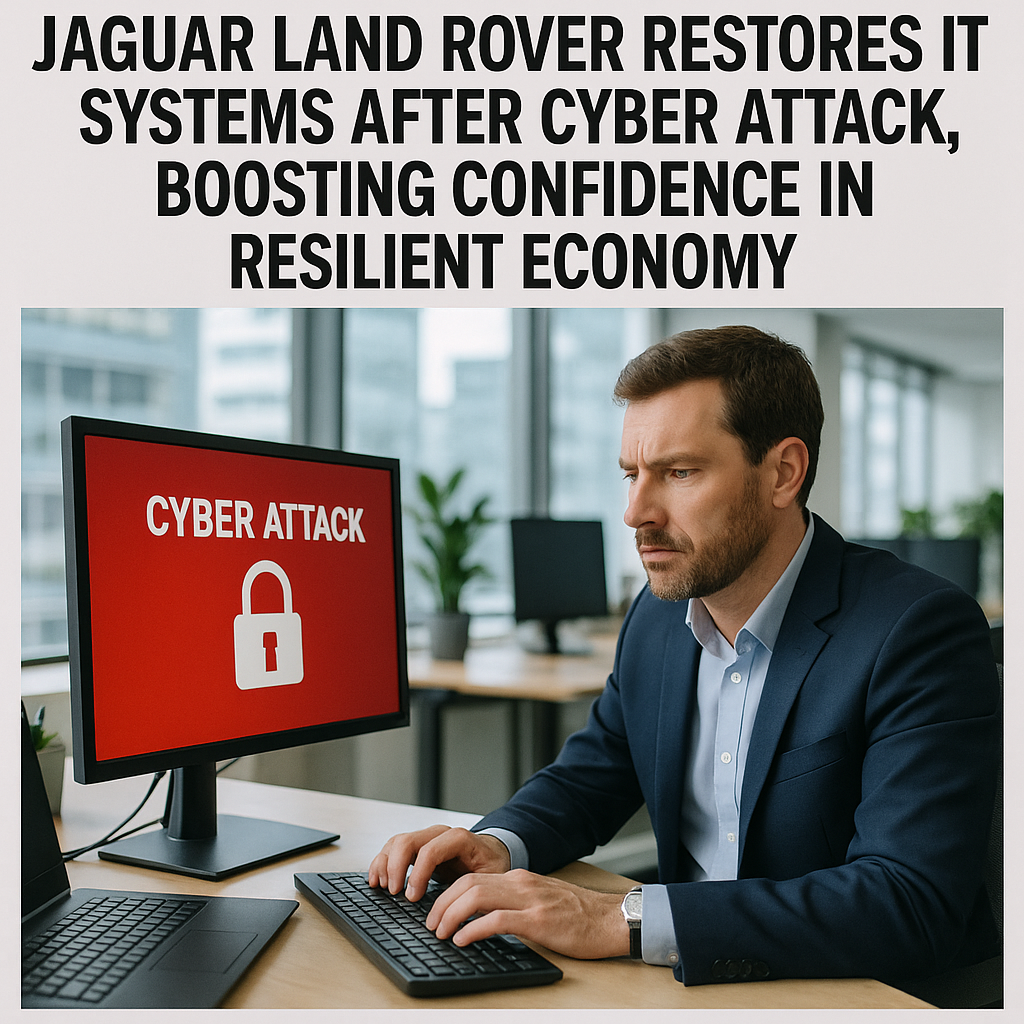
Jaguar Land Rover Restores IT Systems After Cyber Attack, Boosting Confidence in Resilient Economy

The recent cyber-attack on Jaguar Land Rover (JLR), a cornerstone of the UK’s automotive industry and a substantial player in global luxury vehicle manufacturing, has sent shockwaves through the supply chain and financial markets alike. Since August, JLR’s operations have been significantly impacted, with production lines suspended and logistics frozen due to malicious cyber interference targeting its IT infrastructure. The company’s phased restart of operations signifies a cautious yet critical step toward restoring stability, but the economic ripple effects pose a broader challenge for policymakers, investors, and industry stakeholders.

JLR’s predicament underscores the vulnerability of modern manufacturing ecosystems that rely heavily on sophisticated IT networks. Its announced plan to clear a backlog of payments and ramp up invoicing processing highlights the severity of the disruption and the urgent need for resilience strategies. Nonetheless, the impact extends far beyond its factories: an estimated 100,000 jobs across the supply chain are at potential risk, with many smaller firms teetering on the brink of insolvency. The UK government has committed to a multi-faceted support package, including discussions around government-backed loans and potential procurement of critical parts, though skepticism remains among suppliers regarding the efficacy of these interventions. As industry minister Chris McDonald emphasized, “support must be tangible, not just promises.”

  • The UK government faces increased pressure to safeguard its industrial backbone, with Prime Minister Rishi Sunak indicating that support measures are being developed around the clock.
  • Economists warn that prolonged shutdowns could diminish the UK’s competitiveness, especially as global markets recover and demand shifts towards technologically advanced and sustainable transport solutions.
  • Market analysts note that investor confidence in the automotive sector may waver until clear, tangible policies emerge to shield suppliers from the cyclical shocks of cyberattacks and operational halts.

Furthermore, the policy consequences of the cyber incident could accelerate government intervention in the industrial sector, prompting calls for improved cybersecurity standards and risk management frameworks across critical manufacturing nodes. This scenario also calls into question the reliance on just-in-time logistics, suggesting a strategic pivot towards more resilient supply networks. Think tanks like the Institute of Economic Affairs argue that infrastructure resilience should become a national priority, to prevent future crises that can destabilize supply chains and economic output. Amidst these circumstances, forward-looking business leaders and policymakers must navigate a complex landscape where innovation and security are becoming inseparable. The question is no longer whether industries can standalone, but whether nations can harness this challenge as a catalyst for a resilient and technologically robust future.

As the wheels of global markets turn and nations position themselves for future powers, the pulse of economies remains relentless. In this digital age, the strength of a nation’s economy now hinges on its ability to innovate securely, adapt swiftly, and safeguard its industrial heart. While the immediate outlook remains tense, the resilience forged in this crucible of crisis will define the leaders of tomorrow. In crafting policies that protect supply chains, foster technological advancements, and promote strategic independence, governments and corporations alike are scripting the next epoch of economic power—an era where resilience and innovation shape the very fabric of global influence.

Social Media Auto Publish Powered By : XYZScripts.com