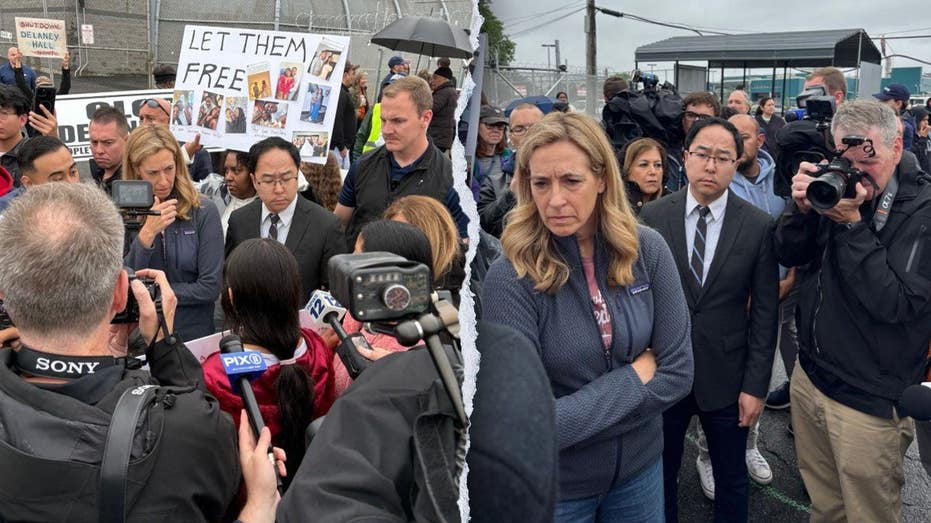
New Jersey’s Democratic Governor Mikie Sherrill and Senator Andy Kim have come under fire for their Memorial Day visit to the Delaney Hall migrant detention facility in Newark. The high-profile appearance, intended to highlight alleged ‘unacceptable’ conditions and demand the facility’s closure, has been met with sharp criticism from federal authorities, who characterized it as a ‘political stunt’ amidst heightened security concerns.
The visit unfolded as protesters gathered outside the privately run center, raising questions about the appropriateness of such actions on a national holiday dedicated to honoring fallen service members. Critics argue the timing and nature of the engagement diverted attention from solemn observances and potentially inflamed an already tense situation.
Timing and Intent Under Scrutiny
The decision by Governor Sherrill and Senator Kim to visit Delaney Hall on Memorial Day has drawn particular attention. According to a Department of Homeland Security (DHS) spokesperson, as reported by Fox News Digital, Governor Sherrill’s presence was ‘nothing more than a political stunt’ given that visitation was suspended due to recent unrest. The spokesperson acknowledged Senator Kim’s legitimate congressional oversight role and his direct communication with Secretary Markwayne Mullin, which facilitated his access. However, the governor’s appearance was framed differently, suggesting a calculated move rather than a routine inspection.
Senator Kim, in a statement on X, asserted that he and Governor Sherrill were at Delaney Hall to ‘meet with families of detainees and listen to community advocates,’ emphasizing their joint effort to ensure voices were heard and to demand the immediate shutdown of the facility. This stance underscores a persistent push from some Democratic factions to reform or close immigration detention centers.
Allegations of Unacceptable Conditions and Demands for Closure
The core of the lawmakers’ protest stems from claims of ‘unacceptable’ conditions within Delaney Hall and reports of an ongoing hunger strike among detainees. Advocacy groups and the Democratic officials contend that U.S. Immigration and Customs Enforcement (ICE) should not be permitted to operate the facility under current circumstances. The specifics of these conditions, beyond the general assertion, remain a key point of contention and a focus for those advocating for the detainees.
The demand for immediate closure highlights a broader ideological divide on immigration enforcement and detention policies. While proponents of closure cite humanitarian concerns, those who support the facilities emphasize their role in maintaining border security and managing the legal processes for undocumented immigrants.
“Governor Sherrill’s visit to Delaney Hall is nothing more than a political stunt on Memorial Day when visitation is currently suspended due to riots outside the facility.”
Protests, Agitators, and Institutional Challenges
The atmosphere surrounding Delaney Hall on the day of the visit was reportedly volatile. DHS officials stated that approximately 125 ‘agitators’ surrounded the facility, some displaying ‘anti-ICE signs and Antifa flags.’ These individuals allegedly formed a human chain, blocking entries and exits and impeding facility operations. Such actions raise serious questions about public order and the safety of both staff and detainees within institutional settings.
The clash between protesters and authorities on the preceding Sunday further illustrates the escalating tensions. These incidents underscore the challenges faced by law enforcement and immigration agencies in managing facilities amidst vocal opposition and sometimes disruptive demonstrations. Maintaining order and ensuring the smooth functioning of vital government operations, particularly those related to national security and immigration, is paramount for institutional integrity.
The events at Delaney Hall underscore the complex and often contentious nature of immigration policy in the United States. While lawmakers have a right and a duty to conduct oversight, the manner and timing of such actions, particularly when coinciding with public disturbances and national observances, invite scrutiny. The broader debate over immigration enforcement and the role of detention facilities continues to be a flashpoint, demanding both compassionate consideration and a steadfast commitment to institutional order.