



Matox News

Truth Over Trends, always!

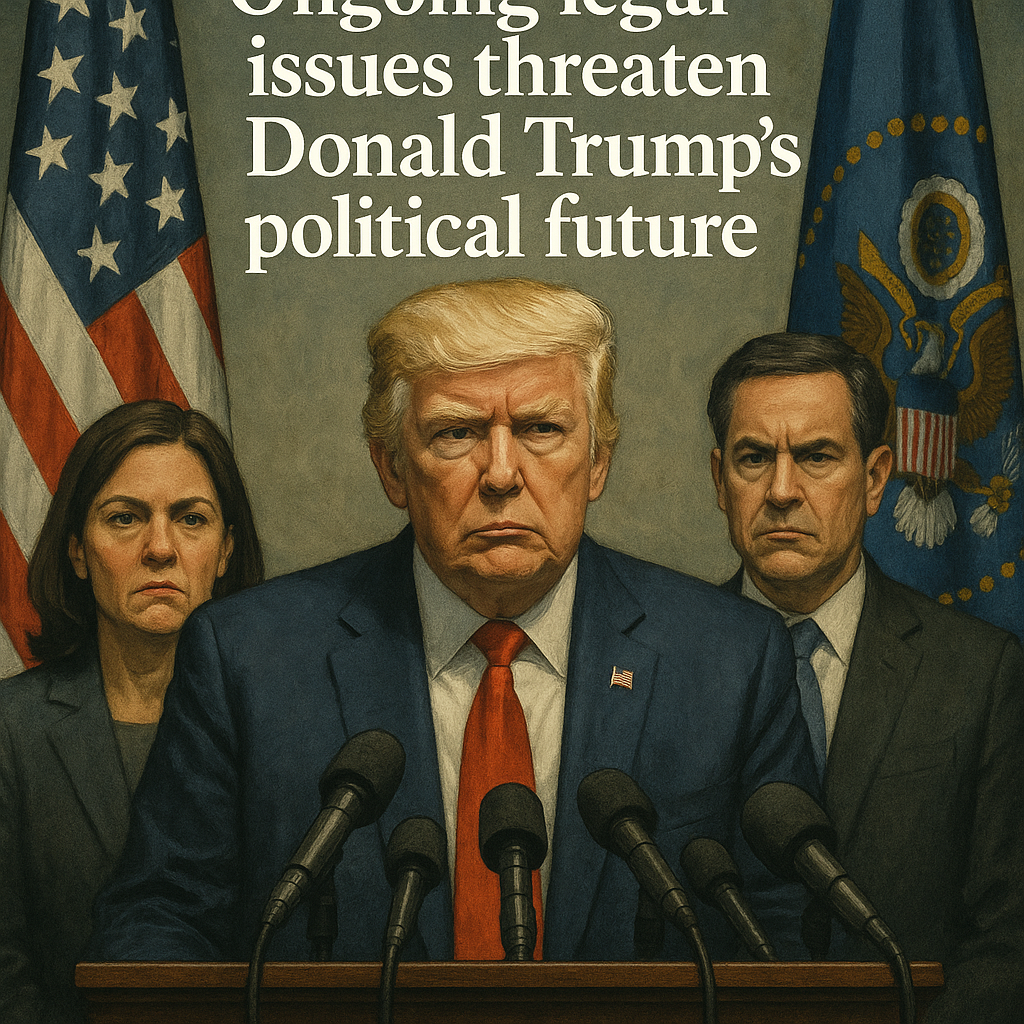
Ongoing legal issues threaten Donald Trump’s political future

In the ever-evolving theater of American politics, former President Donald Trump once again emerges as a central figure, announcing his bid for the White House amid a landscape rife with power struggles, ideological clashes, and constitutional debates. This move signals a potential reset of the Republican Party’s trajectory, emphasizing a return to core conservative principles that have galvanized his base. Yet, it also underscores an intense competition for influence within the party’s future, where who controls the narrative could determine the electoral outcomes and policy directions of the nation.

This renewed campaign-place has starkly illuminated intra-party tensions, highlighting the ideological cleavages among conservatives and libertarians, and the influence of populist rhetoric. Navigating this terrain demands an understanding of the power dynamics at play. Critics argue Trump’s return signals a resistance to the political establishment, a drive to reclaim populist sovereignty rooted in traditionalist values, and an unwavering belief in the notion that the government’s role is to serve the people, not bureaucrats. However, entrenched party elites and mainstream media outlets push back, framing his bid as disruptive — a challenge to the bipartisan consensus that often blurs patriotic priorities with entrenched interests.

Historically, political power struggles have always centered on who controls the levers of influence and how decisions impact the populace. The current landscape echoes the volatile shifts seen during the Gilded Age or the tumultuous 1960s, where the contest for American identity was fought on the battlegrounds of policy, culture, and constitutional authority. Critics of Trump’s campaign highlight the constitutional tension surrounding executive authority, free speech, and election integrity, with some legal scholars raising concerns about the implications of his rhetoric for democratic stability. Yet, his supporters argue that he embodies an authentic voice of frustration among the American electorate—an agent challenging the status quo and reaffirming their belief that politics is about shaping the destiny of a nation.

Echoing the words of political philosopher Lord Acton—“Power tends to corrupt, and absolute power corrupts absolutely”—these battles over influence are not merely about personalities or policies but are strategic chess moves that determine the contours of American sovereignty. Whether Trump’s bid will alter the balance of power, or whether new trajectories emerge from within the party itself, remains uncertain. However, what is clear is that the stage is set for a decisive clash—where every decision, every rally, and every legislative push rewrites the very narrative of the nation’s future. Political destiny, after all, is written in the crucible of conflict, where the true power lies not in the office held, but in the vision for the country’s soul.


Understanding the Respect for Marriage Act’s key details for young voters

The recent unity demonstrated between Republican and Democratic lawmakers to safeguard same-sex marriage marks a significant shift in the American political landscape. Historically, these two parties have often stood on opposite ends of cultural and legislative debates, yet in this instance, shared concerns over the potential destabilization of marriage rights have catalyzed bipartisan cooperation. The image of legislators rallying to defend a core social institution highlights how power struggles in Congress are increasingly influenced by public sentiment and constitutional interpretations. This alliance emphasizes a recognition that values held by the people, especially around family and identity, remain deeply intertwined with political legitimacy.

At the heart of this debate lies the judicial activism of the Supreme Court, which has raised fears among advocates of traditional institutions and certain constitutional scholars who draw parallels to historical court overreach. Critics argue that the current federal judiciary may be veering away from the original intent of the Constitution, asserting that the Court’s role should be confined within a strict interpretative framework. Notably, constitutional theorists like Robert Bork and the originalists echo sentiments warning against unwarranted judicial expansion, emphasizing that marriage laws are culturally rooted and not merely legal constructs to be redefined at the Court’s whim. Consequently, the bipartisan effort to protect same-sex marriage acts as a bulwark against what some see as the Court’s encroachment into social fabric—the ultimate battle between judicial activism and popular sovereignty.

This power struggle has profound implications for the people’s sovereignty. When legislation is threatened by an overreaching judiciary, it reflects a deeper clash over who holds the ultimate authority: the elected representatives of the people or appointed judges interpreting law in a way that can upend societal norms. As seen in historical parallels such as the debates surrounding Brown v. Board or the Supreme Court’s decisions on civil rights, the outcome of such conflicts often shapes national destiny. Political leaders now face the challenge of balancing constitutional fidelity with the will of their constituents—each decision, each legislation, becoming a stroke on the canvas of history. The current bipartisan move to protect marriage rights echoes the age-old narrative: the struggle for control over defining societal values lies at the heart of political power.

In essence, politics remains the stage where destiny is written, a continuous interplay where power, ideology, and societal values collide and collide again. Today’s debate over marriage rights exemplifies how decisions in the corridors of power ripple outward, directly shaping individual lives and collective identities. Whether this unity persists or fractures under future political winds, the underlying truth endures: the battle for the nation’s soul is ongoing, and in that battle, history’s pen remains mightier than ever. Ultimately, politics is not merely a game of numbers or policy—it is the forge where the future itself is tempered, contesting the essence of what it means to be a society and a people destined for their own unfolding story.

Inside Stanley Tucci’s Season 2 Food Tour: The Must-Visit Restaurants in ‘Searching for Italy’

Discover Italy’s Timeless Charm: A Journey of Wellness, Culture, and Inspiration

Italy, a land renowned for its rich tapestry of culture and gastronomy, continues to inspire a global movement towards a _holistic lifestyle shift_. Watching the acclaimed series Stanley Tucci: Searching for Italy transports viewers into a world where food is more than sustenance—it is an experience that nurtures the soul. Each episode invites audiences to explore the country’s regional specialties crafted by talented chefs, revealing how cuisine can be a catalyst for health, leisure, and cultural connection. This approach champions a lifestyle rooted in _authenticity and mindful appreciation_, encouraging young people to rekindle their relationship with local ingredients and time-honored traditions.

At the heart of Italy’s appeal is its _focus on _wellness through culinary simplicity_**, emphasizing fresh, local produce that sustains both body and mind. Liguria, with its breathtaking coastlines from Portofino to Cinque Terre, exemplifies this harmony. Here, the inventive spirit of Ligurian chefs shines through in signature dishes like pesto—a product of a land forced to adapt through rugged terrain, turning adversity into a delicious heritage. Embracing such authenticity offers a blueprint for today’s youth who seek a _balanced lifestyle_ anchored in _mindful eating and active leisure_. Think aromatic fennel, vibrant vegetables, and freshly caught seafood, all sacrificed to no processed shortcuts but preserved in the essence of _healthy living_.

Moreover, this culinary voyage champions regional pride, which rejuvenates communities and fosters _inspirational connection_. From Genoa’s iconic focaccia—salted just right to awaken the palate—to Sardinia’s rugged coasts producing some of the world’s finest lobster; each dish tells a story that transcends taste buds, inspiring a _resilient, community-focused approach to life_. For young travelers and food enthusiasts alike, embracing this _culture of slow food and authentic craftsmanship_ can be equated with a personal renewal—an active choice to forge a lifestyle aligned with wellness, leisure, and cultural pride.

  • Visit Liguria’s charming villages of Portofino and the Cinque Terre for an immersion in coastal beauty and local delicacies.
  • Explore Genoa’s secret gastronomic gems such as Antico Forno della Casana, where the signature dimples of focaccia are baked to perfection, emphasizing _mindful indulgence_.
  • Sample Sardinian delights like blue cheese at Caseificio Dicecca, celebrating _regional pride in local ingredients_ that support both health and economy.
  • Experience the slow craft of lamb prepared in ancient Greek clay in Martone, a reminder that _patience and tradition_ are vital for true wellness.

In the end, the journey through Italy’s regions reflects a broader narrative: _lifestyle is a voyage_—not merely a routine, but an intentional path inspired by nature, tradition, and community. As Stanley Tucci’s adventures unveil, embracing this rhythm encourages a _personal journey of health, leisure, and cultural pride_. By following Italy’s example—where food becomes a reflection of strength, resilience, and shared heritage—young individuals can cultivate a life that celebrates authenticity and well-being. In doing so, we realize that true wellness is found not only in what we eat but in how we cherish and nurture the world around us, leaving each of us with a legacy of inspired living.

Social Media Auto Publish Powered By : XYZScripts.com