
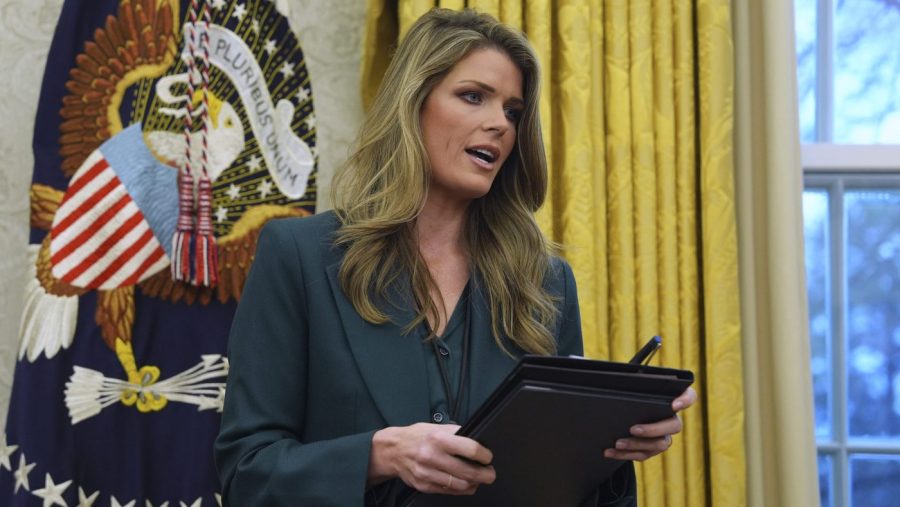

Power Plays and Political Stakes: The Case of Lindsey Halligan
In the rapidly shifting landscape of American politics, few events exemplify the ongoing power struggles that define this era like the recent rise of Lindsey Halligan. From relative obscurity to the forefront of national attention within days, Halligan’s appointment as the *top prosecutor* in the case against former FBI Director James Comey signals more than a candid legal pursuit—it unveils a broader battle for control over the narrative, institutions, and the very fabric of American law and order. Her trajectory, marked by close ties to President Donald Trump—having served as his personal lawyer and a White House official—attests to a crucial shift: the intertwining of legal challenges with partisan strategy, where decisions ripple out to shape the political terrain for generations.
Halligan’s swift ascendance reveals an underlying conflict of authority—a challenge to entrenched bureaucracies and the establishment’s hold over government agencies. Her role in pursuing Comey, a figure once revered within the Democratic establishment, exemplifies a broader *uprising* aimed at reasserting executive influence and accountability. Such legal pursuits are not merely about justice; they are about asserting power dynamics that threaten to redraw the boundaries of institutional independence. The decision to elevate Halligan, a figure connected intimately to Trump’s inner circle, underscores the ideological and strategic battles that threaten to redefine the American legal state—a state no longer purely apolitical but increasingly infused with partisan energy.
This shifting paradigm resonates with historical echoes of constitutional confrontation—from Jefferson versus Adams to the tumult of Civil War-era disputes over federal vs. states’ rights. Today, critics argue that decisions like these threaten to derail the ‘separation of powers’—central to American constitutional design—and place an emphasis on *power consolidation*. The escalation of these conflicts reveals how political actors are harnessing legal mechanisms not just for justice but as tools for control, revealing a deep-seated truth: that in politics, law is often the battleground where the future’s fate is penned, often in ink darker than the truth itself.
Looking ahead, the outcome of this high-stakes legal chess game portends even greater power struggles. As experts—ranging from constitutional scholars to political theorists—scrutinize each move, one fact remains clear: these decisions are sculpting a new political order where the line between legal authority and political dominance blurs. The question persists—will Justice be the guiding principle, or will it be weaponized as a strategic asset in the relentless pursuit of power? As history unfurls, the spectacle underscores that politics is not merely about policy but a grand, unending script where the fate of nations is written in the ink of determination and rivalry, etched on the pages of influence and authority. In this stage of relentless contestation, the only certainty is this: as long as power struggles persist, the destiny of America will be inscribed by those daring enough to shape the rules of the game.





