
Matox News

Truth Over Trends, always!

April private payrolls surge beyond forecasts with 109,000 new jobs, ADP reports

The recent release of private sector employment data from ADP underscores a resilient U.S. economy, even as macroeconomic headwinds persist. In April, companies expanded their payrolls by 109,000 jobs, significantly exceeding the market expectation of 84,000 and marking a notable uptick from March’s revised 61,000. This growth signals a labor market that, despite subtle signs of slowdown, continues to demonstrate strength. Economists like those from the Heritage Foundation emphasize that such employment figures bolster the case for maintaining current fiscal policies, rendering an aggressive shift in interest rate directives less likely in the near term.

Within this expansion, sectors such as education and health services dominate, adding 61,000 new hires, while trade, transportation, and utilities contributed another 25,000. Meanwhile, manufacturing — a sector long prioritized by the Trump administration through tariffs aimed to reshore production jobs — grew modestly, adding only 2,000 jobs. This subdued manufacturing growth raises questions about policy effectiveness and the realignment of supply chains in a post-pandemic economy. Large firms (over 500 employees) and small businesses (fewer than 50) are both contributing significantly, with respective increases of 42,000 and 65,000, although the absence of broad, sector-wide growth indicates an economy that’s both cautious and selective in its hiring. As Nela Richardson, chief economist at ADP, notes, “Softness in the middle—where medium-sized firms operate—reflects a complex labor environment shaped by persistent inflation and geopolitical shocks.”

The policy ramifications of these employment figures are profound. The Federal Reserve, in its recent interest rate decision, chose to hold steady, despite four dissenting votes hinting at a possible rate cut next. The balance of opinions illuminates the delicate dance policymakers face: support the labor market’s resilience without igniting inflationary pressures triggered by tariffs and international conflicts like the Iran war. With inflation remaining stubbornly high, and the headline unemployment rate steady at 4.3%, the Fed’s cautious approach aims to sustain economic stability without risking overheating the economy. The upcoming nonfarm payrolls report from the Bureau of Labor Statistics will be instrumental in shaping future policy trajectories, with consensus expectations of around 55,000 new jobs—neither a sign of booming expansion nor immediate contraction.

This employment landscape signals a pivotal moment for the markets and the broader economic stage. While the U.S. labor market demonstrates resilience, the uneven gains across sectors and the cautious posture of policymakers reflect an implicit reminder: the economy remains a dynamic and delicate organism, pulsating with the ambitions of its entrepreneurs and the security of its workforce. The market’s response will likely influence investment strategies, with keen eyes on sectors poised for innovation and growth amidst geopolitical tensions and technological shifts. As economic commentators and think tanks analyze these data, one truth remains clear: the vitality of the U.S. economy—its capacity to adapt, to harness opportunity from challenge—is the true engine propelling the nation’s rise on the global stage. The pulse of enterprise continues to beat strongly, signaling a future where power isn’t just inherited but forged anew in the fires of resilience and strategic vision, shaping the course of global influence for generations to come.
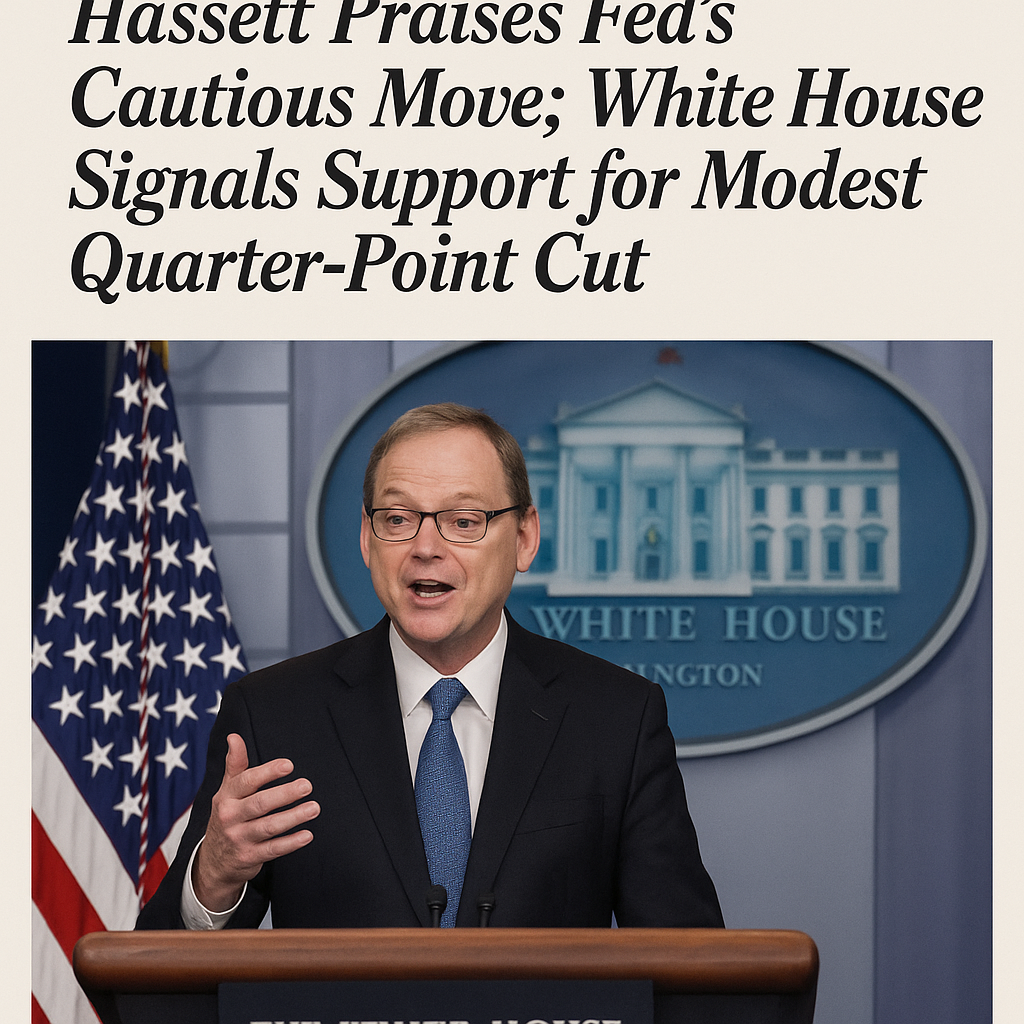

Hassett praises Fed’s cautious move; White House signals support for modest quarter-point cut

Federal Reserve’s Rate Cut Sparks Market Movements and Policy Debates

The Federal Reserve recently implemented a modest quarter-percentage-point cut to its key borrowing rate, signaling a cautious approach as it navigates a complex economic landscape. This decision, perceived by some as a step towards economic stabilization, comes amid shifting market sentiments and ongoing debates among policymakers, economists, and investors. As the global economy faces rising inflationary pressures yet remains resilient, the Fed’s move exemplifies the delicate balancing act it must perform—tamping inflation without stifling growth.

Notably, the White House expressed support for the Fed’s measured approach, with National Economic Council Director Kevin Hassett emphasizing the prudence of a “slow and steady” policy. While some within the administration advocated for a more aggressive half-point cut, the Fed’s decision reflects a consensus aimed at cautious optimism. The recent economic indicators show a robust third-quarter growth rate exceeding 3%, a figure that traditionally would argue against easing monetary policy. Still, inflation running above the Fed’s 2% target, combined with concerns about persistent financial risks, has prompted a nuanced response that favors gradualism over rapid cuts.

Market impacts from this decision are multifaceted. Investors remain vigilant, with equities, bonds, and commodities reacting to the delicate narrative of growth versus inflation control. The policy considerations extend beyond immediate market behavior, touching on policy consequences that could shape future economic stability. Analysts from think tanks and leading economists, including those linked to the Federal Reserve and major banks, indicate that this cautious move might set the stage for future rate adjustments. The decision also underscores ongoing debates about the policy trajectory—should the Fed prioritize containing inflation or supporting a thriving housing market and manageable debt levels?

Importantly, the political dimension persists, with President Donald Trump advocating for more aggressive cuts—arguing that the current rates are insufficient to boost the struggling housing sector and manage the national debt. Such political influences, though not directly altering Fed decisions, shape the policy environment and investor sentiment. As the Fed considers its next moves amid diverse economic signals, the broader implications for market impact and policy stability will be paramount. The coming months will test whether this measured approach will secure sustained growth or prompt future rallying cries for more rapid easing, reflecting the eternal tug-of-war at the heart of economic policy.

Looking ahead, the pulse of the economy remains a reflection of national strength and future global influence.

In this high-stakes game, where monetary policy acts as both shield and sword, the resilience of economies hinges on informed decision-making and bold leadership. Investors, policymakers, and citizens alike watch with anticipation, realizing that the economic landscape is a grand stage—an epic arena where the forces of innovation, policy, and global power collide. While uncertainties persist, the underlying momentum suggests that the future economy will be shaped by those willing to navigate its shifting tides with vision, precision, and resolve. This moment underscores the vital truth: **the economy is not merely a system of numbers, but the beating pulse of nations, heralding the dawn of a new era of global influence and economic ascendancy**.

Social Media Auto Publish Powered By : XYZScripts.com


