
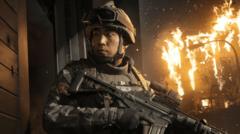

Activision’s highly anticipated new title, Modern Warfare 4, is already sparking significant discussion ahead of its release. Developed by Infinity Ward, the game places players in the midst of a full-scale North Korean invasion of South Korea, a scenario that experts suggest could be highly controversial given the enduring geopolitical sensitivities of the region.
The developer has affirmed that the game will be “grounded in the military authenticity” that has become a hallmark of the Modern Warfare series. Scheduled to launch on October 23, the game’s narrative partly follows South Korean soldiers defending their homeland against the aggressive incursion. This premise, however, has ignited a debate about the line between entertainment and the sensitive realities of unresolved international conflicts.
Fictional Conflict, Real-World Resonance
The decision to feature a North Korean invasion has drawn particular attention from academic circles. Dr. Sarah Son, a Senior Lecturer in Korean Studies at the University of Sheffield, commented on the potential for controversy, highlighting how the game “turns still-unresolved war into entertainment.” This perspective underscores a critical ethical consideration: when does fictionalizing conflict become problematic, especially when the real-world tensions remain acute and impactful for millions?
For many, the Korean War is not a distant historical event but a conflict with ongoing ramifications, including a divided peninsula and frequent saber-rattling. Depicting such a scenario in a global entertainment product inevitably invites scrutiny regarding cultural sensitivity and geopolitical responsibility. The game’s narrative choice compels a discussion on how media portrays complex international relations and the potential for misinterpretation or trivialization.
Diverse Reactions from the Korean Peninsula
Reactions to the game’s premise within Korea itself have been varied. While some voices, like Dr. Son’s, express concern over the commodification of conflict, other Koreans have viewed the inclusion of their nation in a major global franchise more positively. One individual, for instance, described Korea’s presence in one of gaming’s biggest series as a “symbolic moment,” suggesting a recognition on the global stage, albeit through a fictional war scenario.
This divergence in opinion highlights the multifaceted impact of such media. For some, it might represent a form of cultural acknowledgment or a platform for narratives that, while fictional, resonate with national identity. For others, it risks exploiting deeply held anxieties and historical trauma. This complex reception underscores the delicate balance developers must strike when incorporating real-world geopolitical themes into their creative works.
“Turning still-unresolved war into entertainment could be controversial.” – Dr. Sarah Son, University of Sheffield
Advancing Technology Meets Geopolitical Storytelling
Beyond its contentious storyline, Modern Warfare 4 is also notable for its technical advancements. The game is set to launch on current-generation consoles, PC, and the Nintendo Switch 2, marking a significant step as the first mainline Call of Duty title to bypass older platforms like the PlayStation 4 and Xbox One. This technological leap promises enhanced graphics and gameplay experiences, further immersing players in its high-stakes narrative.
As noted by News Desk, the developer’s commitment to “military authenticity” will be put to the test in how it handles the intricate details of a modern conflict, particularly one with such sensitive origins. The gaming industry continually pushes boundaries, both technologically and thematically. However, the decision to engage with a scenario as volatile as a North Korean invasion serves as a reminder of the broader responsibilities that come with crafting globally consumed narratives.
The impending release of Modern Warfare 4 thus stands as a significant moment, not only for the gaming world but also for ongoing discussions about the portrayal of international relations in popular culture. Its reception will undoubtedly provide further insights into public sentiment regarding the intersection of entertainment and geopolitical realities.






