
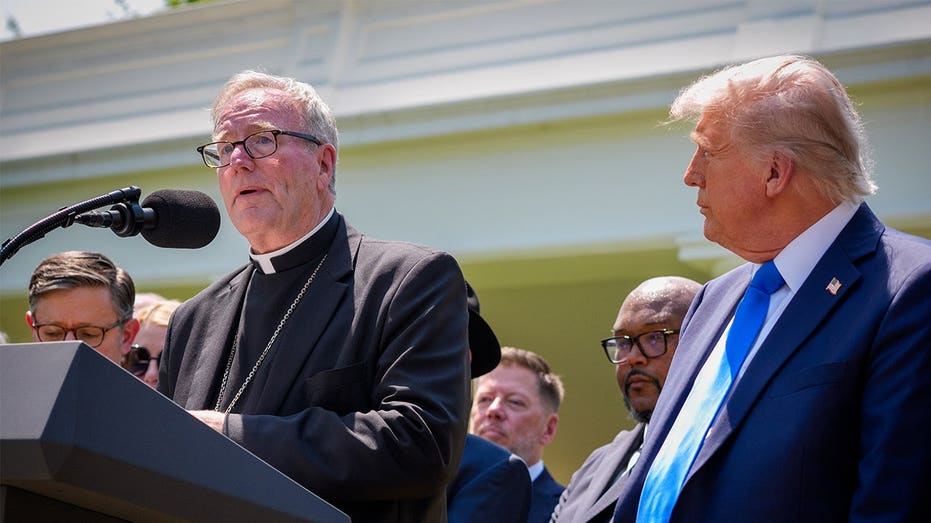

Bishop Robert Barron, a leading voice in American Catholicism, is set to deliver a significant address at President Donald Trump’s “Rededicate 250” prayer event this Sunday on the National Mall. Barron plans to articulate his conviction that the “marginalization of God” poses a fundamental threat to the nation’s democratic foundations, a message resonating with center-right conservative principles regarding societal order and institutional strength.
The event, organized by the Trump-aligned “Freedom 250” nonprofit, aims to foster a spiritual recommitment ahead of America’s 250th anniversary. It is expected to draw a substantial audience, including President Trump, members of his White House Cabinet, and numerous major faith leaders.
A National Call for Spiritual Recommitment
In an interview with Fox News Digital, Bishop Barron revealed that his remarks will underscore a central belief: that “if you marginalize and privatize religion, democracy is in danger.” He firmly asserts that a recognition of God is essential to the very foundations of American democracy, suggesting that many contemporary discussions about threats to democracy overlook this crucial spiritual dimension.
Barron’s participation highlights a broader conservative concern regarding the erosion of traditional values and the role of faith in public life. The “Rededicate 250” event is positioned as a timely moment for national reflection on the principles that have historically underpinned American society.
“If you marginalize and privatize religion, democracy is in danger.” – Bishop Robert Barron
The Perils of Secularization
Expanding on his concerns, Bishop Barron directly links the decline of religious influence to various societal challenges. He contends that removing God from the public equation leaves society vulnerable to what he terms “radical self-choice.” This perspective, he warns, can lead to ideologies such as “wokeism” and a “culture of self-invention,” where individual will supplants objective moral or spiritual frameworks. According to Barron, such unchecked individualism is “deadly to our democracy.”
His address is expected to draw upon historical precedents, with Barron intending to open his speech by invoking Abraham Lincoln’s Gettysburg Address, specifically noting the inclusion of the phrase “under God” in later versions of the iconic speech, reinforcing the idea of a divinely guided nation.
Reinforcing Foundational Principles
The bishop’s message aligns with a significant segment of the American populace that believes religious faith is not merely a private matter but a vital component of civic virtue and national cohesion. By framing the marginalization of God as a direct threat to democracy, Barron challenges contemporary secularizing trends and advocates for a renewed emphasis on the spiritual dimensions of public life.
This event serves as a powerful platform for discussing the intersection of faith, governance, and national identity, inviting attendees and observers to consider the profound implications of spiritual decline on the stability and future of American institutions. The call for a re-dedication to foundational principles resonates deeply with those who advocate for a return to traditional values and a robust public square for religious expression.






