
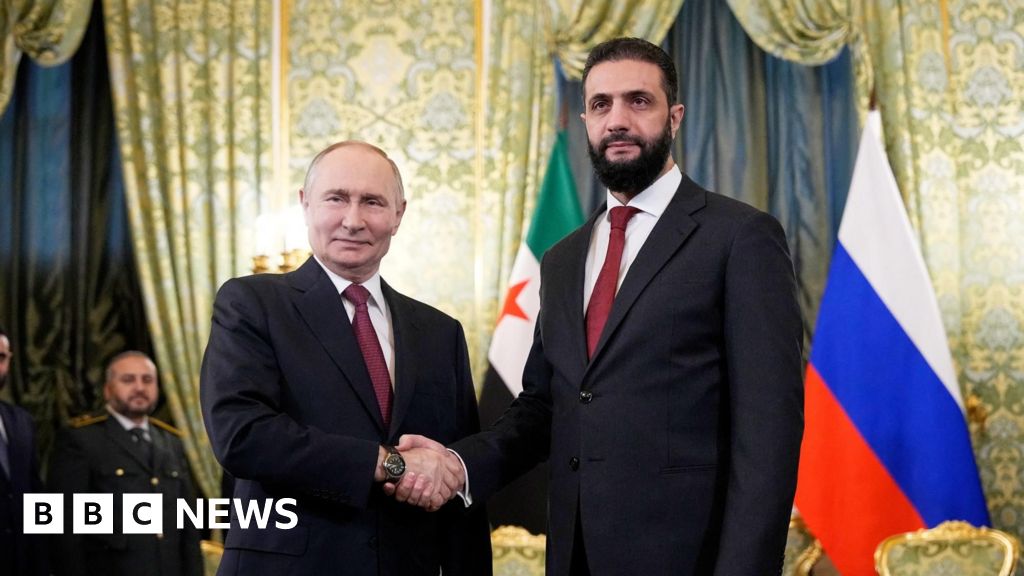

In a remarkable shift of alliances and perceptions, Syria’s interim President, Ahmed al-Sharaa, recently held his first high-level talks with President Vladimir Putin in Moscow, signaling an unprecedented thaw in longstanding enmity. Once firmly embroiled on opposite sides of Syria’s brutal civil war, both leaders demonstrated that pragmatic interests now overshadow ideological divides. Putin’s reference to their “special relationship” underscores an emerging geopolitical calculus wherein regional stability and strategic access take precedence over past allegiances. Such a diplomatic overture hints at a broader recalibration of Middle Eastern alliances, with Moscow seeking to cement its influence even as some Western powers question the legitimacy of Assad’s exiled regime.
The meeting in Moscow highlights a significant realignment where former enemies now seek common ground. Last year, Bashar al-Assad was ousted from power after years of brutal repression, supported by Western sanctions and military backing from regional actors. Yet, in a surprising turn, the Syrian leadership appears receptive to partnering once more with Russia, a key guarantor of regime survival, primarily through access to strategic military bases at Tartous and Hmeimim. Analysts see this as a calculated move by Damascus to leverage Russia’s military prowess and economic resources for sovereignty preservation. Sharaa’s commitment to allowing Russia continued military access reflects a tacit acknowledgment that without Moscow’s support, Syria’s stability remains fragile, vulnerable to future geopolitical upheavals.
Despite the seemingly cordial tone, the deep-rooted tensions of history linger beneath the surface. Russia’s decision to grant asylum to Assad, accompanied by Lavrov’s candid admission that Assad and his family faced “the risk of physical elimination,” demonstrates the complex layers of geopolitics at play. Russia’s strategic interests extend beyond mere military presence; they encompass economic investments, diplomatic influence, and the prevention of regime collapse that could destabilize the entire region. Meanwhile, Sharaa’s expressed desire to restore Syria’s relations with the world, especially with Russia, underscores an intent to secure vital international support for rebuilding Syria’s battered economy and maintaining territorial integrity. However, international organizations and foreign policy analysts warn that such alliances might entrench authoritarian rule and delay the quest for genuine democratization in the country.
The geopolitical impact of this renewed partnership extends far beyond Syria’s borders. A Russia-Syria alliance shifts the regional power dynamics, challenging Western influence and complicating efforts by entities like the US and the European Union to shape the future of the Middle East. For Moscow, maintaining its foothold in the Mediterranean through Syria is a strategic priority, reinforcing its global ambition to project power in areas once dominated by Western influence. Conversely, Syria’s push to redefine its sovereignty by seeking aid from Russia raises critical questions about the future of international diplomacy, sovereignty, and the limits of Western-led democracy promotion. The delicate balance between cooperation and dependence is now at the crux of regional stability, with echoes felt across neighboring nations and global power centers.
As the corridors of power continue to turn and history writes new chapters, the global community watches with bated breath. Will this pragmatic alliance forge a durable peace or sow the seeds for future conflicts? The answers remain mired in shadows of geopolitics and the relentless pursuit of national interest—an unfolding drama that will define the region’s destiny long after today’s headlines fade into history’s archives. The world stands on the precipice of a new chapter, where alliances are rewritten and the true cost of power is measured not just in treaties, but in centuries to come.





