
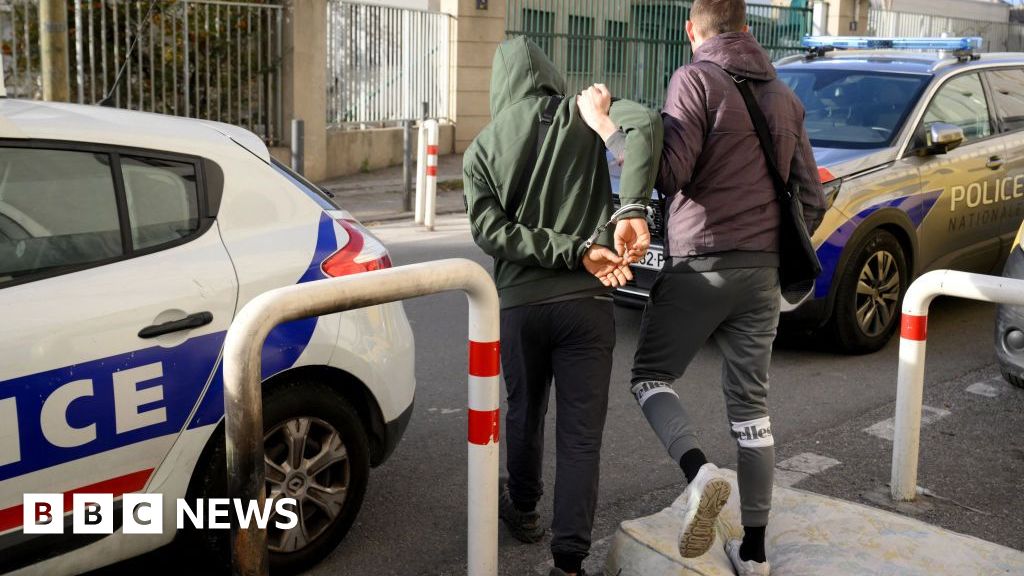

In the historic port city of Marseille, a disturbing psychose has gripped its once lively streets, revealing the devastating impact of unchecked organized crime and social neglect. Reports emerging from local authorities, community leaders, and international analysts depict a city in chaos, where the fabric of law and order is unraveling amid a surge of violence, juvenile involvement, and a rapidly evolving drug trade. The harrowing scenes of children witnessing brutal murders, such as in the recent case of 15-year-old Adel, serve as grim symbols of a society under siege, with violence becoming part of everyday life.
Over the past eight years, France’s Ministry of Justice estimates a more than fourfold increase in teenagers recruited into the drug trade, a crisis amplified by social media’s dark influence and the erosion of traditional social structures. French police have responded with what officials euphemistically term “security bombardments,” raiding disorganized drug dens and arresting hundreds, yet the problem persists. With an estimated 20,000 individuals involved in Marseille’s illicit industry—culminating in confiscated assets worth €42 million in a single year—the city remains a battleground. Analysts warn that such measures are merely surface responses, failing to address the root causes entrenched within poverty, marginalization, and systemic corruption.
Adding fuel to the fire is the growing role of *foreign* actors, with local politicians like Franck Alissio claiming that much of the criminal leadership comprises immigrants or foreigners with dual nationality. This controversial assertion, though difficult to verify, underscores the debate over national sovereignty and social integration. Meanwhile, community organizer Mohamed Benmeddour describes children as young as 13 being coerced into violence and drug trafficking, often under threat of torture or death. The social fabric is fraying, as a younger generation becomes ensnarled in cycles of violence, with the grisly murder last month of Mehdi Kessaci, a young police trainee, serving as a stark turning point. His family’s mourning, coupled with the community’s trauma, illustrates how violence is now a weapon used by gangs to sow fear and exert control.
Many experts, including Philippe Pujol, caution against over-reliance on stronger police actions alone, emphasizing that such tactics only mask deeper societal wounds. Instead, they advocate for comprehensive reforms addressing the chronic poverty, educational neglect, and political failures that nourish organized crime. Yet, political factions such as the far-right National Rally propose draconian measures—including stricter border controls and immigration policies—as quick fixes. This discourse reveals a fractured society struggling to reconcile its rich history as a melting pot with the realities of modern urban chaos.
As Marseille teeters on the brink of societal collapse, her streets tell a story of decline, where hope battles the specter of despair. Amid the relentless gunfire, scorched bodies, and the sirens echoing through alleyways, history remains an unfinished narrative—a story not just of crime, but of nations failing to safeguard their future generations. With each new tragedy, the city’s scars deepen, serving as a dark warning: unless decisive action is taken to confront the deeper roots of this crisis, Marseille’s story may become a tragic blueprint for the unraveling of urban societies across the world.





