
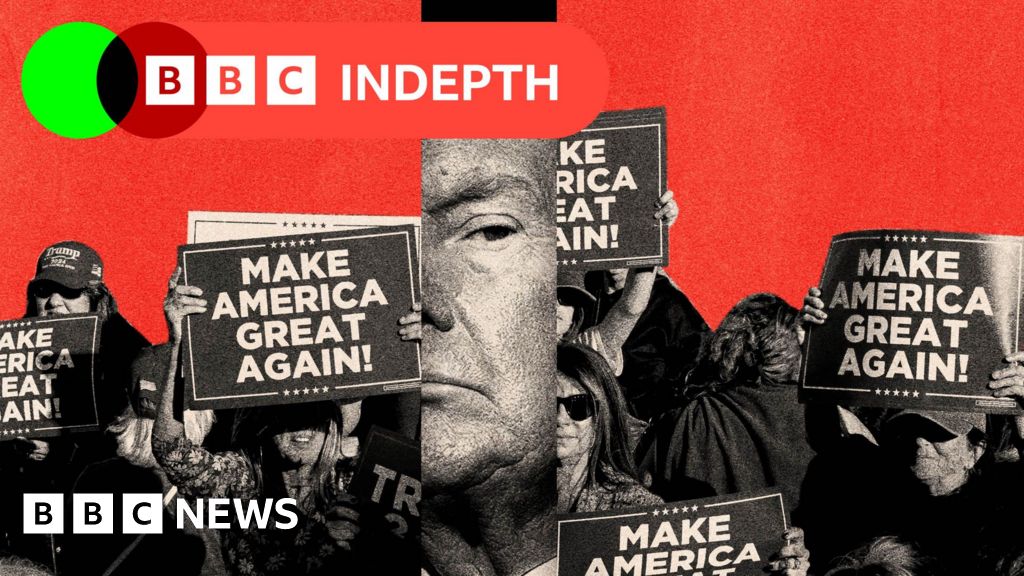

America’s Political Crossroads: The Future of Trumpism and the 2024 Race
Nearly a year before the next presidential election, Donald Trump continues to dominate the Republican landscape, but cracks within his movement suggest that the party’s future is far from certain. At a pivotal moment, Trump’s recent statements and internal party dynamics reveal a shifting political terrain that will profoundly influence how nations and societies view America’s trajectory. As Trump hints that he may not run again—in fact, explicitly stating “it’s not going to be me”—the Republican Party faces an impending reckoning over its identity, core base, and the ideological direction it will take post-Trump. Influential voices like political analysts and history scholars warn that these internal divisions could reshape American politics for decades.
In recent months, the Republican Party has experienced a noticeable decline in support among minority and working-class voters, those who propelled Trump’s 2020 campaign into the White House. The latest data indicates a narrowing of the party’s electoral coalition, driven partly by internal disputes and a rising chorus of dissenters—from congressional figures like Marjorie Taylor Greene to business leaders like Elon Musk. This factionalism exposes the fissures in the MAGA movement—fired up in rallies, yet increasingly fractured in policy debates and party loyalty. This factionalism comes at a time when many international observers and domestic analysts argue that the Republican coalition has diverged sharply from its Reagan-era ideals, shifting toward economic nationalism, border security, and an America-first foreign-policy, as outlined by historian Laura K. Field. Such ideological changes not only redraw the American political map but also advance new challenges for allies, competitors, and international institutions grappling with Washington’s waning influence.
From Vance to Rubio: A team of rivals?
The intra-party jockeying is intensifying, with figures like JD Vance, Marco Rubio, and Robert F. Kennedy Jr. positioning themselves as potential heirs to the MAGA mantle. Despite moments of camaraderie, the upcoming contest appears more like a collage of competing visions—ranging from traditional conservatives advocating for a return to Reagan-esque values to populist, nationalist insurgents pushing for a more radical departure. Interestingly, many of Trump’s would-be successors, while echoing his rhetoric, are also suspecting that the political loyalty of the ‘new entrants’—those who joined MAGA more recently—is not guaranteed. Piloting through this turbulent landscape, Senator Rubio has shifted hard from his earlier support for liberal immigration policies, aligning increasingly with Trump’s hardline stance, but cracks in the coalition widen as some support for political violence and conspiracy theories emerge among the more radical factions.
The core question remains: Can the Republican establishment maintain its hold over a fracturing base that is more ideological than ever? The recent Manhattan Institute survey indicates that nearly one-third of current Republican supporters are “new entrants,” less supportive of Trump’s possible heirs. This group’s support drops further when considering issues like political violence, with over half seeing it as sometimes justified—an alarming indicator of how far the party’s social fabric has shifted. As the party struggles to contain these ideological currents, the next few years will see whether the GOP can forge a unified front or splinter into ideological and strategic factions, with the fate of the MAGA movement hanging in the balance.
The future of Trumpism
Despite the setbacks, Trump’s influence appears enduring. Even if he retreats from the political spotlight, the core of his movement has redefined what it means to be a Republican. As pointed out by political analyst Rodney Davis, the post-Trump GOP will be shaped by leaders who must decide whether to maintain the populist, nationalist policies that propelled Trump into power or to attempt a more traditional conservative stance. The party’s recent electoral defeats in states such as Virginia and New Jersey underscore how the coalition’s long-term viability remains uncertain, especially as Democrats make gains in special elections and local races. The underlying question that looms is whether Trump’s revolutionary approach has cemented a new ideological order—one rooted in cultural conflict, economic protectionism, and a disdain for international alliances—or if the GOP can adapt and evolve beyond the MAGA era.
As the timeline races toward the 2026 mid-term elections, the debate over who will succeed Trump has already begun, and the outcome will define the shape of American politics. The forces unleashed by his rise have shaken the old Republican order to its core, turning what was once a party of Reagan conservatism into a broad coalition of populist rebels, ideological purists, and pragmatic elites. Whether this new political architecture will stand the test of time remains an open question, but history is watching. In a nation where power has often shifted on a knife’s edge, the weight of the future presses down heavily on America’s shoulders—its choices, its alliances, its very identity—are still being written, and the next chapter is nowhere near being finished.





