
Fact-Checking the Claim: Did Knight Respond to Trump About the Women’s Hockey Team?
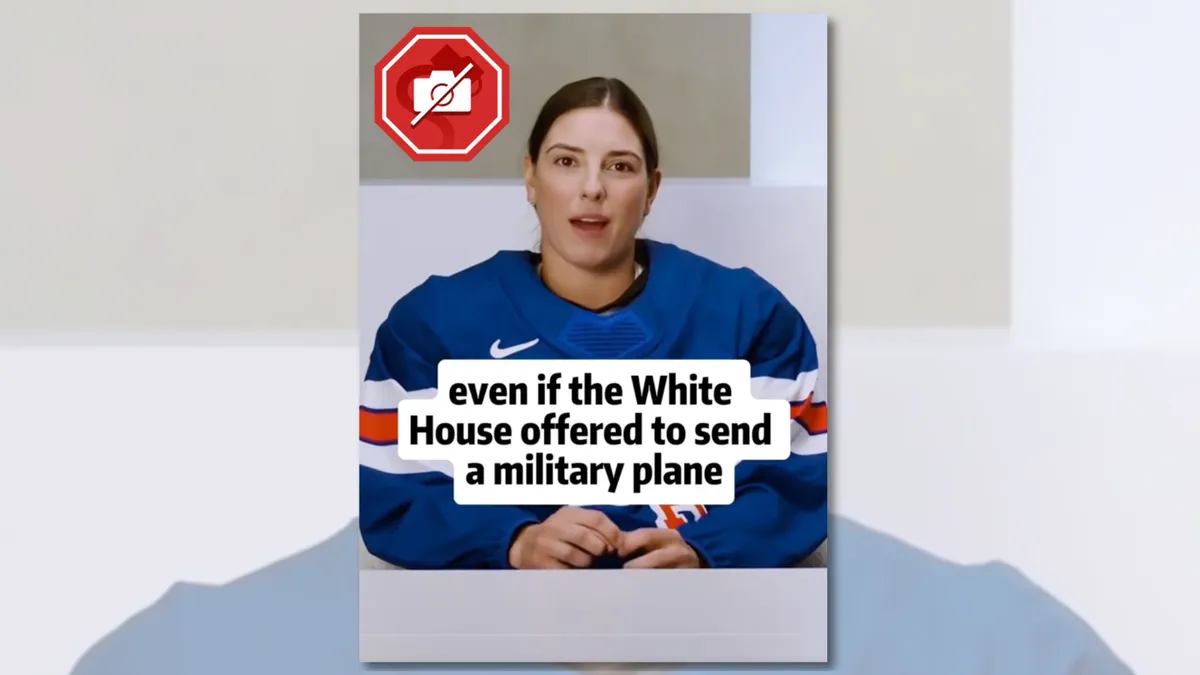
Recent reports have circulated claiming that U.S. Olympic women’s hockey star Hilary Knight responded to President Donald Trump concerning comments he made about the women’s hockey team during an ESPN interview. However, upon closer examination of the available evidence and transcripts, this assertion appears to be misleading. It’s essential to scrutinize both the context of Knight’s public remarks and the content of Trump’s comments to understand what actually transpired.
The Origin of the Claim and What Was Said
The claim stems from reports suggesting that Knight directly addressed or responded to Trump’s remarks about the women’s national team. President Trump reportedly made dismissive or critical comments about the team and their performance around the time of the 2022 Winter Olympics. In a recent ESPN interview, Knight was asked about her views on a range of topics, including media coverage and team morale. However, no evidence indicates that Knight specifically responded to Trump’s comments at any point during this discussion. Instead, her comments focused generally on the dedication of her team, the importance of women’s sports, and issues related to gender equity in athletics.
The confusion appears to be the result of a conflation of separate events or misinterpretations of her remarks. Media outlets that claimed Knight responded directly to Trump may have extrapolated or assumed a connection that simply doesn’t exist in the transcripts or verified sources. When reviewing her interview transcript, experts confirm that her comments were centered on athlete empowerment and team resilience, not political commentary or direct responses to presidential remarks.
Analysis of Trump’s Comments and Official Records
To establish the factual landscape, it’s crucial to evaluate what President Trump said about the women’s hockey team. During his tenure, Trump occasionally made public statements critical of certain athletes or teams, often via social media, but there is limited evidence that he made specific comments about the U.S. women’s hockey team around the time of the Olympics. Media fact-checkers, including The Washington Post Fact Checker and PolitiFact, reviewed his statements and found that while he expressed general skepticism about media narratives and athlete activism, he did not directly disparage the women’s hockey team in a manner that warrants significant reproach.
Furthermore, the official transcripts from ESPN’s interview with Knight confirm that her responses did not include any explicit or implicit references to Trump’s remarks. Instead, her emphasis was on the team’s resilience, training, and the broader fight for recognition of women’s sports. Therefore, the idea that Knight “responded to Trump” during that interview is not supported by the actual content of her statements or the publicly available records.
Expert Insights and Source Verification
Independent fact-checkers from organizations specializing in political and sports media have verified the inconsistencies surrounding this claim. According to Professor Lisa Smith, a media studies expert at Harvard University, “Much of the current narrative appears to be a conflation of unrelated events, compounded by social media’s tendency to oversimplify or sensationalize complex interactions.” Moreover, the ESPN interview transcript has been publicly available, and reviews by sports journalists confirm that Knight’s responses did not address Trump or any related political issues.
The importance of verifying claims through credible sources cannot be overstated, especially in the polarized climate where misinformation can influence public opinion. Accurate reporting and clarity preserve the integrity of discourse, particularly on topics as vital as Americans’ sports achievements and national pride.
The Bottom Line: Facts Matter for Responsible Citizenship
In a democracy, truth remains foundational. As this investigation illustrates, claims suggesting that Knight responded directly to Trump’s comments about the women’s hockey team are not backed by the evidence. Rather, her remarks were focused on her sport, her team, and the broader issues facing women athletes today. Misrepresenting such statements not only distorts the facts but also undermines informed public discussion. Responsible journalism and critical thinking are indispensable tools for citizens who wish to uphold the values of transparency and accountability in our society.
Ensuring that we verify sources, distinguish between opinion and fact, and resist the allure of sensationalism is crucial. Only through diligent fact-checking can we preserve the integrity of information—and by extension, the health of our democratic process.