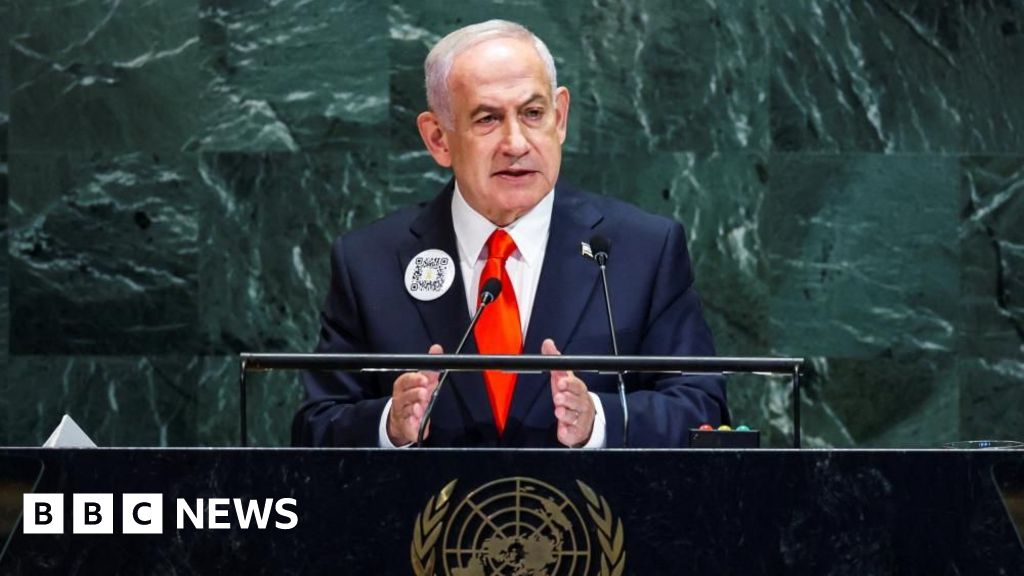

The recent UN General Assembly crescendo has set a stark stage for the volatile trajectory of Middle Eastern geopolitics. Israeli Prime Minister Benjamin Netanyahu delivered a speech that sharply polarized the global community, condemning the recognition of Palestinian Statehood by numerous Western nations. His vitriolic rhetoric labeled such recognitions as a “mark of shame”, insinuating that they send a dangerous message—that “murdering Jews pays off.” This inflammatory assertion reverberates through diplomatic corridors, triggering a wave of walkouts and protests, notably in Times Square, where protesters condemned Israel’s military actions in Gaza. The divergence in international opinion underscores a deepening east-west divide over the conflict, with Western nations like the UK, France, and Canada recognizing Palestine, challenging Netanyahu’s hardline stance, and igniting a geopolitical tug-of-war over legitimacy and influence.
Within this storm, Netanyahu’s opening remarks portrayed a narrative of relentless regional threats and existential peril. Showcasing a map labeled “The Curse,” he delineated Iranian proxy groups spanning the Middle East, asserting that Israel faces encirclement by Hezbollah in Lebanon, the Houthis in Yemen, Hamas in Gaza, and Iran itself. Such rhetoric is designed to consolidate domestic support by framing Israel’s military operations as a regional necessity. The Prime Minister went further, lauding Donald Trump’s administration for its alleged role in striking Iran’s Fordo nuclear site, and drew unsettling parallels between Hamas’s October attack and the 9/11 terrorist assaults—both portrayed as threats to global stability. These narratives serve to rally Israel’s allies and justify aggressive military actions, but they also escalate tensions, rippling across borders, and challenging the international consensus for a peaceful resolution. Historians warn that such militant rhetoric risks further destabilization, perpetuating cycles of violence with long-term repercussions for regional security.
Israel’s firm refusal to recognize a Palestinian State remains at the heart of the discord, with Netanyahu asserting that such a state would threaten Israel’s very existence. This stance, aligned with the opinions of the majority of Israeli citizens, continues to entrench division and hinder diplomatic progress. Compounding matters, Netanyahu dismissed claims from UN investigations that Israel had committed genocide in Gaza—a charge he branded “baseless”—and accused international agencies of deliberately restricting aid. With famine ravaging Gaza, as confirmed by UN-backed bodies, the humanitarian toll becomes an unignorable responsibility that frames Israel’s military campaign either as justified self-defense or, by critics, as collective punishment. The contextual backdrop of Israel’s blockade and media restrictions, which have kept independent journalists out of Gaza for nearly two years, amplifies the uncertainty surrounding the true scope of the conflict and its devastations.
In a provocative move aimed at bolstering morale, Netanyahu instructed Israeli forces to broadcast his speech via loudspeakers on Gaza’s perimeter, claiming to reach Israeli hostages and MIA civilians. Amidst contentious internal debates, critics branded the stunt as “propaganda,” highlighting the growing rift within Israel’s own political landscape. Meanwhile, freshly emerging statements from Palestinian Authority leader Mahmoud Abbas suggest a fleeting hope for diplomacy, signaling readiness to collaborate on peace efforts. Lauding the possibility of a de-escalation, the political question remains whether such hopes will withstand the relentless barrage of violence and hardline rhetoric. The chatter from former US President Donald Trump, hinting at a potential ceasefire “deal” in Gaza, adds yet another unpredictable layer to an already volatile chess game where alliances are tested, and history’s pen continues to write its dark, uncertain chapter. As the world watches with bated breath, the unfolding story of this conflict stands as a stark reminder: in the theater of geopolitics, today’s decisive moves shape the course of history, and tomorrow’s history is nothing less than the legacy of today’s choices.