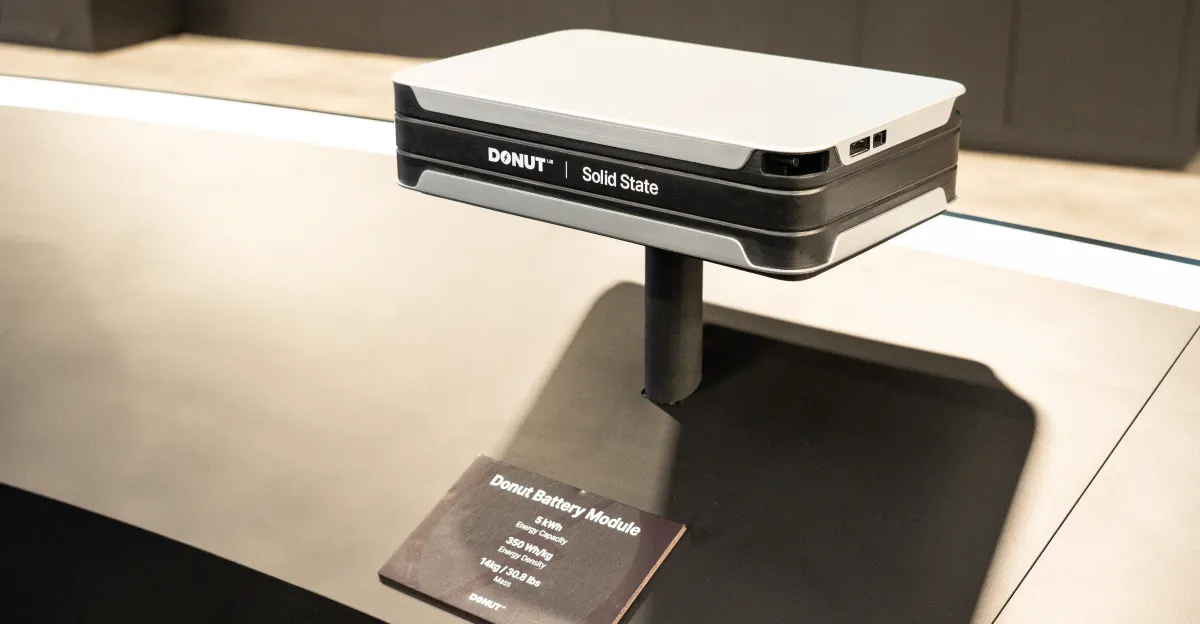

Disruption in Energy Storage: Donut Lab Demonstrates Promising Safety in Solid-State Battery Testing
In a bold stride towards disrupting the electric vehicle (EV) and energy storage sectors, Donut Lab has released initial results from rigorous testing of its innovative solid-state battery. The tests, conducted by VTT Technical Research Centre in Finland—renowned for their extensive battery research—mark a crucial milestone in the pursuit of safer, more durable energy solutions. While traditional lithium-ion batteries have long grappled with safety concerns and limited cycle life, Donut’s latest experiments suggest that its proprietary technology could herald a new era of resilience and longevity.
During targeted high-stress simulations, the battery was subjected to conditions designed to mimic extreme real-world scenarios, including high temperatures and physical damage. Notably, the pouch encapsulating the battery lost its vacuum seal during the heat tests, a condition known to induce thermal runaway—an event that can cause fires or explosions in conventional lithium-ion cells. While the damage led to a significant capacity degradation—down from 24.7 Ah to approximately 11.2 Ah—public statements from Donut emphasize that the battery “fails gracefully,” avoiding catastrophic failures such as fire or thermal runaway. This safety profile starkly contrasts with the risks associated with traditional lithium-ion batteries, which remain vulnerable under similar conditions.
Implications for Industry and Market Disruption
The results underscore the potential for solid-state batteries like those developed by Donut to catalyze a fundamental shift in markets spanning EVs, portable devices, and renewable energy storage. Experts such as Gartner analysts highlight that solid-state technology’s disruption could dramatically lower safety concerns, reduce manufacturing costs, and extend product lifespans—addressing longstanding barriers that have hindered widespread adoption of battery-powered solutions. The company claims its batteries could endure up to 100,000 cycles—an astonishing figure translating to roughly 270 years—far surpassing the 1,000-2,000 cycles typical for current EV batteries.
- Advantage: Significantly increased cycle life implies longer-lasting batteries, reducing waste and costs.
- Innovation: Solid-state architecture inherently prevents liquid electrolyte failures, enhancing safety and performance.
- Potential: Disrupts market dominance of traditional lithium-ion giants by providing safer, more durable solutions.
However, critical questions remain, especially regarding the long-term performance under repeated charge-discharge cycles, a test that remains unverified at this stage. The industry watches closely as Donut approaches this milestone, as iterative aging tests will determine whether this promising prototype can withstand real-world demands. As MIT researchers and tech analysts warn, the transition from promising lab results to commercial viability remains an arduous journey, often fraught with scaling and manufacturing hurdles. Nonetheless, the trajectory of Donut Lab’s innovation hints at a future where safer, longer-lasting batteries could redefine mobility and energy use worldwide.
The Road Ahead
As investment flows into next-generation energy storage, accelerated adoption of solid-state technology appears inevitable. Industry leaders such as Tesla and Apple are racing to develop their own versions, recognizing the game-changing potential of these batteries in creating more reliable and safer devices. The recent tests by Donut Lab serve as a stark reminder of the urgent need for technological disruption—stability, safety, and longevity are no longer optional but imperative in shaping the future energy landscape.
The next phase will be critical: validating long-term cycle durability and manufacturing scalability. If Donut’s claims hold true, the traditional battery paradigm will be irrevocably altered, ushering in an era dominated by innovation, disruption, and strategic advantage for those who lead the charge. The race to dominate this emerging market is on, and the future belongs to the agile, the daring, and the forward-thinking.