Matox News

Truth Over Trends, always!

Individual Freedom: The Cornerstone of Our Future


In the contemporary landscape of political discourse, the question of individual freedom stands at the crux of our society’s evolution. Many argue that personal liberties are fundamental to progress, acting as a bulwark against the encroachments of authoritarianism and collectivism. The essence of individual freedom, encapsulated in the rights to speech, assembly, and personal choice, plays a pivotal role in not only shaping individual lives but also in driving societal advancement.

The historical context of individual freedom can be traced back to the Enlightenment, where philosophers like John Locke and Adam Smith laid the groundwork for liberal democratic principles. Their advocacy for limited government intervention and the sanctity of personal rights offered a counter-narrative to oppressive regimes. In contrast, critics of unleashed individualism contend that unregulated freedoms can lead to societal fragmentation and moral decay. However, the potential pitfalls of individualism should not overshadow its undeniable capacity to catalyze innovation and creativity, essential elements for a thriving future.

Moreover, the modern economy, increasingly driven by entrepreneurship and digital innovation, depends on the freedom of individuals to explore, create, and challenge the status quo. Young entrepreneurs exemplify this trend; they leverage cutting-edge technology to disrupt traditional business models, improving efficiency and accessibility. By enabling individuals to pursue their passions, societies can foster environments that incubate new ideas and solutions, ultimately propelling economic growth. Thus, maintaining robust individual rights becomes essential for nurturing this entrepreneurial spirit.

On the social front, the rise of movements advocating for personal liberties across different spheres—such as gender identity, privacy rights, and freedom of expression—demonstrates a collective push towards a more inclusive society. Many argue that these movements are emblematic of a broader recognition that individual freedom is not merely a privilege but a universal right that enhances social cohesion. Counterarguments suggest that such liberties can sometimes clash with traditional values or lead to divisiveness within communities. However, accepting a multiplicity of identities and perspectives can enrich our cultural tapestry, fostering empathy and progressive dialogue.

Education plays a critical role as well in this discourse. A system that prioritizes individual freedom encourages critical thinking and empowers students to engage with diverse viewpoints. By fostering an environment where questioning authority and exploring new ideas are not just permissible but encouraged, educational institutions can cultivate the next generation of leaders who are equipped to navigate the complexities of modern life. Critics, however, may assert that this approach risks undermining established historical narratives and societal norms, which serve to maintain order. Yet, a well-rounded education that values both personal freedoms and historical context can equip individuals with the tools to engage thoughtfully with both their rights and responsibilities.

Internationally, countries that prioritize individual freedoms often experience more stability and prosperity than those that suppress such rights. Nations that embrace market-oriented policies and democratic governance tend to witness elevated standards of living and greater citizen satisfaction. Conversely, countries that engage in heavy-handed regulation and restrict personal liberties frequently find themselves entrenched in cycles of stagnation and social unrest. Critics of neoliberal policies point to inequality as a potential downside; however, the evidence indicates that absolute freedom spurs opportunities that ultimately uplift everyone, rather than merely enriching a select few.

For many, it is crucial to recognize that individual freedom does not exist in a vacuum. It must be balanced by a commitment to social responsibility and community well-being. This calls for a nuanced understanding of what it means to be free in today’s interconnected world. Many suggest that fostering civic engagement and a sense of duty towards one’s immediate community can enhance individual freedoms rather than diminish them. While critics may argue that a focus on community can infringe upon personal liberties, it is entirely possible to support communal values while maintaining a strong commitment to individual rights.

In conclusion, the trajectory of our future hinges on our commitment to individual freedom as a foundational principle. As we navigate the complexities of modern challenges—be they technological, social, or political—it is imperative to champion the rights of individuals while fostering a sense of collective responsibility. Through a balanced approach, we can ensure that individual freedom not only remains a cornerstone of our identity but also propels us toward a sustainable, enriched future. By standing firm in our belief in the empowerment of all individuals, we pave the way for innovation, inclusivity, and ultimately, a brighter tomorrow.
Fed cuts rates, yet mortgage rates climb—what’s really happening?

The U.S. Treasury bond market is experiencing notable upheaval as long-term yields defy expectations following the Federal Reserve’s recent interest rate cut. Despite the Fed’s decision to lower the benchmark rate by a quarter percentage point to a range of 4.00% to 4.25%, bond traders responded with a surge in longer-dated treasury yields. The 10-year Treasury yield soared past 4.14%, after briefly dipping below 4%. Meanwhile, the 30-year treasury yield climbed above 4.76%, signaling a complex reaction to the Fed’s moves. This divergence indicates that market participants are trying to interpret the Fed’s policy signals within a broader context of market expectations and global economic signals, with consequential market impact on borrowing costs, stock valuations, and inflation outlooks.

Market analysts, including prominent economists like Peter Boockvar, emphasize that the bond market is “selling the news” — a phenomenon where investors, having anticipated the rate cut, now adjust their positions based on the perception that the Fed’s move may signal a shift in policy stance or underlying economic risks. Boockvar notes that the recent spike in yields reflects traders’ skepticism about the Fed’s intentions, especially considering its updated economic projections, which reveal that policymakers see a modest acceleration in inflation — slightly above the 2% target — into 2026. This outlook raises questions about the Fed’s commitment to inflation control, potentially easing policy tightening prematurely and paving the way for persistent inflationary pressures.

The implications for policy consequences are significant. The Fed’s rate cut was framed as a “risk management” move amidst softening labor market data, including weaker employment figures earlier this month. Fed Chair Jerome Powell indicated that the central bank remains cautious, prioritizing job market stability while trying to keep inflation in check. However, the pushback from bond traders suggests that the market perceives a disconnect between the Fed’s communication and the longer-term economic outlook. As Boockvar and fellow investors watch international developments — where yields globally are also trending higher — it becomes clear that the global economic environment is influencing U.S. bond dynamics, adding layers of complexity to the policy landscape.

Meanwhile, the housing sector reflects these broader market uncertainties. For instance, Lennar, one of the largest homebuilders, recently reported disappointing quarterly revenue and weak future guidance, citing “continued pressures” in the housing market driven by elevated interest rates. Such signals from the real estate sector reinforce concerns that persistent high yields and monetary policy tightening could hinder economic growth and the labor market. As economist Chris Rupkey warns, these rising bond yields may ironically signal tougher times ahead. He cautions that declines in bond yields often presage recessions, yet rising yields are currently driven by stable employment data, which might create a paradoxical environment where good labor markets inadvertently complicate monetary policy and dampen consumer confidence.

Looking forward, the bond market’s reactions underscore a fundamental truth: the economy is a living pulse that responds not just to current policies, but to perceptions of future policies and global shifts. The stage is set for a decisive period where the Fed’s next moves could reshape economic trajectories. Will they succeed in tightening inflation without stifling growth, or will markets push policymakers to revisit their approach amid mounting international pressures? One thing is clear: the bond yields act as a barometer of this complex dance — an epic display of economic forces shaping the very foundation of future power. As nations watch, the true test lies ahead: navigating the turbulent waters of inflation, growth, and global interconnectedness to forge the robust, resilient economy of tomorrow.

Germany Promised as Europe’s Growth Engine—Now Economists Have Doubts

Germany’s Economic Gambit: A Race Against the Clock

The global economic landscape remains a game of strategic moves, and Germany finds itself at a pivotal crossroads. Earlier this year, the nation embarked on an ambitious economic overhaul, backed by substantial fiscal reforms and record-setting investment pledges. The government aimed to ignite a domestic revival and serve as a catalyst for the beleaguered euro zone economy. Notable among these initiatives was the suspension of its long-standing debt brake, a policy that historically constrained government borrowing. This measure, combined with a €500 billion infrastructure and climate fund, seemed poised to electrify Germany’s sluggish economy and ripple positively across Europe’s markets and policies.

However, the initial optimism is now facing a sobering reality check. Despite the massive fiscal initiatives, recent data paints a subdued picture. While the first quarter of 2025 saw a modest 0.3% GDP growth, the subsequent quarter reversed course with a 0.3% contraction. These figures reveal the profound challenge policymakers face—a delayed impact of fiscal stimulus in a nation where “it takes time to spend money,” as noted by Berenberg’s chief economist Holger Schmieding. Although defense orders and infrastructure investments are witnessing a “major rise,” the actual output remains sluggish, indicating that Germany’s economy is struggling to translate promises into tangible results. The market impact is clear: investors and analysts are questioning whether Germany’s grand plan can achieve its transformative potential within the expected timeline, or if it risks falling short amid persistent structural headwinds.

Meanwhile, eligibility for fresh risks emerges from the broader policy landscape. As Franziska Palmas of Capital Economics highlights, the expansion of fiscal space—notably the additional government spending on pensions, healthcare, and social benefits—could push Germany’s deficits “much higher” than initially planned. This surge in borrowing and spending, while offering near-term growth, risks sowing seeds of long-term fiscal instability if not carefully managed. Economists warn that this expansion may be more a short-term boost than a sustainable path to prosperity, with some foreseeing a higher deficit over the coming years and a potential increase in inflationary pressures. As such, Germany’s shift toward more aggressive fiscal policies is a double-edged sword—offering an economic shot in the arm but raising questions about debt sustainability, policy credibility, and the risk of overheating an already fragile recovery.

Looking ahead, the prospects for Germany—and by extension, the euro zone—remain uncertain. Leading economic institutes have recently revised down their growth forecasts, now projecting a potential expansion of just over 1% in 2026. Berenberg and others estimate that even with the fiscal stimulus, Germany’s contribution to euro-zone growth might be modest—approximately 0.2-0.3% of additional growth—highlighting how complex and interconnected the European economy’s rebirth will be. The European Central Bank’s recent interest rate cuts and renewed optimism about Spain’s vibrant growth further complicate the picture, hinting that the EU’s recovery depends on a delicate balance of regional cooperation, fiscal discipline, and geopolitical stability. Still, the turning point remains clear: Germany’s ability to transition from a brief daze of recession to sustained growth could shape Europe’s future economic stratification and power dynamics.

As the pulse of national economies continues to beat, the global stage watches keenly—a testament to how critical short-term policy decisions are in shaping future power structures. The coming months will determine whether Germany harnesses its fiscal might into lasting prosperity or falls prey to the perils of overextension and untapped potential. In this fragile balance, the story of Germany is also the story of Europe and, ultimately, the epic quest for economic dominance in an era defined by swift change, fierce competition, and relentless innovation.

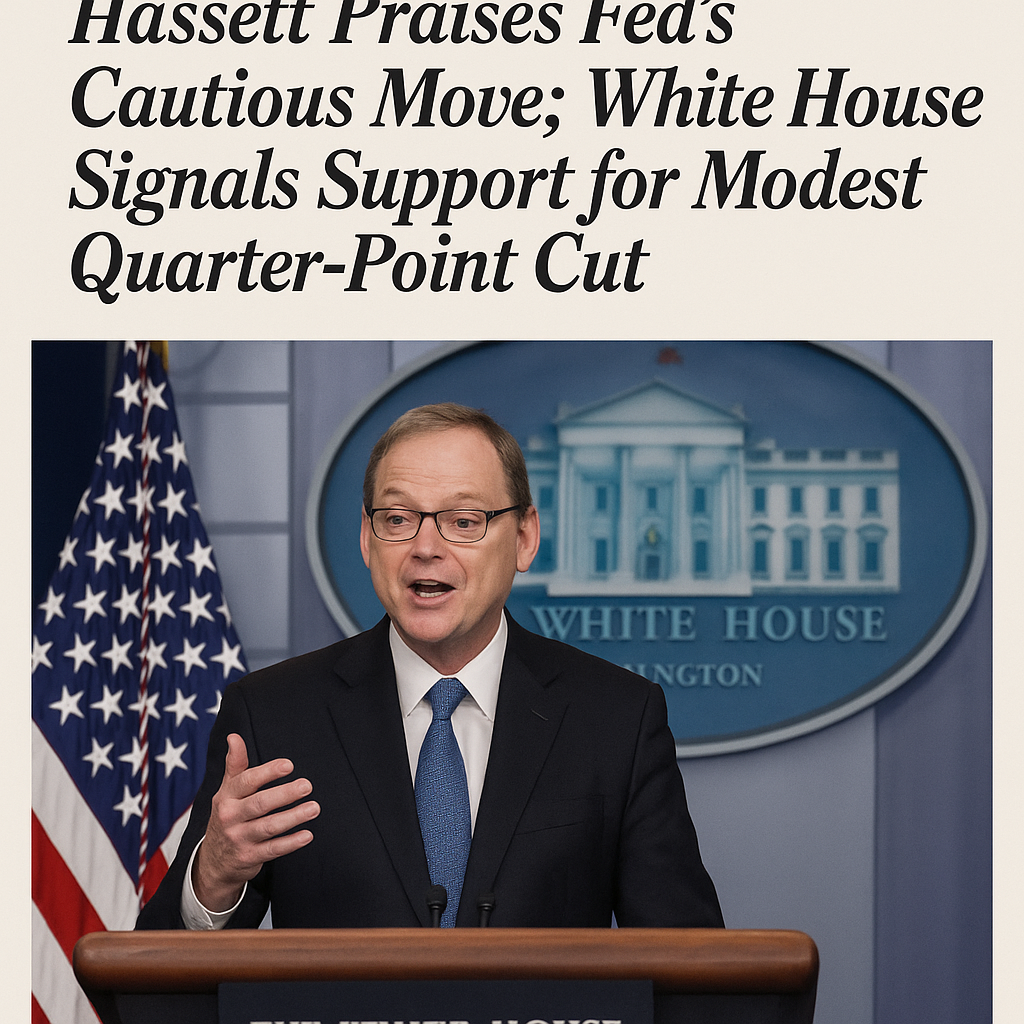
Hassett praises Fed’s cautious move; White House signals support for modest quarter-point cut

Federal Reserve’s Rate Cut Sparks Market Movements and Policy Debates

The Federal Reserve recently implemented a modest quarter-percentage-point cut to its key borrowing rate, signaling a cautious approach as it navigates a complex economic landscape. This decision, perceived by some as a step towards economic stabilization, comes amid shifting market sentiments and ongoing debates among policymakers, economists, and investors. As the global economy faces rising inflationary pressures yet remains resilient, the Fed’s move exemplifies the delicate balancing act it must perform—tamping inflation without stifling growth.

Notably, the White House expressed support for the Fed’s measured approach, with National Economic Council Director Kevin Hassett emphasizing the prudence of a “slow and steady” policy. While some within the administration advocated for a more aggressive half-point cut, the Fed’s decision reflects a consensus aimed at cautious optimism. The recent economic indicators show a robust third-quarter growth rate exceeding 3%, a figure that traditionally would argue against easing monetary policy. Still, inflation running above the Fed’s 2% target, combined with concerns about persistent financial risks, has prompted a nuanced response that favors gradualism over rapid cuts.

Market impacts from this decision are multifaceted. Investors remain vigilant, with equities, bonds, and commodities reacting to the delicate narrative of growth versus inflation control. The policy considerations extend beyond immediate market behavior, touching on policy consequences that could shape future economic stability. Analysts from think tanks and leading economists, including those linked to the Federal Reserve and major banks, indicate that this cautious move might set the stage for future rate adjustments. The decision also underscores ongoing debates about the policy trajectory—should the Fed prioritize containing inflation or supporting a thriving housing market and manageable debt levels?

Importantly, the political dimension persists, with President Donald Trump advocating for more aggressive cuts—arguing that the current rates are insufficient to boost the struggling housing sector and manage the national debt. Such political influences, though not directly altering Fed decisions, shape the policy environment and investor sentiment. As the Fed considers its next moves amid diverse economic signals, the broader implications for market impact and policy stability will be paramount. The coming months will test whether this measured approach will secure sustained growth or prompt future rallying cries for more rapid easing, reflecting the eternal tug-of-war at the heart of economic policy.

Looking ahead, the pulse of the economy remains a reflection of national strength and future global influence.

In this high-stakes game, where monetary policy acts as both shield and sword, the resilience of economies hinges on informed decision-making and bold leadership. Investors, policymakers, and citizens alike watch with anticipation, realizing that the economic landscape is a grand stage—an epic arena where the forces of innovation, policy, and global power collide. While uncertainties persist, the underlying momentum suggests that the future economy will be shaped by those willing to navigate its shifting tides with vision, precision, and resolve. This moment underscores the vital truth: **the economy is not merely a system of numbers, but the beating pulse of nations, heralding the dawn of a new era of global influence and economic ascendancy**.

Social Media Auto Publish Powered By : XYZScripts.com