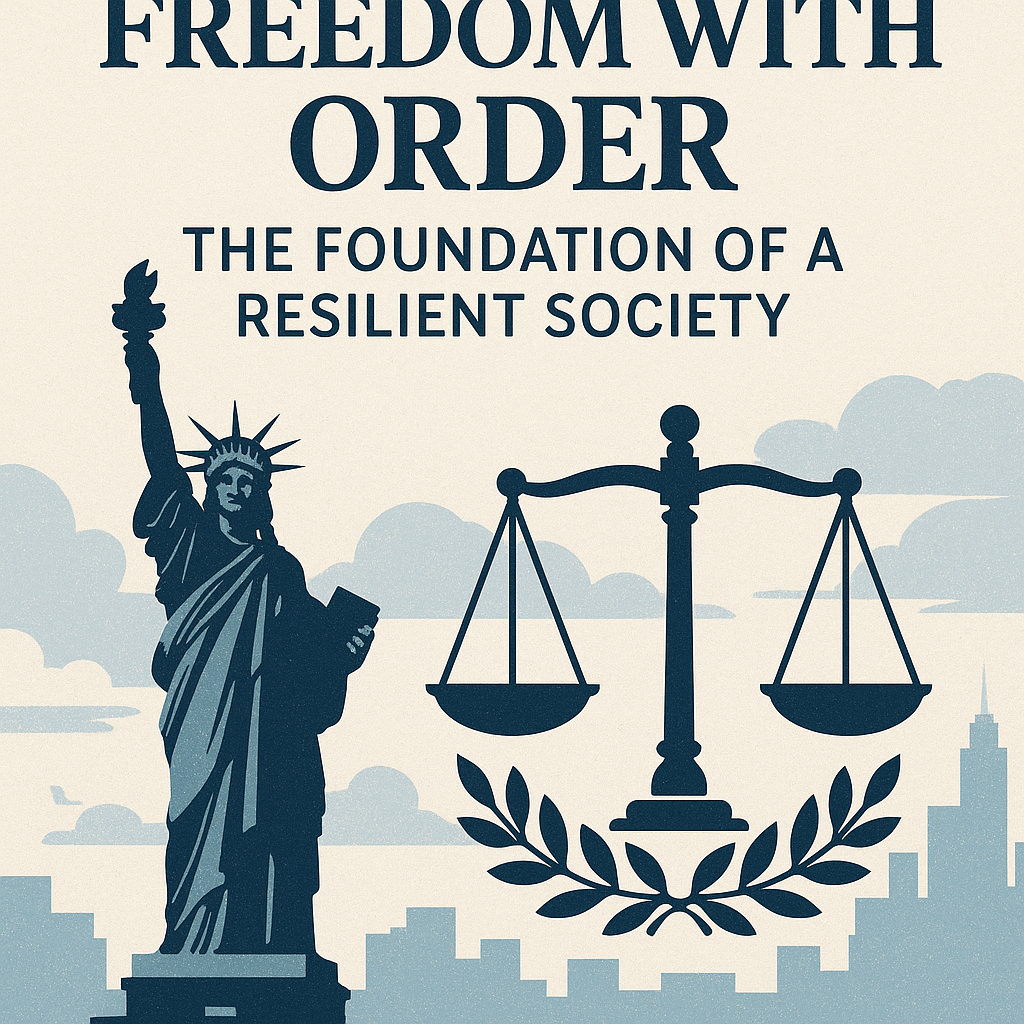

Throughout history, the delicate balance between freedom and order has served as the cornerstone for resilient societies. Critics often misunderstand this dynamic as a trade-off where increased security mandates the sacrifice of liberty. However, seasoned analysts and philosophers such as Alexis de Tocqueville and Friedrich Hayek emphasize that true societal strength emerges when freedom is harmoniously woven with a framework of order—one that upholds justice, personal responsibility, and social stability. In our modern era, this principle remains vital as nations grapple with the chaos of unchecked activism, digital misinformation, and economic volatility, all threatening to unravel the fabric of societal cohesion.
Order provides the scaffolding upon which freedom can flourish. Without clear laws, predictable institutions, and accountability, personal liberties become vulnerable to arbitrary abuse and chaos. As Hayek argued in The Road to Serfdom, excessive controls and central planning inadvertently pave the way for tyranny, strangling individual initiative and innovation. Furthermore, economic stability—a pillar of societal resilience—relies on robust regulatory systems that prevent market excesses and protect consumers. Yet, critics warn that overreach risks stifling entrepreneurship. Balancing this involves fostering a legal environment that safeguards rights while encouraging competition: a mission crucial for youthful societies seeking vitality and adaptability.
In this context, the challenge is cultivating a societal ethos where freedom does not devolve into chaos but is anchored deeply in shared responsibility. This requires fostering civic virtues such as respect for law, discipline, and community engagement. When societies neglect these virtues, they risk devolving into fragmentation, where individual pursuits overshadow collective wellbeing. James Madison famously asserted that “liberty is to faction what air is to fire”—a vital but potentially destructive element unless carefully contained within a framework of ordered liberty. Educating youth on the importance of self-restraint within a free society becomes critical, emphasizing that true freedom entails both liberty and responsibility.
As we peer into the future, the resilience of society may well depend on its capacity to uphold this nexus of freedom fused with order. Societies that embrace this duality act as fortresses against external threats and internal strife, safeguarding the pursuit of progress without sacrificing moral and legal foundations. History suggests that societies which prioritize lawful governance and individual rights can weather intellectual, social, and economic storms with perseverance and grace. The enduring legacy of this balance lies in its promise: to forge not merely a surviving society but one that thrives, diverse yet united, free yet resilient—an unbreakable mosaic crafted by the unwavering harmony of liberty and order.