
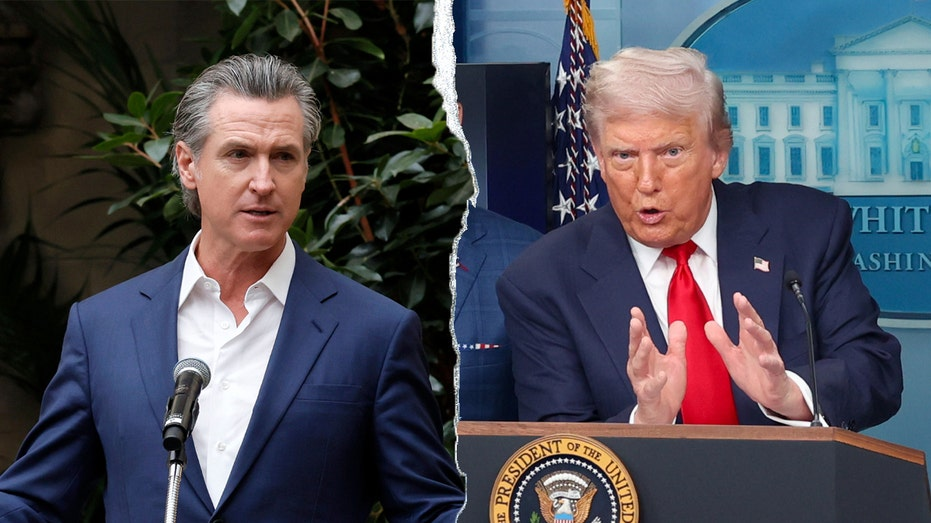

California Governor Gavin Newsom has ignited a fresh political firestorm with a proposal to levy a 100% tax on state residents who receive disbursements from President Donald Trump’s newly established Anti-Weaponization Fund. The controversial move, announced by Newsom, positions the Democratic governor directly against the former president, even as critics within California raise questions about Newsom’s own administration’s spending practices.
Newsom’s Unprecedented Tax Proposal
Governor Newsom articulated his intent during a recent press conference, stating unequivocally, “Anyone from California that receives any of those funds, we want to tax 100% of those proceeds and that’s an action the state of California can take. It’s an action we look forward to taking.” His primary concern, as expressed on social media platform X, is that the $1.78 billion fund could serve as a reward for individuals involved in the January 6, 2021, Capitol riot, many of whom Trump pardoned or commuted sentences for upon returning to office.
Newsom characterized the fund as an unacceptable reward for those he claims “were beating up cops,” emphasizing that such individuals would not only receive pardons but also financial compensation. This strong condemnation highlights a significant ideological divide regarding accountability for the events of January 6th and the appropriate use of political funds.
The Anti-Weaponization Fund Under Scrutiny
President Trump’s Anti-Weaponization Fund, described by its proponents as a nonpartisan effort, has quickly become a flashpoint in national politics. While supporters argue it aims to protect individuals from what they deem politically motivated legal challenges, critics, including Newsom, have labeled it a “boondoggle” designed to benefit Trump’s allies. The fund’s creation and its potential beneficiaries have raised concerns about the weaponization of legal processes and the politicization of financial support.
The timing of Newsom’s push is also notable, occurring amidst widespread speculation that he is positioning himself for a future presidential bid in 2028. His direct challenge to a Trump-backed initiative could be seen as a strategic move to solidify his standing within the Democratic party and national political discourse.
“He pardoned all of those folks that were beating up cops and absolved them, providing them 1.776 billion dollars. So not only do you get a pardon, you get rewarded. That’s why this is needed.” – Governor Gavin Newsom
California’s Own Spending Controversies
Newsom’s critique of the Anti-Weaponization Fund has, predictably, drawn accusations of hypocrisy from Republican and conservative commentators. Many point to his administration’s own history of politically connected spending programs, which they have frequently dubbed “slush funds.” These criticisms are not new and have been a recurring theme in reports from outlets like Fox News.
One prominent example cited by critics is a $25 million California legal fund established by Newsom himself. This fund was created to combat what the governor termed “legal warfare” from the previous Trump administration. While Newsom framed it as a defensive measure, opponents viewed it as another instance of the state allocating significant taxpayer resources for politically charged objectives.
The debate over these funds underscores a broader concern about fiscal prudence and the transparency of government spending. Taxpayers in California, already burdened by high costs of living and various state initiatives, are increasingly questioning the allocation of billions to projects that often face delays, cost overruns, or unclear benefits. This includes the state’s ambitious high-speed rail project, which has faced significant criticism for its escalating budget and prolonged timeline.
Ensuring Accountability and Public Trust
The exchange between Governor Newsom and President Trump’s supporters highlights a critical issue in modern governance: the public’s trust in how political leaders manage vast sums of money. Whether at the federal or state level, the creation of funds perceived as partisan or lacking clear accountability mechanisms erodes confidence in institutions.
For a state like California, grappling with substantial budgetary challenges, the focus on fiscal discipline is paramount. The proposal of a 100% tax, while framed as a moral stand, also raises questions about the state’s authority to confiscate federally originated funds and the precedent it might set. Such actions demand careful consideration of their legal ramifications and their impact on the relationship between state and federal jurisdictions.
As this debate unfolds, the call for greater transparency and stricter oversight of all politically motivated funds—regardless of their origin—will undoubtedly grow louder. Ensuring that public resources are used for the common good, rather than perceived political gain, remains a foundational expectation for sound governance.






