
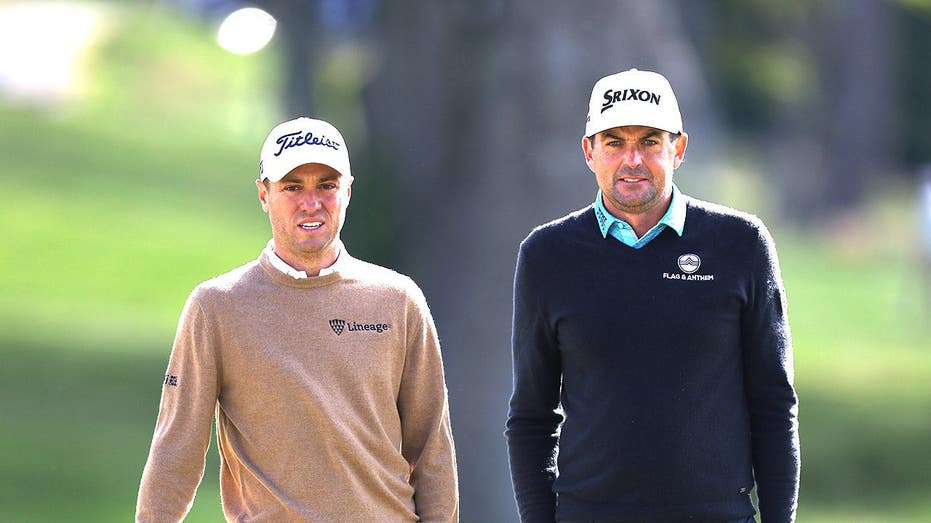

PHILADELPHIA — The second round of the PGA Championship at Aronimink Golf Club saw tempers rise as two of golf’s most prominent figures, Justin Thomas and Keegan Bradley, found themselves in a spirited confrontation with a tournament official over the pace of play. The incident, which also involved fellow Ryder Cupper Cameron Young, underscored the pressures faced by elite athletes navigating a challenging major championship field.
The exchange occurred on the fourth hole, following a first round that had already drawn attention to the speed of play. Both Thomas and Bradley, known for their competitive fire, were visibly animated as they discussed the official’s decision to put their group on the clock, arguing that their position on the course did not warrant the intervention.
The On-Course Confrontation
An official approached the trio — Thomas, Bradley, and Young — in a cart, initiating a discussion that quickly escalated. Eyewitnesses noted finger-pointing and intense dialogue, with both Thomas and Bradley appearing to indicate the group ahead as the source of any potential delay. Thomas, a former PGA Champion, later shared his perspective, stating the group did not agree with the official’s assessment.
“We were behind. That wasn’t our issue… It’s just the fact that we weren’t holding up the group behind us.” — Justin Thomas
Bradley, a past Ryder Cup captain for the U.S. team, also conveyed his displeasure, though his interaction with the official was reportedly briefer. The players maintained that while they were indeed behind the group in front, they were not impeding the progress of the players directly behind them, which is a key distinction in pace-of-play rulings.
Players Point to Challenging Conditions
The players’ disagreement stemmed partly from their assessment of the demanding conditions at Aronimink. Thomas specifically cited the intricate course layout, high winds, and particularly tough pin positions as factors contributing to slower play. These elements naturally extend the time required for decision-making and shot execution, especially in the high-stakes environment of a major.
- Course Conditions: Aronimink Golf Club presents a complex layout.
- Wind: Strong gusts added an extra layer of difficulty for all competitors.
- Pin Positions: Challenging placements demanded precision and careful thought.
- Large Field: A robust 156-golfer field naturally contributes to congestion.
The PGA Championship’s extensive field, coupled with specific course features such as shared tee boxes and crossing paths on certain holes, can inherently lead to bottlenecks. Scores have also been notably high, with only a fraction of the field under par at the time of reporting, further indicating the course’s difficulty.
Broader Implications for Tournament Play
This incident at the PGA Championship highlights a perennial challenge in professional golf: balancing competitive fairness with efficient tournament flow. While officials strive to maintain a reasonable pace, players often feel that external factors, such as course design and weather, are not always adequately considered in real-time rulings. The exchange, reported by FoxNews.com, quickly became a talking point among fans and analysts.
Ultimately, Thomas confirmed that his group managed to catch up to the pace on the very next hole, demonstrating their capability to accelerate when necessary. However, the intensity of the discussion underscores the fine line between regulation and the natural rhythm of high-level competition. Ensuring fair play while managing a large field will remain a key focus for tournament organizers throughout the championship.






