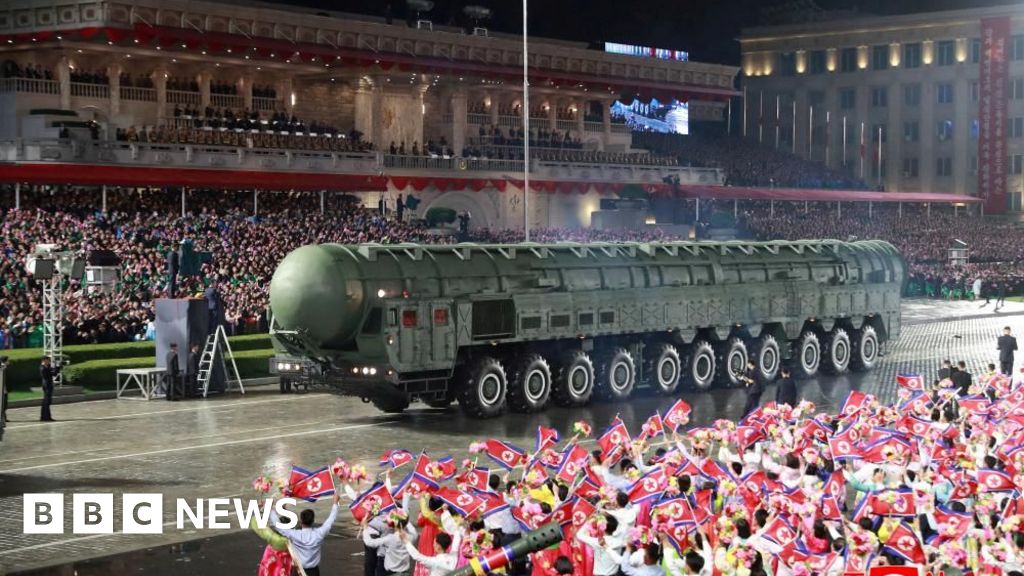

In a clear demonstration of its advancing military capabilities, North Korea unveiled its latest intercontinental ballistic missile (ICBM), the Hwasong-20, during a grand military parade in Pyongyang commemorating the 80th anniversary of its ruling party. The event, broadcast widely on state television, displayed a confident Kim Jong Un overseeing the event—sending a stark message to the world about the regime’s ongoing pursuit of nuclear and missile prowess. The timing and content of this reveal signal an increasingly assertive stance in North Korea’s quest for strategic parity, and potentially, superiority.
The Hwasong-20‘s impressive size strongly indicates its capability to carry multiple nuclear warheads. This advancement marks a notable escalation in Pyongyang’s missile program, which has persisted despite numerous international sanctions and diplomatic efforts to curb its proliferation. Analysts from institutions such as the Council on Foreign Relations warn that this development could fundamentally alter regional security calculations, particularly in South Korea, Japan, and the broader Asia-Pacific region. For the West, this serves as a reminder of North Korea’s resilience and its commitment to maintaining a nuclear deterrent—regardless of diplomatic prospects and economic sanctions.
Ever since Kim Jong Un’s rise to power, North Korea has pursued a dual strategy of nuclear development and diplomatic brinkmanship. However, these latest tests and displays underscore a shift toward greater military self-reliance and readiness to challenge international norms. Some experts suggest that this move complicates efforts by the United Nations and other global institutions to impose meaningful restrictions, and underscores the limitations of *diplomatic engagement* with a regime that views nuclear weapons as essential to its survival. The proliferation of such advanced missile technology not only elevates North Korea’s geopolitical standing but also deepens regional instability, forcing neighboring nations to reconsider their security alignments and military postures.
This escalation is not occurring in isolation. China and Russia, both strategic allies of Pyongyang, have shown mixed reactions that reflect broader shifts in their own geopolitical goals. Some analysts suggest that Beijing and Moscow are tacitly accepting North Korea’s missile tests as part of a complex pushback against perceived Western encroachment and U.S. dominance in the Indo-Pacific. Meanwhile, the international community faces mounting warnings from security experts who emphasize that further advancements in North Korea’s arsenal could spark an arms race on the Korean Peninsula, or even ignite conflict if miscalculations occur. The latest developments serve as a stark reminder that global peace remains fragile, heavily dependent on strategic dialogues and the restraint—or lack thereof—of a regime that appears increasingly willing to test the limits of diplomacy.
Historians like Bruce Cumings and military analysts warn that these technological milestones might mark a pivotal chapter in East Asian geopolitics. The struggle to contain North Korea’s nuclear ambitions is a saga that history may view as a precursor to a broader, more dangerous confrontation. As the world watches, the stakes couldn’t be higher; the balance of power teeters on the edge of a new era where technological advancements wield the potential to reshape conflicts—and societies—forever. In the shadow of this emerging threat, nations must grapple with unsettling questions: Will diplomacy prevail, or will this be the beginning of a new, perilous arms race?”