
Matox News

Truth Over Trends, always!

Scotland Investigates: Two More Patient Deaths at Glasgow Hospital Raise Concerns

Scandal Unfolds at Glasgow’s Queen Elizabeth University Hospital: A Nation’s Trust in Healthcare Shattered

The United Kingdom is currently embroiled in an alarming healthcare scandal that has stunned the international community, exposing reckless decisions and potential political interference that may have cost lives at Glasgow’s Queen Elizabeth University Hospital (QEUH). The deaths of seven patients, many of whom were children battling cancer, are now being scrutinized amidst revelations that contaminated water and ventilation systems could have contributed to infections linked to the hospital’s infrastructure. This crisis has marked a significant turning point in public confidence towards the Scottish healthcare system, raising questions about accountability, transparency, and the influence of political agendas on critical health infrastructure.

Investigations spearheaded by Scotland’s Crown Office and Procurator Fiscal Service (COPFS) have identified the deaths of individuals such as Molly Cuddihy, a young woman who fought a rare bone cancer, and Andrew Slorance, a former Scottish civil servant. These tragic cases are part of a broader six-year inquiry into the hospital’s safety standards, which recently reached its final stages. The inquiry uncovered heartbreaking evidence: serious infections diagnosed in 84 child cancer patients, leading to the deaths of at least two, were almost certainly linked to contaminated water supplies. Such revelations have struck a chord globally, casting a dark shadow over the political decision-making that accelerated hospital opening preparations amidst unresolved health and safety concerns.

Political Shadows Over Hospital Opening: A Cautionary Tale of Power and Neglect

  • The Scottish Labour Party has publicly accused the Scottish government of political pressure to open QEUH prematurely in April 2015, just before the general election, a claim previously denied by prominent leaders like First Minister John Swinney and Nicola Sturgeon.
  • Throughout the investigation, whistleblowers, including three senior microbiologists, have voiced ongoing concerns over inadequate infection control measures and a perceived reluctance by senior management to enact necessary safety reforms.
  • Premier political figures faced accusations of manipulating hospital timelines to serve electoral interests, a move that some analysts argue exemplifies how political interests can threaten public safety and erode trust in government institutions.

This controversy echoes across the international stage, where accountability in public health has become a defining measure of a government’s moral integrity. The WHO and other global health watchdogs regularly emphasize that politicization of healthcare infrastructure compromises patient safety, undermining decades of progress in hospital standards worldwide. Experts warn that this scandal may serve as a stark warning for nations worldwide, illustrating how political expediency and neglect can turn vital healthcare institutions into death traps, especially in times of increasing medical complexity and public skepticism.

Global Lessons and the Brink of History

As the UK grapples with this internal crisis, the broader geopolitical impact remains unmistakable. It underscores the importance of international oversight and transparency in healthcare management, especially in an era where public trust is fragile, and misinformation can easily flourish. The hospital scandal reveals how decisions driven by short-term political gains can have lifelong repercussions, eroding societal trust and provoking a crisis of confidence that no amount of reparations or apologies can swiftly mend. Historians and analysts warn that, if left unaddressed, such failures threaten to regress public health advancements and may influence political stability in the UK and beyond, as whistleblowers and concerned citizens demand accountability.

In the final chapter of this unfolding tragedy, the weight of history presses heavily on the shoulders of policy-makers, healthcare professionals, and society at large. The manner in which justice is eventually delivered—whether through reforms, prosecutions, or societal reckoning—will shape the narrative of accountability in the 21st century. As families mourn and trust is broken, the echoes of this scandal will remind future generations that in the arena of life-and-death governance, the true cost of political games can be measured in lives lost, and a society forced to confront its darkest truths amid the shadows of history still unfolding.
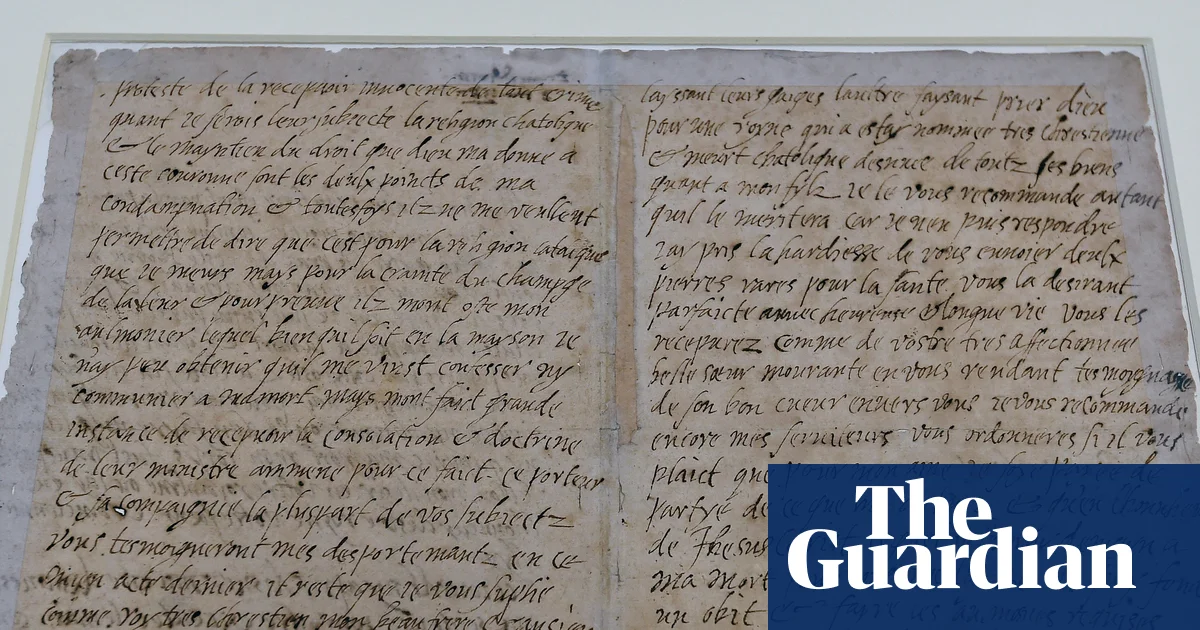

Mary, Queen of Scots’ Last Letter to Be Exhibited After Nearly a Decade in Scotland

Historical Reconsideration: Mary, Queen of Scots’ Last Letter on Display in Scotland

In a remarkable event that transcends centuries, the National Library of Scotland has announced that the last letter of Mary, Queen of Scots, penned mere hours before her execution in 1587, will be showcased at the Perth Museum. This rare exhibition, which opens on 23 January 2024 and continues into April 2026, offers a visceral connection to a pivotal period in Scottish and European history. Mary’s final words, written in French, constitute a rare surviving artifact of a turbulent reign marked by intrigue, rebellion, and international diplomacy — archetypes of the age of monarchs. For scholars and the public alike, this display signifies an extraordinary opportunity to witness an integral shard of history, reminding us of the enduring influence of monarchy and the fragile fabric of sovereignty.

This event gains geopolitical significance beyond its historical value. As Scottland asserts its cultural identity through such exhibitions, it also serves to highlight the broader narrative of British history and its intertwined European history. The letter, kept under tight conservation by the National Library of Scotland, has rarely left its vaults, underscoring the importance placed on preservation amidst the age of digital and rapid consumption. The upcoming display coincides with ongoing efforts to emphasize Scotland’s unique legacy, especially as debates about independence and regional sovereignty continue. Analyzing this moment, international historians note that cultural heritage serves as a vital anchor in asserting national identity for parts of the UK, in a continent increasingly defined by regionalism and resurgence of localized histories.

In addition to Mary’s letter, the exhibition will feature a range of documents from the National Library, including early manuscripts from poets and playwrights such as Robert Burns and Liz Lochhead. These artifacts, situated within the historic context of Mary’s life—including her imprisonment, abdication, and dramatic escape from Lochleven Castle—emphasize how cultural renaissance and national memory are often interconnected. Alison Stevenson, the library’s director of collections, describes this event as a “once-in-a-generation opportunity”, highlighting that this is a moment for collective cultural reflection. The exhibition’s location at Perth, a city central to Mary’s life, transforms her story from distant history into a living, national narrative that stirs patriotic sentiment and historical consciousness alike.

Such events invoke broader geopolitical themes. As Scotland shapes its narrative within the UK, the display acts as a potent symbol of regional identity asserting itself amidst global shifts. The Scottish government recognizes the importance of heritage in fostering national pride—especially as debates over independence and sovereignty persist. The cultural secretary, Angus Robertson, stresses the lasting value of these artifacts as “a priceless record,” emphasizing that their preservation and public display matter profoundly in an era where history is often commodified or politicized. The drama of Mary’s story, with its themes of power, betrayal, and tragedy, resonates well beyond just Scottish borders, reminding the world that history is not static but a battlefield of identity and influence. International institutions such as UNESCO continue to advocate preserving such educational treasures, acknowledging their power to shape perceptions of sovereignty and cultural legacy.

The unveiling of Mary, Queen of Scots’ last letter transcends simple historical curiosity; it is a saga of resilience, tragedy, and national pride woven into the fabric of geopolitics and cultural identity. As her poignant final words are revealed, one cannot help but sense that the story of her life, and the lessons embedded within, are still unfolding—an ongoing narrative that may very well influence the course of regional and global history for generations to come. In the shadows of history’s corridors, the weight of her final notes whispers with an enduring significance, echoing through time as a silent testament to the enduring power of memory and the unending pursuit of sovereignty.

Storm Amy hits UK: London’s royal parks shut, Scotland faces blackouts and travel chaos

Storm Amy’s Global Impact: A Shattering Force of Nature and Its Geopolitical Consequences

As Storm Amy sweeps across northern Scotland, Ireland, and Scandinavia, its destructive power has transcended mere weather phenomena, revealing the vulnerabilities and resilience of modern societies. With wind speeds reaching record-breaking levels—such as the slip of Baltasound into the lowest pressure ever recorded in the UK—this tempest underscores a new chapter in climate variability. According to the Met Office, the storm broke overnight pressure records, signaling a menacing escalation in storm strength that meteorologists and climate scholars are closely monitoring. The storm’s ferocity has led to widespread flooding, power outages, and transportation chaos, emphasizing how nature’s fury is reshaping the geopolitical landscape and how nations respond to environmental crises.

Across Ireland, the storm’s wrath has caused the loss of power for hundreds of thousands, with officials warning that recovery could take days—particularly in counties like Donegal and Galway. Irish police reported the tragic death of a man in County Donegal as a direct result of this weather event, intensifying the human toll amidst the chaos. The Irish Meteorological Service’s yellow and amber warnings highlight the dangerous scale of Wind gusts exceeding 90 mph, which have already toppled trees, torn down power lines, and triggered floods in coastal regions. Similar scenes of devastation have been reported in Scotland, where more than 170 incidents have been logged by Network Rail, including fallen trees obstructing railways, leading to transport bans and economic disruptions. Once seen as unpredictable yet localized, such environmental catastrophes are now evidence of an increasingly volatile climate—a development that is inexorably linked to geopolitical strategies in the 21st century.

Beyond the British Isles, Storm Amy’s reach extends into Scandinavia, striking Sweden, Denmark, and Norway. Heavy gusts have caused power outages in tens of thousands, alongside flooding and damage to infrastructure. The European response reveals a continent on edge, with authorities in Norway issuing flood warnings and warnings for large waves threatening coastal areas. International traffic and maritime routes are severely impacted, showcasing how extreme weather patterns are stirring an urgent reevaluation of geographic vulnerabilities. Historians and climate analysts warn that these storms are consistent with the patterns forecasted by climate change models, heralding a new era where geopolitics will increasingly contend with the instability introduced by increasingly frequent and intense environmental disasters.

Geopolitical Impact: A Testing Ground for Resilience and Cooperation

The widespread devastation from Storm Amy exposes the fragile fabric of modern society’s infrastructures—transport, power, and communication networks—yet also tests the mettle of international cooperation. Governments scrambled to respond, with disruptions affecting everything from regional train services in Scotland to ferry routes in Ireland. The frequent suspension of critical transportation—such as the postponement of rugby matches in Galway and the halting of Scotland’s rail networks—illustrates how environmental shifts threaten economic stability and social cohesion. Analysts at the United Nations warn that failure to adapt to these climate pressures will deepen geopolitical tensions, especially in regions where resources are already stretched thin.

In particular, the storm’s ferocity serves as a sobering wake-up call to Western nations, prompting discussions on infrastructure resilience, emergency preparedness, and climate diplomacy. Governments are now forced to confront the reality: climate change is no longer a distant threat but an immediate challenge with profound geopolitical ramifications. Countries are increasingly entering alliances focused on climate adaptation, energy security, and shared responses to natural Calamities. According to climate scientists, delays in investing in adaptive infrastructure threaten to exacerbate social divides, fueling migration pressures and resource conflicts in vulnerable regions. Even international institutions like the European Environment Agency have voiced concern, emphasizing that the storm’s impacts are a stark illustration of a changing climate demanding immediate international action.

The Unfolding Canvas of History: An Era Marked by Nature’s Wrath

As the storms continue to batter Europe and the British Isles, history reminds us that such events are not isolated but interconnected with the larger currents of environmental and geopolitical change. The images of fallen trees, flooded roads, and power outages are the visuals of a new reality forged by climate shifts—reality in which nations must reshape their policies, their economies, and their very understanding of security. Indeed, as analysts warn, the escalating frequency and intensity of storms like Amy threaten the stability of societies and international order itself. The chaos wrought by this storm is a stark reminder that in an age of rapid environmental change, the lines between nature and geopolitics are irrevocably blurred, and history itself is being rewritten by the power of the elements.

Social Media Auto Publish Powered By : XYZScripts.com



