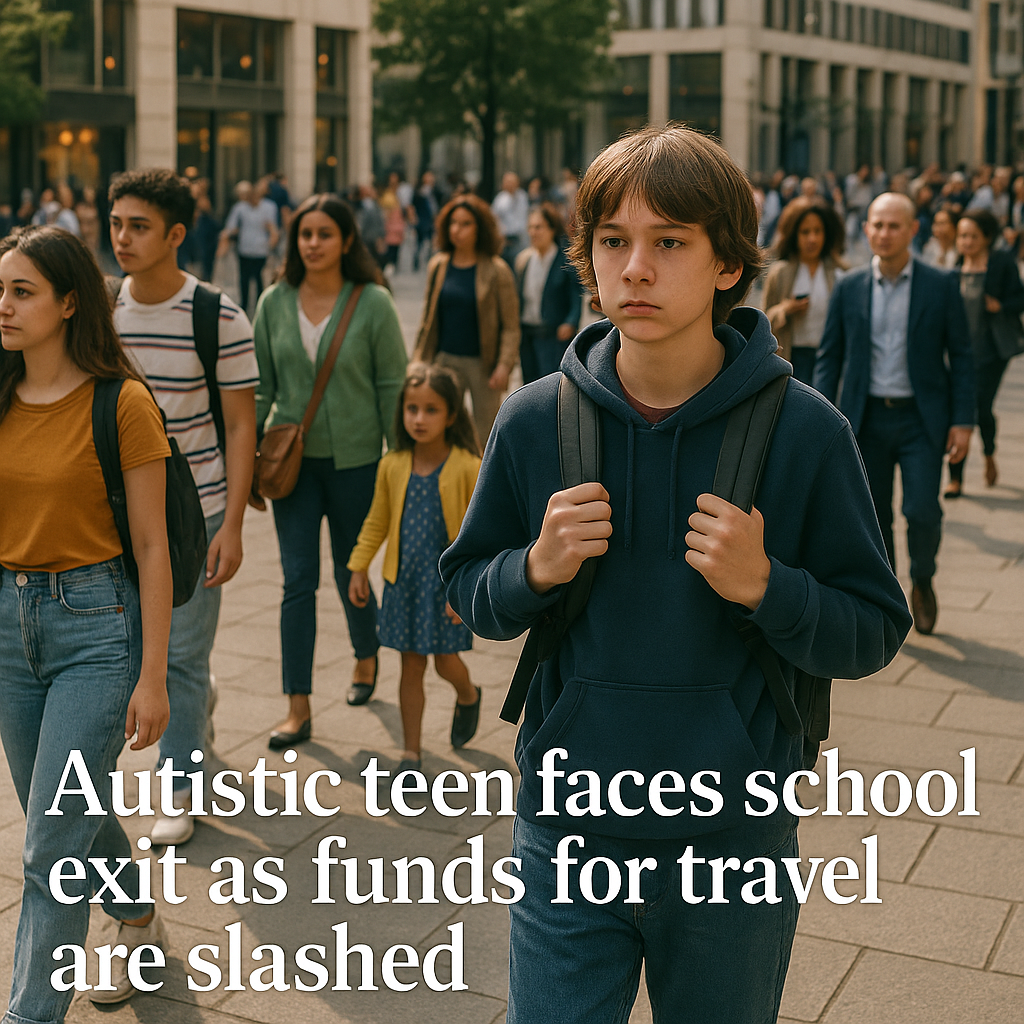
In a society that prides itself on fairness and compassion, the unfolding crisis in special educational needs and disability (Send) support exposes a harsh reality: families caring for children with complex needs are facing systemic neglect and social insensitivity. As communities increasingly rely on local governments to bridge gaps left by austerity-driven cutbacks, the stark disparities in support serve as a wake-up call to reevaluate societal priorities. The story of Luke, a fourteen-year-old autistic boy with sensory processing disorder and ADHD from Somerset, exemplifies how families are being left to shoulder the burden of inadequate social services, impacting not only the well-being of individual children but also the fabric of their families and communities.
With the transition to post-16 education, families like Luke’s find the support structures that once provided essential aid suddenly dissolving. Somerset Council’s decision to cease paying for Luke’s specialized transport—a taxi and in-car support worker—highlight the increasing disconnect between policy and human need. Now, his family faces a difficult choice: to bear the financial weight of costly travel alternatives or to risk safety by navigating unpredictable, unsupervised journeys. This shift not only endangers children like Luke but also underscores a broader societal failure to protect vulnerable youth. Social commentators and sociologists warn that when communities fail to provide adequate support, they risk fragmenting under the weight of inequality, with families bearing the brunt of systemic neglect.
‘Not safe’: The Human Cost of Systemic Austerity
Luke’s mother, Tatjana, describes her son as having “no road safety, no danger safety,” emphasizing that in his current state, he cannot transition to independent travel without significant risk. Her account sheds light on a fundamental moral challenge: the ethical obligation of society to safeguard its most vulnerable members. Since reaching age 16, Luke’s family has been offered a mere “Personal Travel Payment” of fifty pence per mile. Yet, with specialist taxi costs reaching nearly £97 per journey, this amount is grossly insufficient. The loss of dedicated, trained support for children with complex needs often translates into families sacrificing their financial stability and mental health.
Social historian Dr. Helen Miles notes the deterioration in support for families with special needs children, warning that “the long-term consequences threaten to erode social cohesion.” Families, especially those with physical or emotional hardships, become isolated as they struggle to fill the void left by underfunded government programs. Tatjana’s story—her partner’s spinal condition, her former husband’s leg amputation—epitomizes that the social safety net is fraying for those who need it most. Without sufficient support, children like Luke may face a future marred by instability, frustration, and the risk of educational failure, which inevitably impacts families’ stability and the community’s social fabric.
‘The system is broken’: Calls for reform and renewed hope
Former MP Gideon Amos articulates a bitter reality: “The Send system is broken.” His comments reflect a growing frustration among politicians, social workers, and families alike, who observe that “the current approach fails not just in policy but in moral substance.” The Department for Education’s promise to reform and “transform outcomes” signals an opportunity but also a challenge: society must reimagine how it cares for its children. Local authorities like Somerset claim they put “care and consideration” into decisions but admit their resources are stretched thin.
- The current figures show approximately 120 post-16 Send children in Somerset rely on transport support, a number that is unlikely to decline given demographic trends.
This ongoing crisis is a stark reminder that without fundamental systemic overhaul, support for vulnerable children risks becoming a token gesture rather than a societal commitment.
As society stands at a crossroads, the question remains: will society’s collective moral conscience awaken to the plight of children like Luke? The stories behind policies are rooted in human faces—families torn between love and survival, children with dreams hindered by systemic neglect. The challenge ahead is not merely administrative but moral: to build a society where every child’s safety, potential, and dignity are prioritized, regardless of age or ability. In this moment of societal reflection, hope lies in collective action, reform, and an unwavering commitment to transform social failure into a future where every child can find their place. Only then can society truly claim to be just, compassionate, and resilient—qualities that define the strength of a civilization.