
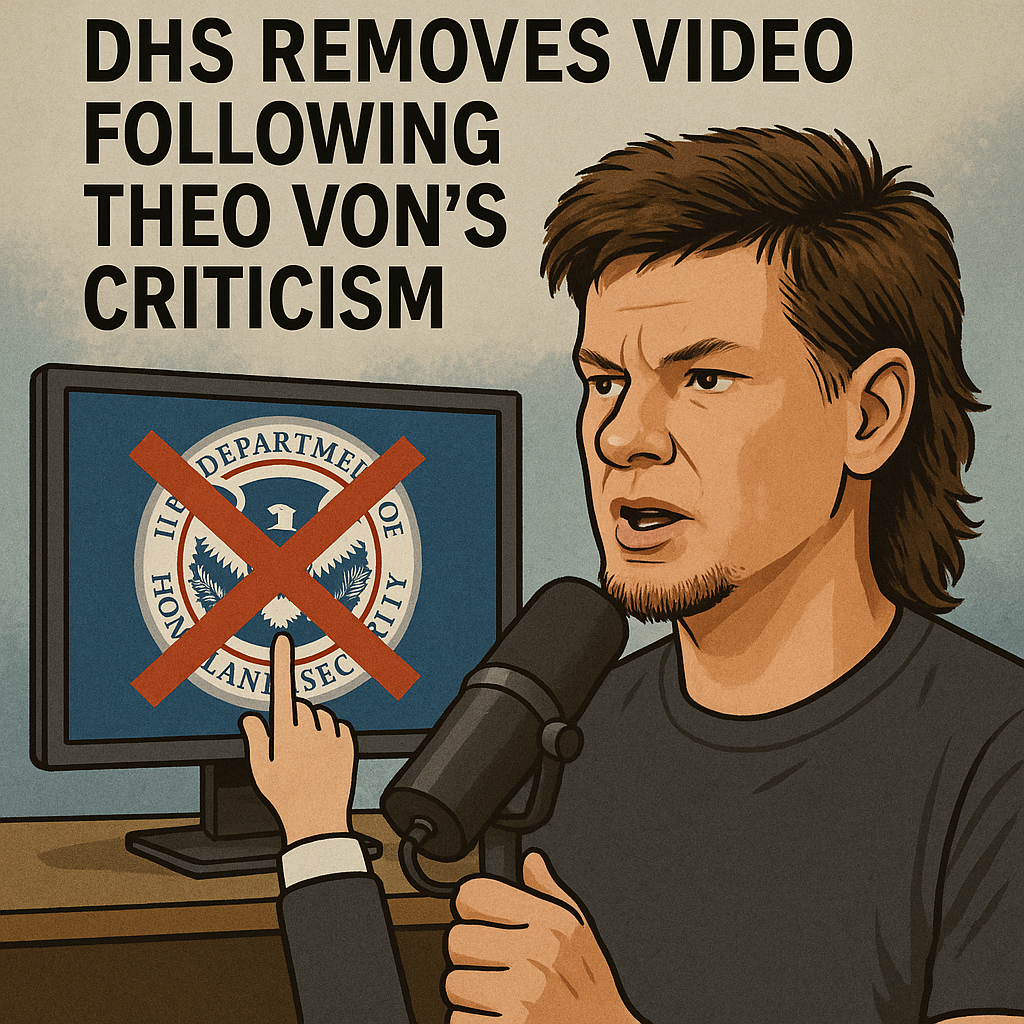

In an era where government agencies increasingly become arenas of public spectacle and power struggles, recent events involving the Department of Homeland Security (DHS) highlight the fragility of authority and the selective nature of political messaging. The DHS, a key instrument in shaping national security and immigration policies, found itself embroiled in controversy after it reportedly removed a social media post featuring internet personality Theo Von. The incident underscores how power dynamics within bureaucratic institutions can influence public perception and reveal underlying tensions between governmental control and individual rights.
According to reports, the DHS posted a video in which Von appeared engaging directly with his audience, making remarks that could be interpreted as humorous or provocative concerning deportation. However, after Von expressed his disapproval at being featured without his consent—citing an invasion of privacy—the agency deleted the content. This move exemplifies a broader trend in contemporary politics: decision-makers navigating the fine line between transparency and suppression. Such acts of digital curation demand scrutiny from constitutional experts who question whether the DHS’s actions represent a form of censorship or an attempt to manage political narratives in an increasingly polarized climate. As historian Charles Beard noted, governance is often a game of “control over information,” a principle as relevant today as it was during the inception of modern bureaucratic states.
This incident also demonstrates how *internal power struggles* within government agencies shape how policies are communicated and executed. It invites an examination of how decision-making hierarchies influence public engagement—a tension rooted in debates over freedom of speech, government transparency, and the authority of bureaucracies. The incident echoes historical parallels; similar disputes over control of the narrative have occurred during the Cold War and other periods of ideological conflict. Today, the digital realm amplifies these struggles, making them increasingly accessible to the public eye and, consequently, more impactful.
Ultimately, the controversy around the DHS’s handling of Von’s video reveals that politics remains a stage where destiny is written through power dynamics. As the nation witnesses this clash of interests—between individual rights and institutional authority—it becomes clear that the decisions made within bureaucratic walls have far-reaching consequences. The establishment’s attempt to manipulate or suppress content not only affects perceptions of legitimacy but also challenges foundational principles such as free expression and government accountability. As political theorists warn, when power consolidates unchecked within the state apparatus, the very fabric of democracy begins to fray, transforming the landscape into a battleground where the eventual winners are those who control the narrative itself.
In this struggle for influence and control, the digital age has rendered traditional political boundaries obsolete. Today, the stage where history is written is no longer solely in legislative chambers or courtrooms but in the fleeting, ever-changing arenas of social media. Here, every post, every deletion, carries the weight of ideological conflicts and the pursuit of ultimate authority. As the dust settles on the DHS’s digital purge, one thing remains undeniable: politics is the story of power – the raw, unyielding force shaping the destiny of nations and individuals alike. In this ongoing game, those who grasp the reins of influence will ultimately determine who writes history and who is forgotten in the shadows of its pages.





