
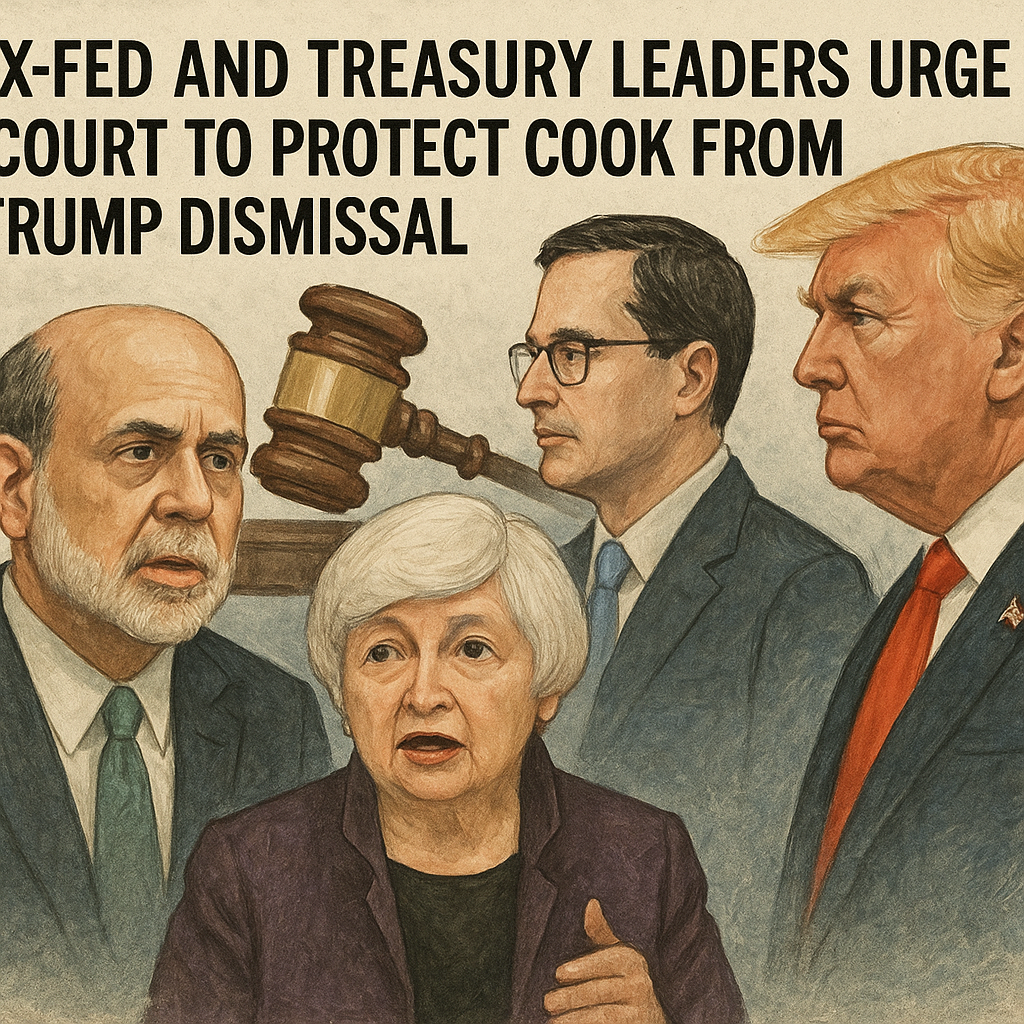


In a dramatic twist that underscores the ongoing power struggles within U.S. financial governance, more than a dozen of the most influential economic policymakers from the past three decades have come together to urge the Supreme Court to uphold the tenure of Lisa Cook, a member of the Federal Reserve Board of Governors. Their collective stance is not merely an act of support for an individual appointment; it symbolizes a broader contest over authority, institutional influence, and the very direction of America’s economic future. As these veteran voices—comprising former Fed chairs and Treasury secretaries—align in their plea, the battle lines are drawn clearly, echoing historic conflicts between independence and political encroachment within central banking.
At the core of this dispute lies a fundamental question: who controls the levers of economic power in the United States? The Federal Reserve, often depicted as an elusive and autonomous institution, has long been the subject of politicization. Critics on the right condemn what they see as unchecked Federal Reserve activism, while supporters argue that its independence is vital for stability and effective policy. The controversy over Cook’s appointment—initially stymied by administrative delays—becomes a flashpoint illustrating the ongoing power struggle between the executive branch and the judiciary. The question remains whether the Court will respect the *constitutional independence* of the Fed or bow to political pressures seeking to influence monetary policy by other means.
This confrontation harks back to historical battles over the role of central banks and the political limits placed on their authority. Figures like **A. E. Carter** from the Federal Reserve’s founding era understood the importance of insulating monetary policy from short-term political whims—a lesson often overlooked when political ideologies threaten the autonomy of vital institutions. The current push to influence or remove Cook questions whether the judiciary is willing to serve as a guardian of this independence, or if it will become a pawns in a broader ideological struggle. The stakes extend beyond individual careers, directly impacting how policies are crafted—whether to favor free-market principles, regulators, or political elites seeking control over economic levers.
This dynamic also impacts the American people, who are caught in the crossfire of decisions made behind closed doors. To many, the idea that a small group—be it Congress, the judiciary, or a cabal of bureaucrats—can wield such profound influence over the economy challenges the very basis of popular sovereignty. As political theorists like **James Madison** warned, the separation of powers is designed to prevent any single faction from becoming a tyranny. Yet, in today’s climate, decision-making appears increasingly centralized, with powerful elites vying for control and shaping the destiny of millions. The fight over Cook’s position is more than a personnel matter; it is a decisive battle over how the future of economic governance will be written.
As history has shown, politics is the arena where destiny is forged. The latest power struggle within the U.S. financial system underscores that |the battle for authority is ultimately a fight for the soul of the nation|. Will the judiciary act as a bulwark protecting institutional independence, or capitulate to political expedience? The outcome will determine how boldly America’s institutions can stand against those who seek to manipulate them for short-term gains. And in the end, the destiny of the nation—its stability, greatness, and value—resides not just in the policies enacted, but in the battles fought for the very principle of who holds the power to shape the future.





