Matox News

Truth Over Trends, always!

Why Is Ice Still a Mystery to Science?

Groundbreaking Research Challenges Long-Standing Theories on Ice Slipperiness

The age-old mystery of why ice remains perpetually slippery has entered a new phase of understanding, with recent scientific advancements threatening to disrupt traditional perspectives in physics and materials science. German researchers have proposed a compelling fourth hypothesis—known as the premelting theory—that suggests an intrinsic, microscopic layer of liquid water exists on ice surfaces prior to contact, fundamentally redefining the phenomenon. This innovative approach tailors to a broader trend in scientific disruption—where classic theories are being replaced by more nuanced, real-world models.

The Evolution of Theories: From Pressure to Premelting

The longstanding debate began in the 1800s with James Thomson, who theorized that additional pressure from a human step could locally lower the melting point, thus creating a slippery layer of water. His idea was supported by Lord Kelvin, but later challenged in the 1930s by scientists like Frank Bowden and T. P. Hughes, who argued that the pressure exerted by even vigorous skaters isn’t sufficient to cause melting. Their calculations indicated that the force generated on a typical skate is orders of magnitude too weak to influence ice’s phase change significantly. This skepticism prompted the scientific community to look elsewhere.

Friction and its Falling Out of Favor

Another dominant hypothesis suggested that heat generated through motion—the idea of frictional heating—caused the ice to melt at the contact point. However, recent experimental studies, including those by Daniel Bonn at the University of Amsterdam, have challenged this assumption. By creating microscopic ice slabs and measuring the forces involved, Bonn’s team discovered that ice slipperiness appears largely independent of the speed of movement, undermining the frictional heating explanation. These findings place the role of surface physics into sharper focus, emphasizing that the phenomenon might arise from more subtle, surface-specific processes rather than bulk heat generation.

The Rise of the Premelting Hypothesis and Industry Implications

Perhaps the most revolutionary shift is the renewed support for the premelting hypothesis—an idea originating from Charles Gurney and others—that ice’s surface is inherently wet at temperatures below 0°C. This microscopic wet layer could be responsible for the persistent slipperiness, and its understanding opens doors for disruptive applications across multiple industries. For instance, manufacturers of anti-icing and de-icing products could leverage this knowledge to develop more effective solutions, reducing reliance on chemical de-icers that harm the environment. Similarly, advances in ice-related transport technologies—like autonomous snow plows or luxury skating rinks—stand to benefit from a profound grasp of the surface physics involved.

  • Emerging technologies in surface coating and material design aiming to manipulate or reinforce the premelted layer.
  • Potential for reduced energy costs and increased safety in winter transportation through advanced understanding of ice’s natural properties.
  • Strategic positioning for companies innovating in climate resilience and infrastructure adaptation.

The Future: Innovation, Disruption, and Competitive Edge

As top industry analysts from Gartner and innovation leaders like Elon Musk and Peter Thiel emphasize, those companies that quickly adapt to the evolving scientific landscape hold the keys to gaining a first-mover advantage. The shift toward understanding surface premelting not only symbolizes a significant paradigm change but also indicates an upcoming wave of technological disruption in fields ranging from transportation to renewable energy. With research like Bonn’s providing a clearer picture of ice’s intrinsic properties, the energy sector and smart infrastructure developers are keenly watching for how to incorporate this knowledge into next-generation solutions.

The decades ahead will determine whether traditional industry giants or agile startups lead the charge—yet one thing remains clear: the race to harness the fundamental science of ice is more urgent than ever. Those who can translate these breakthroughs into practical, scalable applications will set the course for resilience and innovation in a warming world, cementing their position at the forefront of the new technological frontier.

Weather balloon disruption shuts down Lithuania’s top airports—major security alert!

The recent series of provocative incidents in the Baltic States underscores a shifting landscape of geopolitical instability that threatens the delicate balance of power in Eastern Europe. Lithuania, a staunch member of both European Union and NATO, responded decisively by closing its two largest airports and border crossings following the discovery of numerous helium weather balloons drifting into its airspace. These balloons, believed to be used for smuggling, notably carry Belarusian cigarettes, which are far more expensive within EU borders. The Lithuanian government blames Belarusian President Alexander Lukashenko, an ally of Russian President Vladimir Putin, asserting that his regime tolerates and perhaps facilitates this covert smuggling operation—a move that directly undermines EU security principles and regional stability.

This escalation is not isolated. Reports indicate that, throughout the year, Lithuania has seen an unprecedented number of incursions, with hundreds of helium balloons detected and dozens crossing into its territory. The same pattern of aerial intrusions is evident in neighboring Poland, which experienced over 100 similar incidents, further signaling an orchestrated effort to destabilize the Baltic region. Analysts point out that these seemingly minor incursions are part of a broader strategy by Russia and its proxies to test NATO’s resolve and to sow chaos within EU borders, exploiting vulnerabilities in eastern European countries. Security experts warn that such tactics could prelude more aggressive actions, echoing fears of a renewed hybrid warfare aimed at dividing the alliance and reasserting Moscow’s influence.

The recent encounter involving Russian military aircraft further amplifies these concerns. On Thursday, Lithuanian military sources confirmed the entry of a Sukhoi SU-30 fighter and an IL-78 tanker into Lithuanian airspace—an area protected by NATO’s Enhanced Air Policing Mission. Though the aircraft departed after brief incursions, NATO scrambled fighter jets as a show of force, signaling that the alliance remains vigilant amid the continued threats. These deliberate aerial provocations coincide with diplomatic protests from Vilnius, which summoned the Russian chargé d’affaires and issued a stern warning, underscoring the fragile diplomatic environment. Russia’s denial of the incursions, despite credible military reports, reveals its attempt to obfuscate the narrative and maintain plausible deniability—yet the message remains clear: the Baltic States are caught in the crossfire of a renewed geopolitical struggle.

This unsettling chain of events illuminates the broader geopolitical impact of Russia’s tactics. Under the veneer of trivial balloon crossings, a strategic message is sent: the security of eastern NATO members is fragile, and the Kremlin is willing to test the collective resolve of the West. International organizations and security analysts alike warn that such provocations could serve as precursors to more serious escalations—potentially softening defenses or creating opportunities for unilateral actions that threaten regional sovereignty. Historians like John Mearsheimer argue that Moscow’s deliberate destabilization efforts are designed to weaken NATO from within, reviving Cold War-era fears of renewed conflict in Europe. The unity of the alliance and the resilience of its eastern flank are under direct threat; the question remains whether Western nations can suppress the temptation to retreat or whether they will confront this threat head-on, risking broader confrontation in their effort to uphold stability.

As the curtains lift on this chapter of unfolding history, the precarious balance between sovereignty and aggression continues to sway. The Baltic region has again become a testing ground for geopolitical rivalry, where every balloon, incursion, and diplomatic protest leaves an indelible mark on the fabric of international security. The question looms: how much longer can democratic nations defend their borders against this invisible war? The answer, still shrouded in uncertainty, echoes across the corridors of power—while history, with relentless perseverance, watches and waits, ready to judge the decisions that will shape the future of the free world.

Lake Powell’s shrinking capacity hits critical levels, new report reveals

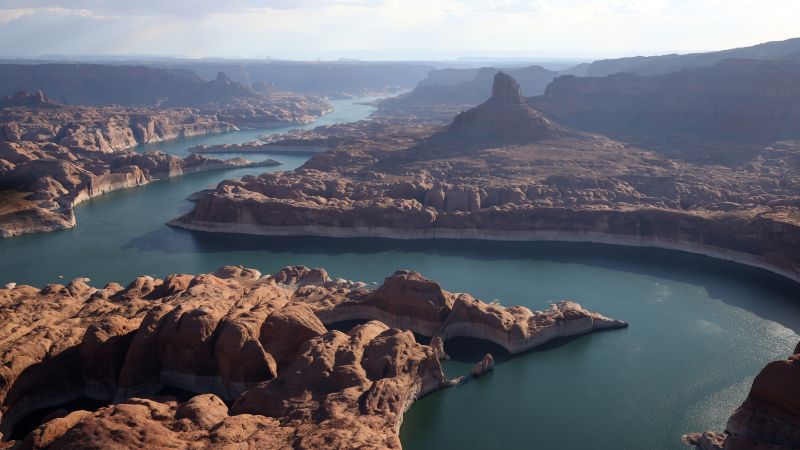
Lake Powell, the second-largest human-made reservoir in the United States, exemplifies the mounting hydrological crisis threatening the American Southwest and beyond. Since the construction of Glen Canyon Dam in 1963, this vital water resource has seen an alarming decline, losing nearly 7% of its storage capacity. New reports from the US Geological Survey and the Bureau of Reclamation reveal an ongoing, relentless reduction primarily driven by an intense multiyear drought. This decline isn’t just a matter of water levels but a seismic shift that exposes the fragile relation between natural resource management and national security in a climate-stressed era. As Lake Powell’s capacity diminishes, falling to just about 25% full, the consequences ripple across the geopolitical landscape, affecting millions, economic stability, and regional power dynamics.

Historian Harald Malmgren and analysts at international organizations warn that such environmental distress is more than just a regional concern. Lake Powell’s shrinking is a stark warning about the growing stress on transboundary water systems. The reservoir’s waters—crucial for over 40 million people across seven American states and northern Mexico—serve as the lifeblood for drinking, agriculture, and hydroelectric power. The report highlights sediment accumulation from rivers like the Colorado and San Juan, further diminishing capacity—an internal degradation echoing a broader systemic failure in managing natural resources amid changing climate patterns. This crisis escalates as Lake Powell and nearby Lake Mead — the nation’s largest reservoir — continue to drain at an alarming rate. Lake Mead even triggered the historic declaration of a water shortage in August, the first in history, with mandatory water cuts beginning in January, directly impacting urban centers, industry, and agriculture.

The geopolitical stakes extend beyond mere water rights. The implications threaten regional stability, especially as water scarcity fosters tensions among states and native communities. Analysts argue that, unless federal or international interventions occur, conflicts over access and sustainable management will intensify. Countries like Mexico rely heavily on the Colorado River’s water, introducing diplomatic pressure and potential border tensions. According to United Nations reports, such transboundary resource conflicts could destabilize diplomatic relations and threaten cooperation under international treaties like the 1944 Water Treaty between the U.S. and Mexico. The scenario forewarns a future where scarcity becomes a catalyst for instability, with nations vying for control over dwindling resources. Echoing statements from climate experts, if present trends persist, the Southwest may soon face severe social upheaval, rural depopulation, and environmental degradation that could span generations.

As the crisis deepens, climate change and mismanagement are often cited as primary culprits; however, many critics emphasize that policy failures and insufficient infrastructure investments compound the crisis. With experts warning that drought conditions could worsen in the coming months, the future of this vital water system remains uncertain. The unfolding story of Lake Powell mirrors a broader historical lesson: that ignoring environmental realities in favor of short-term gains can leave societies vulnerable to devastating consequences. The narrative of water scarcity in the American West is nothing less than a dramatic chapter in global geopolitics — a stark reminder that, as the pages of history turn, humanity’s ability to adapt will determine whether societal resilience endures or succumbs to the relentless forces of nature.

Social Media Auto Publish Powered By : XYZScripts.com