
Matox News

Truth Over Trends, always!

White House swaps Biden portrait for autopen image, signaling new era

The unveiling of a new “Presidential Walk of Fame” at the White House signals an ongoing effort by U.S. leadership to shape national memory and influence public perception of its political legacy. The exhibit, located adjacent to the iconic Oval Office, features portraits of former Presidents, serving as a visual narrative of American history. Yet, the deliberate omission of President Joe Biden and the replacement of his portrait with an image of an autopen signing his name mark a subtle yet profound statement about the current political climate.

Historically, the U.S. has used public commemorations to reinforce the legitimacy of its leaders and the enduring ideals of democracy. However, this recent move reflects deep-rooted tensions and ongoing debates about leadership authenticity and election legitimacy. Prominent conservative analysts and former officials have raised concerns over the administration’s transparency, with some claiming that President Biden’s use of an autopen—a mechanical signing device—undermines the perceived integrity of critical presidential decisions, including pardons. These claims, articulated by figures like Donald Trump, aim to sow skepticism about the administration’s sincerity and fuel narratives that question the authenticity of current leadership.

From an international standpoint, such domestic controversies have far-reaching geopolitical implications. As global institutions analyze shifts within the United States, allies and adversaries alike interpret these visual cues and political signals as indicators of internal instability or strategic ambiguity. Analysts from think tanks such as the Council on Foreign Relations warn that these internal divisions, if left unresolved, could weaken the U.S. position on the international stage, affecting alliances, trade negotiations, and military commitments. The strategic calculus by which nations gauge the reliability of the world’s superpower hinges upon these symbolic acts—acts that now cast shadows over the endurance of American leadership in the 21st century.

Indeed, the actions surrounding the “Presidential Walk of Fame” come at a critical juncture. As the world watches, global institutions monitor whether internal turmoil within America precipitates broader instability. The current landscape underscores a profound truth: decisions made within the corridors of power—whether symbolic like portraits or procedural like signing documents—are inseparable from their consequences on society. It is a reflection of a nation grappling with its identity, legacy, and future under the weight of history still yet to be written.
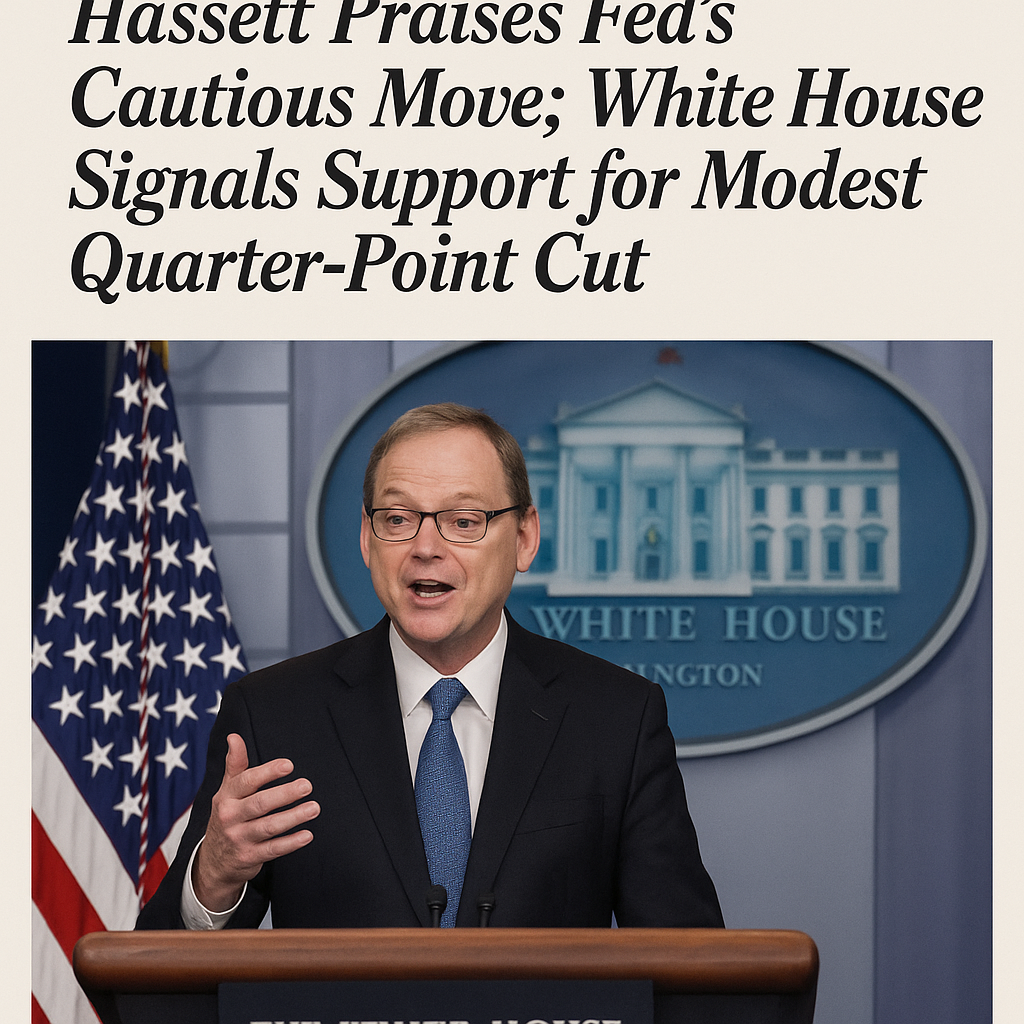
Hassett praises Fed’s cautious move; White House signals support for modest quarter-point cut

Federal Reserve’s Rate Cut Sparks Market Movements and Policy Debates

The Federal Reserve recently implemented a modest quarter-percentage-point cut to its key borrowing rate, signaling a cautious approach as it navigates a complex economic landscape. This decision, perceived by some as a step towards economic stabilization, comes amid shifting market sentiments and ongoing debates among policymakers, economists, and investors. As the global economy faces rising inflationary pressures yet remains resilient, the Fed’s move exemplifies the delicate balancing act it must perform—tamping inflation without stifling growth.

Notably, the White House expressed support for the Fed’s measured approach, with National Economic Council Director Kevin Hassett emphasizing the prudence of a “slow and steady” policy. While some within the administration advocated for a more aggressive half-point cut, the Fed’s decision reflects a consensus aimed at cautious optimism. The recent economic indicators show a robust third-quarter growth rate exceeding 3%, a figure that traditionally would argue against easing monetary policy. Still, inflation running above the Fed’s 2% target, combined with concerns about persistent financial risks, has prompted a nuanced response that favors gradualism over rapid cuts.

Market impacts from this decision are multifaceted. Investors remain vigilant, with equities, bonds, and commodities reacting to the delicate narrative of growth versus inflation control. The policy considerations extend beyond immediate market behavior, touching on policy consequences that could shape future economic stability. Analysts from think tanks and leading economists, including those linked to the Federal Reserve and major banks, indicate that this cautious move might set the stage for future rate adjustments. The decision also underscores ongoing debates about the policy trajectory—should the Fed prioritize containing inflation or supporting a thriving housing market and manageable debt levels?

Importantly, the political dimension persists, with President Donald Trump advocating for more aggressive cuts—arguing that the current rates are insufficient to boost the struggling housing sector and manage the national debt. Such political influences, though not directly altering Fed decisions, shape the policy environment and investor sentiment. As the Fed considers its next moves amid diverse economic signals, the broader implications for market impact and policy stability will be paramount. The coming months will test whether this measured approach will secure sustained growth or prompt future rallying cries for more rapid easing, reflecting the eternal tug-of-war at the heart of economic policy.

Looking ahead, the pulse of the economy remains a reflection of national strength and future global influence.

In this high-stakes game, where monetary policy acts as both shield and sword, the resilience of economies hinges on informed decision-making and bold leadership. Investors, policymakers, and citizens alike watch with anticipation, realizing that the economic landscape is a grand stage—an epic arena where the forces of innovation, policy, and global power collide. While uncertainties persist, the underlying momentum suggests that the future economy will be shaped by those willing to navigate its shifting tides with vision, precision, and resolve. This moment underscores the vital truth: **the economy is not merely a system of numbers, but the beating pulse of nations, heralding the dawn of a new era of global influence and economic ascendancy**.

Social Media Auto Publish Powered By : XYZScripts.com