In a bold move showcasing disruption in the digital workspace, Aether OS is redefining the boundaries of how users interact with cloud-based desktops. Utilizing the cutting-edge AT Protocol, Aether OS seamlessly links to Bluesky accounts and promotes a decentralized social ecosystem, indicative of a broader shift toward user-controlled data sovereignty. This development signals a significant departure from traditional, siloed computing, emphasizing user empowerment through open protocols and distributed networks.
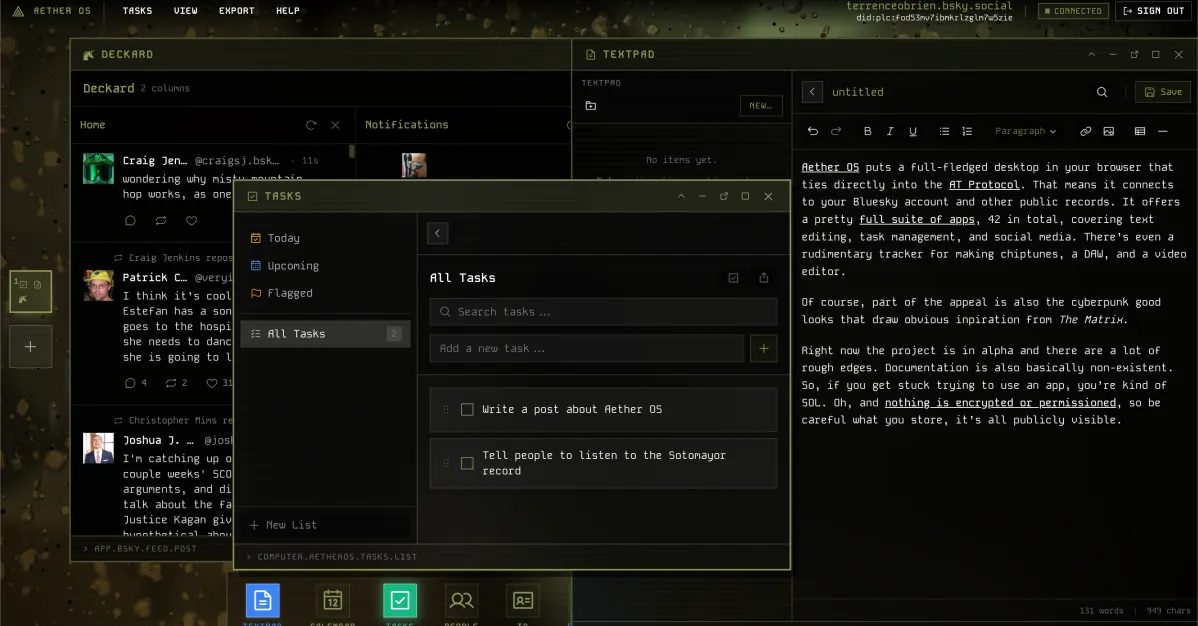
At the heart of Aether OS is its comprehensive suite of 42 applications—ranging from text editors and task managers to social media tools—crafted entirely within a browser environment. The platform’s design, inspired by cyberpunk aesthetics reminiscent of The Matrix, showcases a forward-thinking approach to digital identity and personalization. Notably, features like embedded audio trackers, digital audio workstations (DAWs), and video editors highlight the convergence of creative tools into a unified, accessible virtual desktop. According to industry analysts, such integration in a web-based platform accelerates the democratization of creative workflows, empowering youth and professionals alike to innovate without the constraints of hardware limitations.
However, as an alpha project, Aether OS currently faces considerable challenges. Its documentation is sparse, and the platform’s stability leaves much to be desired—early adopters report encountering bugs and usability issues. Importantly, security remains an open concern: since nothing is encrypted or permissioned, user privacy is vulnerable, with all data being publicly accessible. Experts caution that in its present form, Aether OS underscores the need for robust security frameworks to rival traditional desktop environments before it can truly disrupt established norms.
The implications for businesses and the broader industry are profound. As cloud computing advocates like Gartner emphasize, the future will belong to platforms that prioritize decentralization, user control, and interoperability. Innovators such as Elon Musk and Peter Thiel have long championed models that challenge conventional tech giants, and Aether OS exemplifies this ideology by fostering a disruptive ecosystem driven by open standards and community participation. The seamless integration with public records and social profiles suggests new opportunities for decentralized social networks and digital identities, which could reshape the landscape of online engagement and commerce.
Looking ahead, the trajectory points toward an era where browser-based desktops powered by open protocols become the norm for creative professionals, entrepreneurs, and digital natives. As the ecosystem matures, expect to see rapid innovation, with features like enhanced security, richer developer tools, and broad industry adoption. The sense of urgency is clear: delaying adaptation risks falling behind in a race where technological leadership and user-centric design are paramount. For those aiming to lead in tomorrow’s digital economy, understanding and engaging with developments like Aether OS will be essential—while the clock on innovation continues to tick, the window to shape the future narrows.