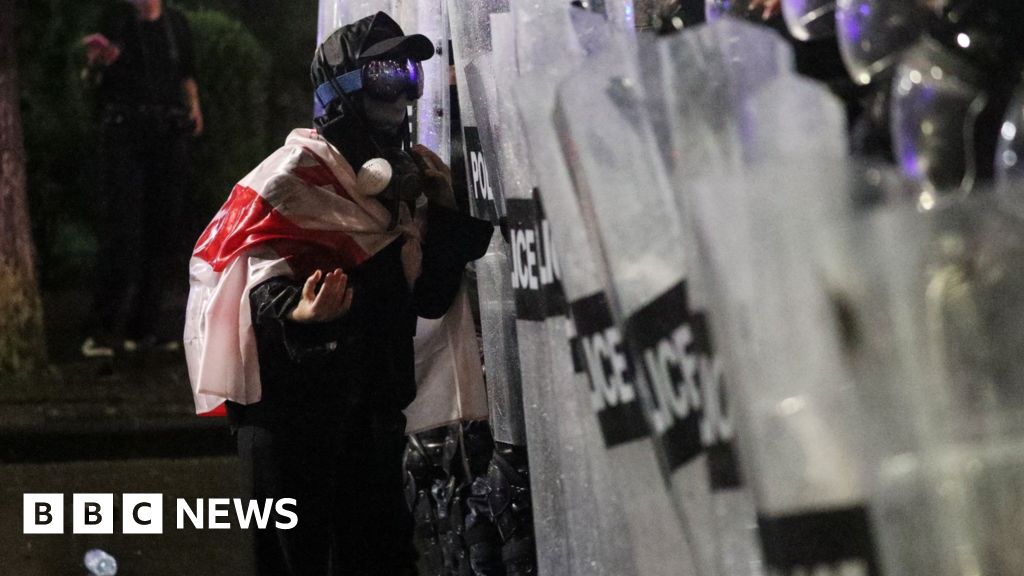
In a dramatic escalation of internal unrest, Georgia has once again become a flashpoint in the volatile landscape of Eurasian geopolitics. Anti-government protesters in the capital city, Tbilisi, attempted to storm the presidential palace amid mounting tensions between the nation’s pro-Western opposition and the ruling Georgian Dream party. Law enforcement responded with force, deploying tear gas and water cannons in an effort to disperse demonstrators who have, for months, been demanding profound political change. The scene of chaos underscores a nation at a crossroads, where the future of its sovereignty aligns dangerously with the intense tug-of-war between Western aspirations and Russian influence.
The protests, initiated by opposition factions calling for a “peaceful revolution”, are rooted in longstanding grievances. Critics accuse Georgian Dream of embracing pro-Russian policies and exhibiting authoritarian tendencies, exacerbating public discontent. These demonstrations gained momentum following the party’s controversial decision to freeze Georgia’s European Union accession talks, abruptly halting a pivotal goal that symbolized the country’s pursuit of Western integration. Since winning the 2021 elections amid allegations of fraud, the ruling government has faced persistent opposition, which claims that the government’s actions threaten Georgia’s democratic future and its aspirations to join Western institutions. According to analysts like Dr. Helen Mason, the unrest signifies more than local discontent; it reflects broader geopolitical vulnerabilities that could reshape regional alignments.
The European Union and United States watch these developments with a wary eye, aware that their influence in Georgia, a strategic buffer in the Caucasus, may be challenged or compromised. Georgia’s oscillation between Western ambitions and Russian influence positions it as a volatile arena where international interests intersect disruptively. The decision by Georgian Dream to halt EU accession talks not only signals internal political divergence but also demonstrates Russia’s ongoing efforts to maintain dominance over the South Caucasus, seeking to prevent Western integration in a region it considers within its traditional sphere of influence. As historian Marko Petrovic notes, such internal conflicts are often magnified by external powers seeking to shape the regional order in their favor.
- The unrest in Georgia exemplifies the fragility of post-Soviet states whose political alignments remain battlegrounds for broader international influence.
- The decision to freeze European integration efforts underscores the delicate balance between national sovereignty and external pressures from Russia and Western nations.
- International institutions are alarmed at the potential for escalation, seeing Georgia as a pivotal piece in the chess game for influence in Eurasia.
The fate of Georgia holds profound implications beyond its borders. As the nation teeters on the brink of further turmoil, the international community must grapple with what could be a major turning point in the ongoing struggle for regional dominance. History reveals that such moments—marked by internal protests and external pressures—often set the stage for larger conflicts or shifts in alliances. As the world watches Georgia’s streets, the question remains: will this small but strategically vital nation forge a new path toward sovereignty and Western integration, or will it succumb to the gravitational pull of nearby powers eager to reshape the regional map? The answer lies in a tumultuous future where history yet writes itself, and the echoes of today’s struggles will resonate for generations to come.