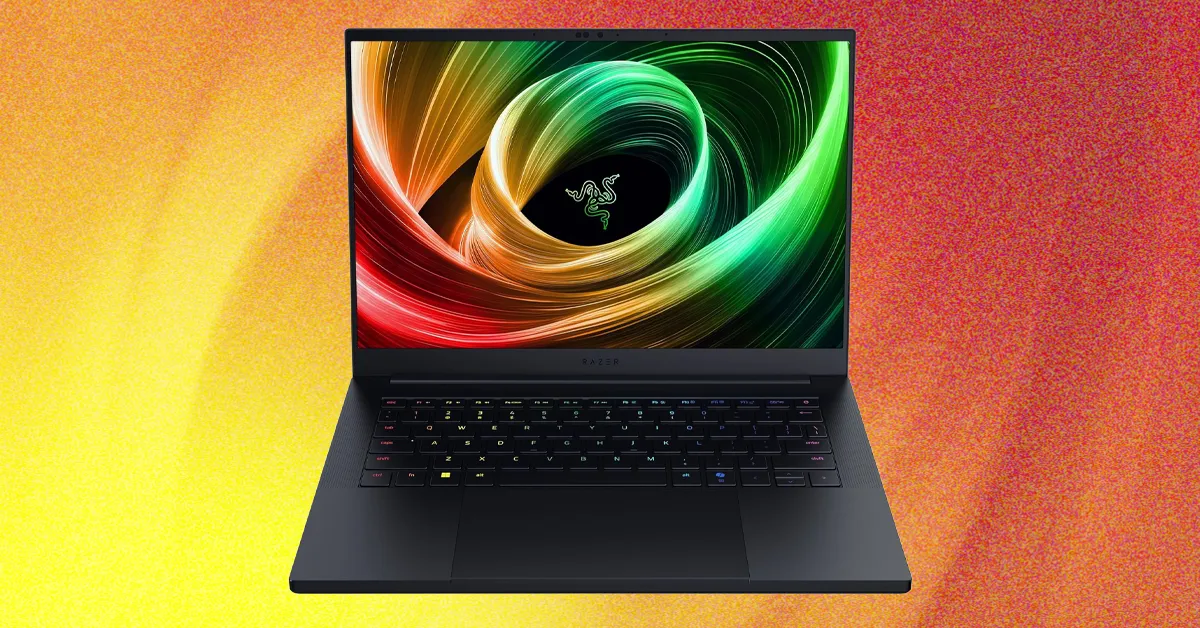
Razer Sets the Stage for Gaming Laptop Disruption with Next-Gen Hardware
In a move that underscores the relentless push for innovation in gaming hardware, Razer has unveiled its latest gaming laptop configuration, harnessing the raw power of the AMD Ryzen AI 9 365 processor paired with the cutting-edge Nvidia RTX 50-series graphics cards. Starting with a foundational 1 TB of storage, users can choose between the RTX 5060 and 5070, two GPUs emblematic of Nvidia’s ongoing disruption in graphics processing technology. The new models reflect a strategic focus on performance optimization and user configurability, with Razer enforcing storage and memory upgrades based on their GPU selection—marking a shift that emphasizes tailored computing experiences in the gaming industry.
Performance Benchmarks Illuminate Industry Shifts
Initial reviews suggest that the Razer Blade 14 offers performance aligned with current expectations for high-end gaming laptops. Testing at a native resolution 2560 x 1600 strikes a balance between visual sharpness and smooth gameplay, though many gamers will prefer 1920 x 1200 for superior frame rates. Notably, the RTX 5070 performs approximately 14% faster than the previous RTX 5060 in comparable models, such as Lenovo’s Legion 7i Gen 10, signaling a step forward in GPU efficiency and power density.
Critically, the performance benchmarks were conducted without leveraging Nvidia’s advanced upscaling—such as frame generation or ray tracing—which means these numbers underrepresent the full potential of the hardware. By employing Nvidia’s DLSS technology, gamers can sustain higher frame rates without compromising visual quality, underscoring the industry’s shift toward AI-driven rendering advancements that challenge existing paradigms.
Business Implications and Industry Disruption
This latest release highlights how companies like Razer continue to disrupt traditional gaming laptop markets by integrating performance-centric innovations with modular, configurable platforms. The industry is witnessing a shift towards more user-customizable hardware, driven by consumer demand for mobility, power, and flexibility—all while maintaining competitive edge against competitors like ASUS, MSI, and Alienware.
Strategic differentiation lies in the advanced GPU offerings and their integration with AI-based features. As noted by industry analysts from Gartner and MIT, AI acceleration in graphics and workload processing will soon become standard, forcing incumbents to innovate swiftly. For instance, the RTX 5070 and upcoming RTX 5070 Ti models with increased VRAM will further challenge existing high-performance segments, especially as the demand for portable yet powerful machines grows exponentially.
Future Outlook: Innovation as a Business Mandate
The gaming hardware industry is on the precipice of significant transformation. Traditional perceived limitations—such as power consumption and thermal management—are being addressed through disruptive innovations in cooling systems, AI-optimized rendering, and component miniaturization. With giants like Elon Musk and investors like Peter Thiel emphasizing disruption and breakthrough tech, the race to dominate the next wave of AI-infused, ultra-portable gaming platforms intensifies.
In this environment, businesses that prioritize innovation, agility, and user-centric customization will lead the future of gaming hardware. As Razer’s latest models demonstrate, this is not merely about incremental upgrades but about redefining performance benchmarks and industry standards. The next few years promise to be a battlefield where disruption is the new norm, and those who fail to adapt risk being left behind in a rapidly evolving technological landscape.