Matox News

Truth Over Trends, always!

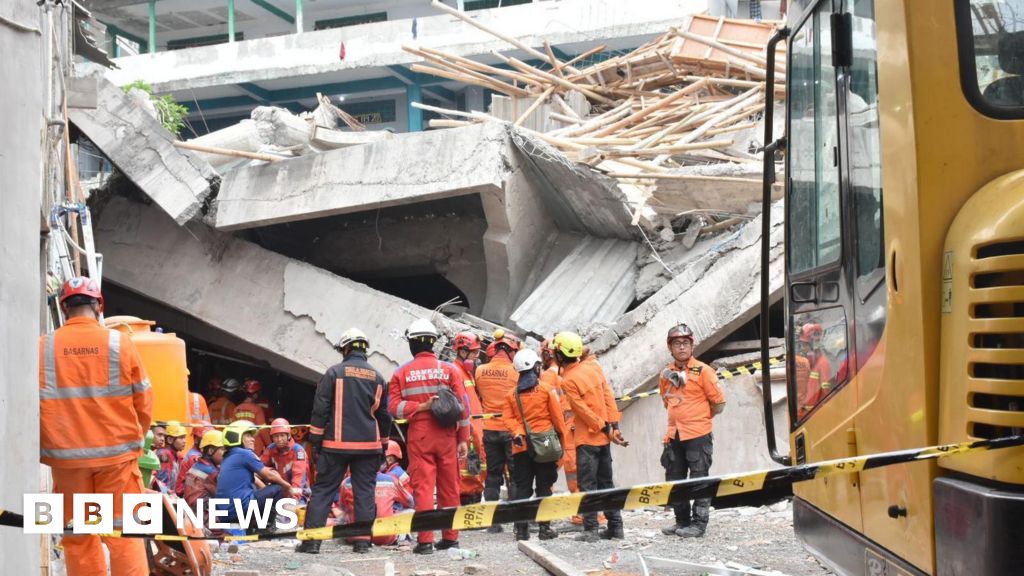
Scores feared dead as school building collapses, authorities warn

The recent tragedy in Indonesia, where a collapsed Islamic boarding school has left at least five students dead and over 100 injured, underscores a critical moment in the nation’s ongoing safety and governance struggles. The incident, centered in the town of Sidoarjo, reveals the dangerous consequences of unchecked construction practices and regulatory failures. The building’s collapse, caused by the addition of two unsafe floors to an under-constructed foundation, highlights the larger issues Indonesia faces in terms of infrastructure development and regulatory oversight, issues that resonate across many developing nations in Southeast Asia.

Despite the international outcry and efforts of rescue teams using thermal drones and heavy machinery, the possibility of finding survivors has diminished. The disaster management agency (BNBP) announced that *no signs of life* were detected in the debris, a heartbreaking entry point into the larger conversation about safety standards and government accountability. Experts and analysts warn that such tragedies reflect deeper systemic flaws—poor enforcement of building codes, corruption, and the prioritization of economic gains over safety—threatening societal stability and the legacy of governance in the region. The incident also serves as a stark reminder of the. *fragility of human life* amidst rapid urban proliferation and construction without appropriate oversight.

On a broader geopolitical level, the incident in Indonesia acts as a clarion call to regional institutions and international partners. While those involved are primarily concerned with immediate rescue operations, critical analysis from organizations like the World Bank and international human rights groups emphasize that long-term safety reforms are necessary for social progress. Such disasters threaten to undermine the legitimacy of local authorities and fuel public distrust in state institutions, which are often seen as ineffective or corrupt. These events have repercussions beyond national borders; they feed into regional narratives about governance, sovereignty, and the need for vigilant oversight as urban populations swell. How nations respond—by tightening regulations, improving safety standards, and ensuring transparency—will determine their standing on the global stage.

Historian and policy analysts stress that this incident is no isolated event but part of a broader pattern affecting many countries committed to rapid development amid legacy issues of governance and accountability. The tragic collapse in Indonesia symbolizes a moment where history is still being written—where the choices to reform or ignore safety standards could have lasting consequences. As rescue teams turn their tools towards removing debris, the world watches and waits, acutely aware that the true test lies ahead: whether this tragedy will catalyze meaningful change or become yet another chapter of neglect in the overarching narrative of progress and safety. In this unfolding history, every decision, every policy, and every effort to secure the safety of the vulnerable will leave an indelible mark on the fabric of society.


Florida man accused of killing and eating his own pet peacocks, authorities say

Recent events from Florida underscore a disturbing trend that transcends regional boundaries—acts of cruelty and violence that reflect broader societal tensions and value shifts. The case of Craig Vogt, a 61-year-old man charged with killing and consuming his pet peacocks out of spite, highlights how personal conflicts can escalate into extraordinary acts of cruelty. Such incidents may seem isolated, yet they serve as a stark mirror to underlying issues that resonate across nations and cultures: the erosion of civility, the rising influence of individual alienation, and the unpredictable consequences of unchecked emotion. Internationally, analysts warn that these outbursts point, {\em perhaps} alarmingly, to the fragility of social cohesion amid rapidly changing societal norms.

This case also raises questions about the underlying legal and cultural frameworks that address animal cruelty, a matter of global concern validated by institutions such as the World Organisation for Animal Health (OIE) and several national agencies. While the United States continues to grapple with inconsistent legislation across states, the incident exemplifies how personal grievances can manifest in extreme acts of violence, with potential ripple effects on community safety and social trust. Historians often cite that acts of individual violence are frequently shaped by a complex web of societal factors: economic struggles, mental health issues, or cultural attitudes. As the US justice system considers this case, international organizations observe that such stories should serve as cautionary tales, prompting a reevaluation of community support mechanisms and animal welfare laws that might prevent further tragedies.

On a broader geopolitical spectrum, the repercussions of seemingly isolated incidents contribute to the ongoing narrative of societal stability. When individual acts of cruelty go unchecked, they threaten to undermine the moral fabric of community life—an issue that populates the agendas of both emerging nations and established powers. The European Union, for instance, maintains strict animal protection policies, recognizing that the health of societal morals directly correlates with international standing and internal safety. Conversely, nations with lax enforcement risk fostering environments where such bizarre acts could become normalized, fueling unrest or destabilization amid already complex geopolitical tensions. International security think tanks warn that these micro-level anomalies, if ignored, could serve as indicators of deeper systemic unrest, especially amid the increasing social upheaval driven by economic downturns or political polarization.

Ultimately, the story of Vogt and his peacocks might seem an isolated anomaly, but beneath it lies a resonant warning: the choices made by individuals reflect, and threaten to reshape, the societal landscape. As history unfolds, nations must grapple with the subtle but potent influence of personal morality and justice, knowing that even the smallest actions can echo through the corridors of power and history. The collective hope remains that society can learn from such disturbing episodes—transforming tragedy into a catalyst for stronger, more compassionate communities—before the weight of unchecked cruelty inexorably changes the course of history itself.

Danish Authorities Boost Security After ‘Actor’ Shuts Down Aalborg Airport—Europe News

Europe at a Crossroads: Denmark’s Drone Crisis Sparks Geopolitical Uncertainty

In recent weeks, Denmark has become the epicenter of a series of unsettling drone incursions in its airspace, exposing vulnerabilities that threaten not only national security but also the broader stability across Europe. Authorities now firmly believe that these attacks are orchestrated by a professional, hybrid entity rather than rogue private operators, marking a significant escalation in the use of drone technology as a tool of strategic disruption. Such systematic attacks, occurring at multiple locations including Aalborg airport, have prompted Danish officials to consider activating Nato’s Article 4 proceedings—an act of consultation that signals heightened concern about external aggression and regional destabilization.

Defense Minister Troels Lund Poulsen has emphasized the sophisticated nature of these operations, likening them to a hybrid attack using different types of drones. This assessment underscores a broader pattern of hybrid warfare—a strategy employed by state and non-state actors designed to create chaos and sow division, often without direct military confrontation. The incident comes amidst a crescendo of geopolitical tension that involves not just Denmark but the entire continent. Analysts from the European Union and global security think tanks warn that these incidents may portend a new era of covert conflicts, where technology-driven asymmetric warfare becomes the norm.

The strategic significance of Denmark’s response cannot be understated. The government’s consideration of requesting Nato Article 4 consultations indicates a potential shift toward collective security measures in the face of evolving threats. Although the country has yet to officially invoke the article, the ongoing engagement with Nato and the European Union reveals a deliberate effort to bolster defenses and establish a unified front. Historically, security experts like Dr. Emily Carter and notable organizations such as EUROPOL suggest that this escalation could serve as a precursor to intensified security cooperation across the Atlantic Alliance, redefining the geopolitical landscape even further.

While Denmark’s leadership states there is no evidence linking the drone incidents to Russia, fears persist over the broader implications of escalating tensions in Eastern Europe. The possibility that these attacks aim to undermine Denmark’s support for Ukraine aligns with patterns observed in recent European confrontations, where technological infiltration has played a tactical role. As the country gears up for a major diplomatic event—the upcoming EU summit—the emphasis on expanding defense capabilities and legal frameworks suggests a definitive move toward hardening national infrastructure against future hybrid assaults. This crisis, often dismissed as a mere technological nuisance, risks evolving into a catalyst for broader geopolitical realignments.

The unfolding story of Denmark’s drone crisis encapsulates a pivotal moment in international affairs—an era where the battleground extends beyond conventional borders into the skies, and where the decisions made today will resonate in the corridors of power for generations to come. The weight of history presses upon Europe’s fragile balance, as the specter of covert warfare clandestinely shifts the trajectory of global peace and security.

Social Media Auto Publish Powered By : XYZScripts.com



