Matox News

Truth Over Trends, always!

Breaking: Worry over H5 bird flu hitting elephant seals on remote Australian island

In a week marked by unprecedented scientific observations and intense geopolitical debates, the international community finds itself at a critical inflection point. Australian scientists have recently detected signs consistent with H5 avian influenza—commonly known as bird flu—in elephant seals on Heard Island, located more than 4,000 kilometers southwest of Perth. While officials from the Department of Agriculture, Fisheries and Forestry clarify that a definitive detection has yet to be confirmed, this finding underscores the persistent threat of zoonotic diseases crossing species and boundaries, especially in isolated regions. Of particular concern is the fact that Australia remains the only continent without the highly contagious H5 strain, a fact that both scientists and strategists highlight as a potential weakness in regional biosecurity.

Experts warn that such wildlife cases, while seemingly isolated, heighten the urgency for international cooperation in surveillance and preparedness. The detection on Heard Island, a sub-Antarctic enclave, signals that viruses may be quietly circulating in the most remote corners of the planet—yet the potential for spread to mainland populations still triggers alarm. The World Health Organization and regional bodies are closely monitoring developments, emphasizing that the potential spillover of H5 into human populations could alter the global landscape dramatically. Historian and analyst Dr. Samuel Rothenberg notes that “the interconnectedness of ecosystems and nations today amplifies the impact of such biological threats,” warning that in an age of rapid travel and climate change, what begins in isolated wildlife could soon become a global crisis.

Simultaneously, while health officials grapple with preventing a pandemic, political leaders face escalating challenges on the domestic front—particularly concerning law and order, where recent cases have shaken public confidence. In New South Wales, authorities are resuming their investigation into the decades-old cold case of Colleen Walker-Craig, a 16-year-old Indigenous girl last seen in 1990. The renewed effort to locate her remains, involving water searches along the Nambucca River, is emblematic of a broader societal struggle to address unresolved atrocities and ensure justice. As detectives reopen old wounds, the political implications resonate across the Pacific, fueling calls for reform and transparency. Analysts suggest that this is a testament not only to the persistence of local issues but also to the broader importance of justice in shaping national identity and sovereignty.

Adding to the complexity, the Australian government is considering large-scale reforms—lifting caps on major events at the historic Royal Randwick Racecourse and easing restrictions on concerts in Sydney—aimed at revitalizing the economy and boosting city vibrancy. However, critics from the opposition argue that such measures could be overshadowed by internal crises, including a surge of unfair dismissal claims that threaten to overwhelm the nation’s tribunal system. Opponents contend that these legal backlogs, which have increased by 27% over the past five years, symbolize deeper systemic issues—exposing an economy struggling under burdens of red tape and regulatory duplication. Opponent and Shadow Minister Andrew Bragg warns that these legislative changes, while well-intentioned, threaten to make it even more difficult for local businesses to thrive, thus impacting Australia’s geopolitical standing as a competitive hub in the Indo-Pacific region.

As the tide of crises and opportunities continue to unfold, from virus detection to justice and economic reform, history remains an unforgiving judge. The decisions taken in these critical moments will echo through generations, shaping the destiny of nations in an era defined by transnational challenges and resilience. The world watches with bated breath, knowing that history’s next chapter is still being written—its ink penned by policymakers, scientists, and societies daring to face the turbulent future with resolve or despair.


India’s First Female Train Driver: Breaking Barriers and Leading the Way Forward

India’s Trailblazer: Surekha Yadav and the Broader Impact on Gender Equality in Critical Sectors

In a groundbreaking testament to persistence and progressive change, Surekha Yadav recently bid farewell after 36 years of service as India’s first female train driver. Her remarkable career, which began in 1989, symbolizes more than personal achievement—it underscores a shifting tide in gender roles within India’s traditionally male-dominated infrastructure sectors. Yadav’s journey from rural Maharashtra to operating the nation’s railways highlights the critical *geopolitical impact* of fostering equal opportunities in industries vital to economic development.

When Yadav first took to the locomotive, her decision defied societal norms. She entered into a profession then unthinkable for women, particularly in India, where government jobs are among the most coveted for the security and perks they offer. Her success challenged entrenched stereotypes, paving the way for a new generation of women amid a system historically reserved for men. Increasingly, international organizations, including the United Nations and global labor advocates, emphasize the importance of integrating women into strategic sectors such as transportation and engineering — a move that directly influences social stability and economic resilience in developing nations.

Unpacking the international significance of Yadav’s career

  • Her story has become a symbol of *progressive social change*, inspiring industries worldwide to break gender barriers and adopt inclusive recruitment policies.
  • As one of over 2,000 women now operating Indian Railways, her influence extends beyond individual achievement to national strategies aimed at empowering women in critical roles.
  • Historians and analysts, including Dr. Rajeev Malhotra, argue that Yadav embodies the *turning point* in India’s social fabric, where economic necessity meets evolving perceptions of gender roles.

Furthermore, the *geopolitical impact* resonates globally, as nations observe India’s efforts to modernize and diversify its workforce. India, with its sprawling rail network and strategic position as a rising economic power, aims to project an image of progressiveness and gender equality. This not only enhances India’s soft power but also sets a precedent for other developing nations attempting to balance modernization with traditional values. International organizations increasingly recognize the importance of such domestic shifts, as they bolster the global fight against gender discrimination, which remains embedded in many sectors worldwide.

How decisions at the policy level influence societies and nations

The Indian government’s recognition of jobs like train-driving as *winnable battles for social inclusion* illustrates a broader international trend towards sustainable development and gender parity. Ms. Yadav’s mentorship of aspiring women operators exemplifies how individual careers catalyze societal change, challenging societal norms and expanding the horizons of what is considered possible for women. These stories foster an environment where gender becomes less of a barrier to participation in vital sectors—enhancing economic productivity and social cohesion.

Experts from the World Economic Forum emphasize that such shifts in employment patterns not only empower women but also serve as a *game-changer* in addressing unemployment and economic inequality. By breaking ceilings in transportation and engineering, nations reinforce their commitment to cultivating resilient societies capable of adapting to global challenges, including climate change, urbanization, and technological disruption. As India continues to interlace its development goals with gender inclusivity, the international community watches closely, poised to learn and emulate this model of transformation.

The Ongoing Archive of Meaning

As Ms. Yadav’s locomotive finally pulls into the station after decades of service, she leaves behind more than just a legacy of skill and determination. Her retirement marks a *significant point in history*, yet the odyssey of gender equality in India’s infrastructure remains incomplete. The weight of her story underscores that decisions—local, national, and international—shape the societal landscape and write the next chapter of history. With each train that departs and arrives, there is a silent acknowledgment that every mile driven is a mile towards a more inclusive and resilient future—an indelible mark in the ongoing march of progress.

Breaking Barriers: I Launched the World's First Deaf Rave, Empowering Our Community
Breaking Barriers: I Launched the World’s First Deaf Rave, Empowering Our Community

Social Innovation in Youth Culture: The Deaf Rave Movement Sparks Change

Across communities in the UK, a quiet revolution is unfolding—one that challenges longstanding social divides and redefines what it means to unite through music and culture. At the forefront is a vibrant movement led by deaf communities who are reclaiming spaces for themselves, especially through the groundbreaking initiative known as Deaf Rave. This innovative approach exemplifies a broader societal shift towards inclusive entertainment and demonstrates how addressing social issues can profoundly impact families, education, and community cohesion.

Historically, social exclusion has marginalized deaf individuals, often confining them to the peripheries of vibrant youth movements such as dance clubs and festivals. Sociologists like Dr. Mark P. Block have noted that such marginalization fosters a sense of alienation, intensifying societal divides. Yet, deaf pioneers like the individual whose story this article follows are creating change from within—organizing events that integrate visual and tactile elements with traditional music forms. Their efforts are not just about recreation but are a form of cultural assertion and a vital step toward societal equity. By adapting venues with vibrating floors and tactile vibrations, they transform music from a purely auditory experience into a multisensory celebration accessible to all.

This movement highlights how educational and familial landscapes are being reshaped. Programs like DJ workshops for deaf children signal a significant cultural shift, emphasizing that developmental opportunities and creative expression should not be predicated on hearing ability alone. Such initiatives foster family bonds through shared participation and break down misconceptions about deafness as a barrier rather than a different way of experiencing the world. As Dr. Ruth L. Okediji argues, nurturing diverse cultural expressions in youth is essential for cultivating a society where every child feels valued and heard, regardless of their sensory abilities.

However, the road to true inclusivity faces challenges. Organizers often encounter resistance from venue owners unfamiliar with the needs of deaf attendees, fearing issues surrounding noise levels or safety. These hurdles reflect a broader societal reluctance to adapt traditional spaces, which often default to auditory-centric paradigms that exclude deaf individuals. Yet, stories of success demonstrate that change is possible. The Deaf Rave movement has garnered support from public figures, earning honors such as an honorary Master of the Arts and an MBE, achievements that symbolize growing recognition of deaf culture’s vibrancy and significance. With initiatives like schools’ DJ workshops and festivals, the movement exemplifies how social issues can be addressed creatively to nurture communication, community, and belonging.

As society stands at this crossroads, the story of Deaf Rave invites us to consider our collective responsibility. Society’s ongoing challenge is to foster environments where diversity is celebrated and social inclusion becomes the norm—not the exception. Serious reflection on our cultural infrastructure, educational methods, and community practices reveals the possibility of transformation. It is in these moments of resilience and innovation that society’s true potential reveals itself—a testament to human ingenuity and our capacity for collective empathy. In the silent yet vibrant beats of these deaf raves, society finds a hope— a promise that through understanding and adaptation, we can create a future where everyone’s voice, regardless of how it is heard, is truly heard.

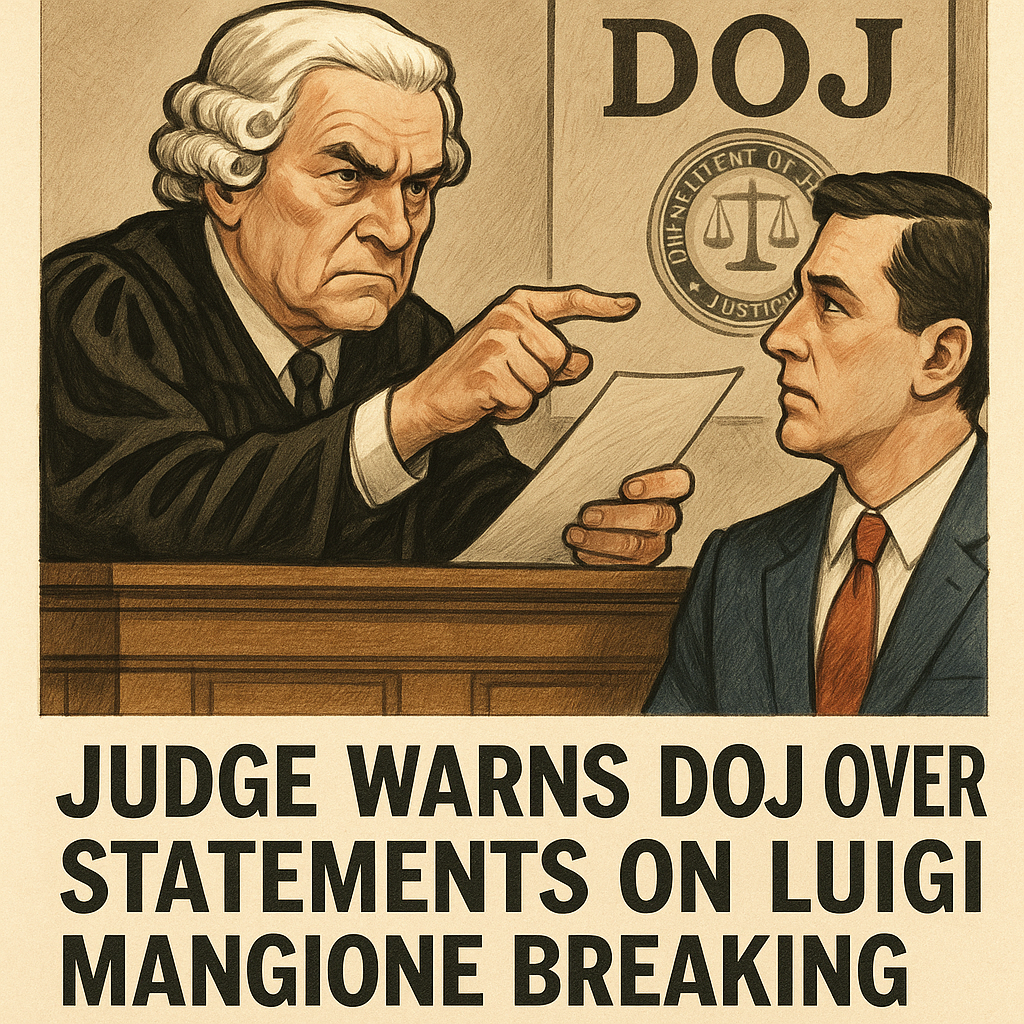
Judge warns DOJ over statements on Luigi Mangione breaking court rules

The unfolding controversy surrounding the Department of Justice’s (DOJ) handling of Luigi Mangione has cast a stark light on the intricate power struggles shaping American governance today. As the federal court, under the guidance of U.S. District Judge Margaret Garnett, suggests that DOJ officials may have violated established court protocols, it becomes evident that the boundaries between executive authority and judicial independence are under acute stress. Judge Garnett’s explicit caution — warning prosecutors about potential sanctions for continued public misconduct — underscores a broader conflict: the tension between prosecutorial discretion and the judiciary’s role as a neutral arbiter. This situation exemplifies the enduring debate about whether institutions thrive under clear boundaries or unravel when those borders are disregarded by powerful actors seeking to influence outcomes.

At the heart of this dispute lies a fundamental question of who holds the ultimate authority in the rule of law. The Biden-era DOJ, often seen as an extension of the executive branch’s expansive ambitions, appears to be embroiled in a struggle for control over narrative and influence, particularly when it involves politically sensitive figures. Historical parallels emerge when considering the Watergate era, where executive overreach provoked an unparalleled constitutional confrontation. Today, prosecutors’ attempts to publicly discuss sensitive legal matters—potentially a breach of protocol—highlight how decision-making processes are shifting, challenging the traditional separation of powers. Such confrontations are less about the individual case and more about who ultimately decides what justice looks like in a system still haunted by the echoes of political intervention.

The power struggle extends beyond mere procedural disputes, touching on the core of what it means for the people to be governed. Justice experts warn that consistent *public undermining of court authority* sets dangerous precedents, eroding the foundational tenets of constitutional law, which emphasize the independence of judiciary institutions. These actions reveal a strategic push by some within the DOJ to influence public perception and sway judicial proceedings—an effort to shape policy landscapes through raw political pressure. When legal processes become battlegrounds for partisan advantage, the consequences ripple outwards, threatening to diminish public trust and destabilize the delicate balance designed by America’s founders. Such struggles form the battleground where power is contested and the destiny of civic order is written.

Ultimately, this ongoing saga underscores a critical truth about politics: it is less a realm of fixed ideals and more a theater where the forces of authority clash, often with decisive, society-wide repercussions. As constitutional giants like **Alexander Hamilton** once argued, the strength of America’s republic resides in the careful orchestration of **separated powers**, yet those boundaries are consistently tested under the weight of ambition and influence. The legal skirmish over Mangione is symbolic of a larger epoch — one where internal conflict and strategic decision-making threaten to reshape the very fabric of American governance. For the watchers of history and future architects of policy, it is evident that in the theater of politics, the stage is where destinies are written, often with the ink of contention and the pen of power.

Social Media Auto Publish Powered By : XYZScripts.com