Matox News

Truth Over Trends, always!

Supreme Court Signals Power Boost for Trump to Fire Feds

The United States, a nation long proud of its constitutional checks and balances, finds itself at a pivotal moment as the Supreme Court faces a significant case that could reshape the landscape of federal agency independence. The case, Trump v Slaughter, hinges on whether President Donald Trump legally had the authority to dismiss Rebecca Slaughter, an FTC commissioner appointed to enforce laws protecting consumers and fair competition. This legal confrontation exposes raw tensions over the extent of presidential control and the durability of longstanding bureaucratic protections, a debate rooted in the legal history that spans almost a century.

At the heart of the dispute is a foundational question concerning the nature of presidential power versus independent agency autonomy. During the oral arguments, the conservative justices appeared to align with Trump’s position that the President should have broad authority to oversee and, if believed necessary, remove commissioners—an idea strongly opposed by liberals and legal scholars emphasizing the importance of independent agencies. Historically, agencies such as the FTC, established in 1914, were designed to operate free from presidential interference to ensure impartial enforcement. Congress explicitly limited presidential removals for commissioners to “inefficiency, neglect of duty, or malfeasance,” illustrating a clear legislative intent to shield these entities from political pressure.

However, the Trump administration’s legal team challenged this framework, labeling the historical “Humphrey’s Rule” as an “indefensible outlier” that hampers the executive’s capacity to enforce the law effectively. Such arguments resonate with many who believe that a strong presidency must be able to swiftly remove officials obstructing policy objectives, especially in a turbulent political climate. Researchers and political analysts warn that overturning this precedent could fundamentally weaken the American system of calibrated agency independence, possibly leading to increased politicization of bureaucracies. The prospect of the court dismantling a 90-year-old precedent raises alarms about the future of American governance, with critics arguing that it may open a Pandora’s box of executive overreach.

The decision from the court will have profound geopolitical impact. As the world watches, the ruling could influence how other democracies structure their administrative independence, especially as concerns about authoritarian tendencies grow. The International Monetary Fund (IMF) and World Bank acknowledge that stable and independent institutions are vital for global economic stability; a shift in U.S. doctrine could send ripples across global financial markets and international diplomacy. Historians like Dr. William Novak warn that the sovereignty of government agencies forms a cornerstone of modern liberal democracies; undermining this independence risks a dangerous erosion of the rule of law and democratic accountability.

As the court’s decision looms, history continues to unfold. Whether the conservative majority will uphold the principle that agencies like the FTC can operate shielded from political interference or endorse a stronger presidential hand remains to be seen. Yet, the very fabric of how America’s government functions — its balance of power, accountability, and independence — hangs in the balance. One thing is certain: the longer this conflict persists, the clearer it becomes that the forces shaping the future of American governance are deep-rooted and fiercely contested. In this moment, history’s pen is poised, and the weight of the next decision could redefine the contours of American power and liberty for generations to come, a testament to the ongoing struggle over who truly holds the reins of the world’s most influential democracy.

Feds smash $15B Bitcoin haul from alleged scam empire—justice in action!

Global Crackdown on Cryptocurrency-Linked Scam Centers Signals Tech Disruption and Business Shifts

The recent seizure of 127,271 bitcoins, valued at over $15 billion, marks the largest cryptocurrency confiscation in U.S. history, signaling a seismic shift in how law enforcement is leveraging blockchain forensics to combat organized cybercriminal syndicates. Led by agencies determined to dismantle *factory-scale* operations, this historic action exposes the rigor and sophistication behind *illicit financial networks* that utilize the speed, transparency, and pseudo-anonymity of cryptocurrencies to sustain large-scale scams. As cryptocurrency ecosystems become intertwined with criminal enterprises, the impact on digital asset exchanges and related business sectors urges industry stakeholders to rethink compliance, security paradigms, and the role of technology in safeguarding legitimate markets.

Innovation in Enforcement and Industry Disruption

The seizure, which includes a trove of digital assets linked to *scam compounds* operating across Southeast Asia, Europe, and Latin America, underscores the depth of innovation in both malicious schemes and the efforts to counter them. According to Ari Redbord, global head of policy at TRM Labs, the broad scope of the operation “strikes at the operational and financial core” of this *criminal infrastructure,* revealing how *sophisticated laundering techniques*, often involving *layered jurisdictions* and *cryptography*, sustain these illegal enterprises. The criminal operations, as detailed in recent indictments, also maintain *bribery records* and leverage *mobile-controlled social media accounts*, illustrating how technology-driven these scams have become.

The implications for the crypto business landscape are profound. As researchers observe the *growth of scam compounds* outside Southeast Asia—spreading into the Middle East, Eastern Europe, and Latin America—the industry must accelerate *innovative security solutions*. Venture-backed startups, such as blockchain analytics firms, and giants like Elon Musk’s Tesla and Peter Thiel’s Palantir, are already pushing boundaries with AI-driven fraud detection. Yet, the scale of these operations suggests that *regulatory frameworks* and *technological innovation* must outpace criminals if legitimate markets are to prosper amid *disruption*.

Business Implications and the Future Trajectory

With well over $15 billion seized, this case exemplifies the critical intersection of financial technology and law enforcement’s new frontier—using data analytics, machine learning, and cross-border cooperation to identify and dismantle *illicit financial flows*. As industry experts from Gartner and MIT emphasize, the evolution of *crypto compliance* tools can serve both as *deterrents and enablers*, fostering a more resilient and transparent digital economy. Conversely, unchecked illicit activity poses a risk of *massive financial destabilization* and erodes public trust in cryptocurrency markets.

The broader business community must recognize that *disruption is inevitable*; however, it also presents enormous opportunities for *disruptive innovation*. Companies invested in *blockchain security*, *AML frameworks*, and *regulatory technology* are poised to lead the next wave of *trust-based blockchain environments*. As international authorities allocate greater resources—highlighted by the U.S. Justice Department’s resolve—the imperative to innovate and adapt becomes urgent. Moving forward, *proactive engagement* with emerging technologies and *collaborative enforcement* will determine whether the crypto economy can evolve into a secure asset class or become a battleground for criminal disruption. The clock is ticking for industry leaders to stay ahead in this high-stakes game, where technological evolution and law enforcement will define the future of digital assets and global finance.”

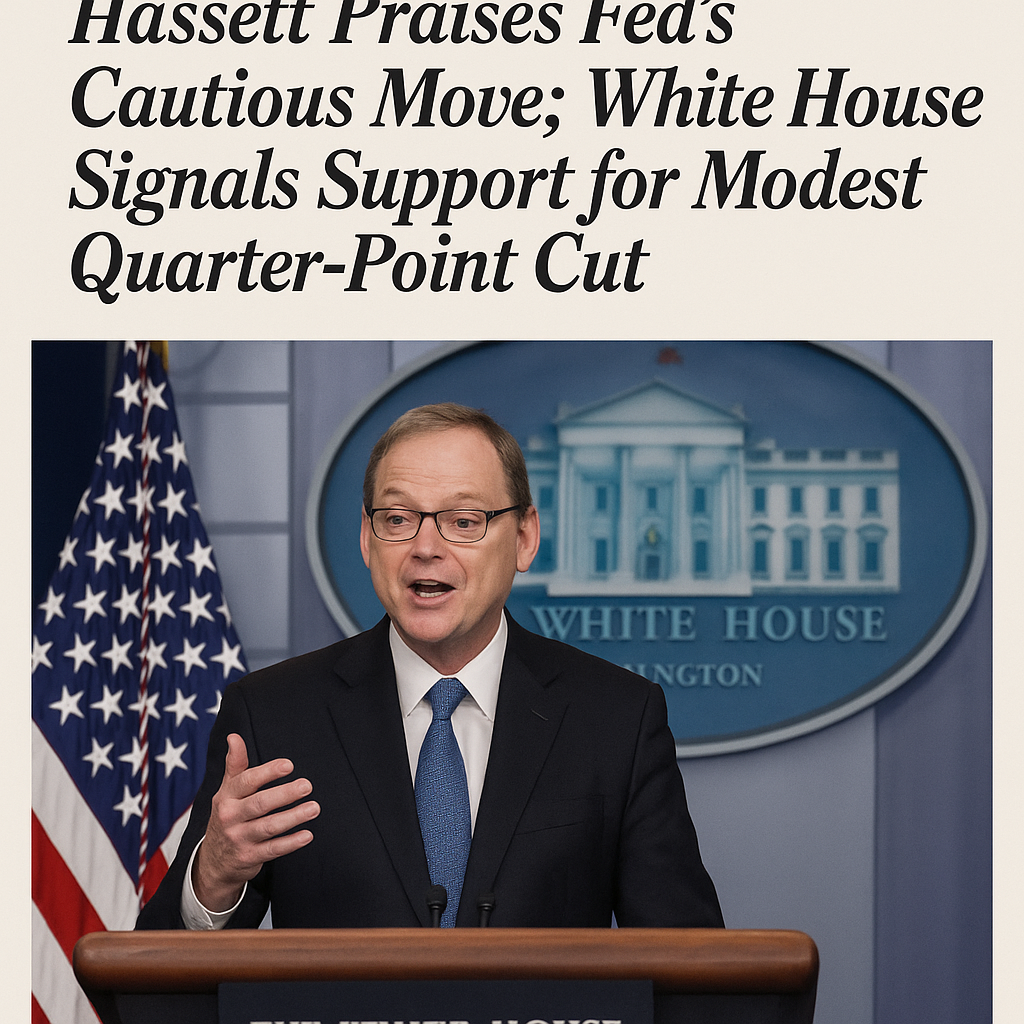
Hassett praises Fed’s cautious move; White House signals support for modest quarter-point cut

Federal Reserve’s Rate Cut Sparks Market Movements and Policy Debates

The Federal Reserve recently implemented a modest quarter-percentage-point cut to its key borrowing rate, signaling a cautious approach as it navigates a complex economic landscape. This decision, perceived by some as a step towards economic stabilization, comes amid shifting market sentiments and ongoing debates among policymakers, economists, and investors. As the global economy faces rising inflationary pressures yet remains resilient, the Fed’s move exemplifies the delicate balancing act it must perform—tamping inflation without stifling growth.

Notably, the White House expressed support for the Fed’s measured approach, with National Economic Council Director Kevin Hassett emphasizing the prudence of a “slow and steady” policy. While some within the administration advocated for a more aggressive half-point cut, the Fed’s decision reflects a consensus aimed at cautious optimism. The recent economic indicators show a robust third-quarter growth rate exceeding 3%, a figure that traditionally would argue against easing monetary policy. Still, inflation running above the Fed’s 2% target, combined with concerns about persistent financial risks, has prompted a nuanced response that favors gradualism over rapid cuts.

Market impacts from this decision are multifaceted. Investors remain vigilant, with equities, bonds, and commodities reacting to the delicate narrative of growth versus inflation control. The policy considerations extend beyond immediate market behavior, touching on policy consequences that could shape future economic stability. Analysts from think tanks and leading economists, including those linked to the Federal Reserve and major banks, indicate that this cautious move might set the stage for future rate adjustments. The decision also underscores ongoing debates about the policy trajectory—should the Fed prioritize containing inflation or supporting a thriving housing market and manageable debt levels?

Importantly, the political dimension persists, with President Donald Trump advocating for more aggressive cuts—arguing that the current rates are insufficient to boost the struggling housing sector and manage the national debt. Such political influences, though not directly altering Fed decisions, shape the policy environment and investor sentiment. As the Fed considers its next moves amid diverse economic signals, the broader implications for market impact and policy stability will be paramount. The coming months will test whether this measured approach will secure sustained growth or prompt future rallying cries for more rapid easing, reflecting the eternal tug-of-war at the heart of economic policy.

Looking ahead, the pulse of the economy remains a reflection of national strength and future global influence.

In this high-stakes game, where monetary policy acts as both shield and sword, the resilience of economies hinges on informed decision-making and bold leadership. Investors, policymakers, and citizens alike watch with anticipation, realizing that the economic landscape is a grand stage—an epic arena where the forces of innovation, policy, and global power collide. While uncertainties persist, the underlying momentum suggests that the future economy will be shaped by those willing to navigate its shifting tides with vision, precision, and resolve. This moment underscores the vital truth: **the economy is not merely a system of numbers, but the beating pulse of nations, heralding the dawn of a new era of global influence and economic ascendancy**.

Social Media Auto Publish Powered By : XYZScripts.com