Matox News

Truth Over Trends, always!

Fox CEO warns Trump: No platform if he targets Fox in 2020 talk—Sean Hannity reports

In the unfolding saga of American politics and corporate media, new revelations have surfaced from a trove of court documents that shed light on the intense internal conflicts within Fox News during the tumultuous aftermath of the 2020 presidential election. These documents, part of a defamation lawsuit brought by Smartmatic, expose the behind-the-scenes decision-making that shaped the network’s coverage—decisions that had profound geopolitical impact and how such decisions reverberate across nations and societies. For years, Fox News has positioned itself as the voice of conservative America, but these disclosures suggest a complicated reality: a corporation torn between its audience loyalty and a cautious approach to the political fallout it could engender.

Among the most striking revelations is a text exchange from October 2020, where Lachlan Murdoch, the CEO of Fox Corporation, directly warned Sean Hannity that President Donald Trump could not appear on the network if he continued to attack it publicly. Murdoch’s words reflect a pivotal moment—the balancing act of maintaining a lucrative audience while avoiding political alienation. This internal tension intensified post-election, as Fox News faced a furious backlash from Trump supporters who felt betrayed after the network called Arizona for Joe Biden. Internal emails reveal Murdoch’s concern over audience erosion and the potential impact on revenue, illustrating how economic interests often trump principle in modern media management. The consequences of this internal conflict extend beyond corporate boardrooms: they influence the flow of information to millions, shaping public perceptions on issues critical to national stability.

Experts and analysts argue that these documents underscore a broader trend: the strategic depictions and selective reporting of election fraud claims had a **direct role in fueling the disorder in the United States**, culminating in the infamous Capitol riot of January 6, 2021. Murdoch himself acknowledged that Trump’s claims of election theft contributed to the chaos—yet he denied the network had endorsed those allegations outright. This nuanced stance highlights a pattern seen across various global media outlets: sensationalism combined with editorial caution can escalate tensions instead of calming them. How this shift in narrative influences international stability will be scrutinized for years, as peoples across the globe witness the fragility of their own democratic institutions.

Adding to the significance, the court filings reveal Murdoch’s awareness of the damage Smartmatic’s reputation was suffering long before the lawsuit, alongside his acknowledgment that the network’s post-election coverage was a *deliberate pivot*—a strategic move away from unwavering support for Trump to mitigate further backlash. This internal admission exposes how media outlets often serve not only as information channels but as geopolitical players capable of influencing diplomatic relations and internal stability. In this climate, decisions made within a corporate media giant can ripple outward, impacting international perceptions of legitimacy, sovereignty, and the very fabric of democracy. As historians and international watchdogs analyze this narrative, the realization dawns: in an era where truth is often a battleground, the power wielded by media conglomerates defines the boundaries of freedom and control.

As the legal proceedings continue, and both parties prepare for their day in court next month, the weight of history remains heavy. The revelations lay bare the tumultuous internal debates, walkings a fine line between journalistic integrity and political expediency. In the shadows of these disclosures lurks the enduring question—how much influence should corporate media have over the course of a nation’s destiny?’ As the world watches, the epic struggle unfolds: a battle not just over facts, but over the very soul of democracy, as powerful currents threaten to sweep everything away in their relentless pursuit of control and influence.

Kristen Bell and Brian Cox Express Surprise Over Their Involvement in Fox News Podcast—A Reflection on the Changing Cultural Landscape

In an era where the consecration of cultural memory is often overshadowed by relentless novelty, recent developments underscore a profound truth: culture remains the bedrock of identity, tradition, and societal coherence. The controversy surrounding Fox News’ announcement of The Life of Jesus Christ Podcast — a project seemingly resurrected from recordings made fifteen years prior and released without full consent — offers a revealing case study. It is, at its core, a reflection of the ongoing tension between the past’s enduring authority and the present’s insatiable quest for instant gratification. This episode exemplifies how culture functions as both memory and prophecy, shaping our understanding of tradition while offering glimpses of what humanity can become when rooted in historical continuity.

Indeed, the saga echoes the sentiments of Ortega y Gasset, who famously warned that “culture is the sum total of what our ancestors have created, and it is our obligation to preserve and invigorate it.” Yet here, the dissonance is palpable: the actors involved, many of whom voiced their participation years ago, learned only at the last moment of the project’s release. Such scenarios threaten to reduce sacred narratives — old voices re-voiced, ancient teachings repurposed — to mere commodities. In this, we see the peril of radical commodification overtaking the reverence that once imbued our cultural icons with spiritual significance. As Chesterton might argue, such commercialization risks transforming the sacred into the profane, stripping it of its profundity and turning tradition into a mere backdrop for entertainment—a tool to be used or discarded at will.

Furthermore, the controversy highlights a cultural shift wherein the integrity of artistic and spiritual authenticity is often sacrificed on the altar of market strategy. Critics observe that the project’s producers explicitly requested secrecy about the age of the recordings, desiring that the final product seem fresher and more relevant. This echoes Tocqueville’s insights on the tyranny of public opinion and the manipulation of perception for expedience. When tradition is sanitized and repackaged without regard to the original creators’ consent, it risks becoming a hollow echo, a simulacrum of its former self; a secular relic designed to appeal to modern tastes rather than uphold spiritual truth. In this dance between old and new, we are compelled to remember that culture’s raison d’être is to anchor society in enduring values, not to serve as a fleeting entertainment commodity.

Yet, amid these modern distortions, the core truth remains: our cultural patrimony is what makes us uniquely human. It is through our stories, our art, and our spiritual heritage that we forge a sense of purpose and community. As the philosopher T.S. Eliot observed, heroically and poetically, “the past will always be with us, not just as memory but as prophecy—a glimpse of what humankind can aspire to when it honors its roots.” This enduring truth calls us to be vigilant custodians of our traditions, recognizing that revival must be rooted in respect, not exploitation. After all, the cultural tapestry of humanity is as much a reflection of memory as it is a blueprint for the future—a sacred manuscript preserved and read anew across generations. When we cherish our cultural memory, we begin to glimpse that distant horizon where human history and divine aspiration converge into a single, luminous stream of hope and identity.

Trump booed at Commanders game before taking over Fox broadcast booth to call plays

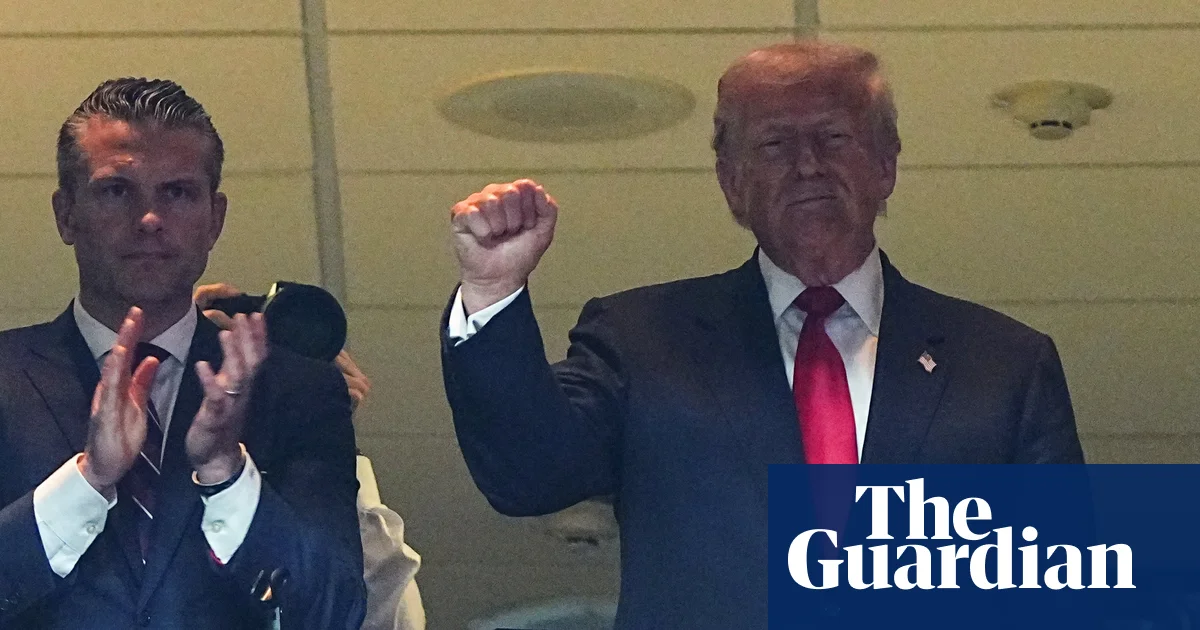
In an unprecedented move that symbolically bridges the worlds of sports, politics, and international influence, Donald Trump made history as the first sitting U.S. president in nearly fifty years to attend a regular-season NFL game. His presence at the Washington Commanders’ match against the Detroit Lions not only ignited heated reactions among fans but also served as a vivid display of the ongoing cultural and geopolitical fractures within America. While crowds in Washington, D.C., expressed their mixed sentiments—ranging from cheers to boos—the spectacle underscored how deeply divided the nation remains, and how influential figures from the global arena continue to leverage sports as a stage for political statement and influence.

This public spectacle is more than just a partisan protest; it reflects a broader geopolitical narrative where domestic political conflicts are playing out under the watchful gaze of the international community. Historically, such the attendance of a sitting U.S. president at an NFL game signals the importance of national identity and internal cohesion. Yet, the reactions from the crowd—boos, chants, and jeers—highlight a nation polarized along ideological lines. Experts remind us that the U.S.’s internal fractures are, in many ways, echoed globally, as international powers observe and interpret America’s political turbulence on every stage, from the battlefield to the sports arena.

The event also has implications for geopolitical positioning. Trump’s desire to have the Commanders’ new stadium named after him, as revealed by reports of White House intermediaries, demonstrates how branding and influence extend beyond politics into the realm of international soft power. This project, valued at nearly $4 billion, symbolizes a broader trend: the merging of economic ambitions with national identity—an ambition echoed in the development of international alliances and contentious treaties. As noted by several international analysts, such moves can be seen as the embodiment of a nationalist resurgence aiming to solidify American influence domestically while projecting strength internationally.

Furthermore, this event occurs amidst a global chessboard, where neighboring and distant powers watch as internal tensions simmer. Historians caution that when national symbols become politicized—such as debates over stadium naming and the involvement of political figures in civilian life—it can have far-reaching effects on a nation’s international image and diplomatic relations. The spectacle of a U.S. president mingling with military personnel during the game, and the NFL’s participation in patriotic initiatives, serve to reinforce a narrative of resilience amid division. Yet, critics argue that this superficial unity masks underlying societal conflicts that could, if left unaddressed, lead to fragile stability.

As the weight of history presses down, the unfolding story of Trump’s NFL appearance is more than a fleeting media event. It is a mirror held up to a world grappling with its own divisions and aspirations. While leaders and analysts debate the implications, the image of a polarizing figure standing amidst cheers and jeers at a sports stadium echoes a deeper truth: the forces shaping the future are playing out in arenas of both national pride and international influence. It is a reminder that history is a constant battlefield, where every gesture and decision—no matter how seemingly trivial—can ripple across borders, shaping the course of nations for generations to come.

Fox News is gearing up to bring real talk to the No Spin Zone—no more fluff!

The Dominion Voting Lawsuit: A Turning Point in Media Accountability and Global Power Dynamics

In Wilmington, Delaware, a judicial spectacle is unfolding that transcends the courtroom, hinting at a seismic shift in the intersection of media influence, legal accountability, and geopolitical leverage. The upcoming trial of Fox News—a media titan with global reach—charges the network with defamation over false claims about the 2020 US presidential election. The staggering $1.6 billion lawsuit filed by Dominion Voting Systems signals an unprecedented challenge to the narrative control wielded by major media outlets, especially those aligned with right-wing political factions seeking to maintain their influence amidst growing scrutiny.

Historically, Fox News has survived institutional crises by deploying a blend of legal maneuvering and strategic ambiguity. Yet, this time, the case threatens to expose a pattern of misinformation that has shaped public opinion for years. Legal analysts and media scholars warn of a watershed moment in how truth and accountability are conceptualized in the digital age, recognizing that global political stability depends increasingly on media honesty. As this high-profile trial approaches, the international community watches closely, aware that any verdict favoring Dominion could set a legal precedent with far-reaching implications, potentially curbing the unchecked power of sympathetic networks to distort facts, undermine democracy, and influence geopolitical stability.

The trial also underscores a broader shift in geopolitical power dynamics. U.S. domestic politics, often seen as a microcosm of global tensions, are now intertwined with international interests. Countries that are allies of the Western bloc are increasingly concerned about the spread of disinformation that emanates from influential American media, capable of destabilizing democracies worldwide. Critics, including international organizations such as the United Nations, warn that unchecked misinformation can accelerate conflicts and erode the fabric of international law. Conversely, nations challenging the dominant narratives—like Russia and China—see these legal proceedings as a symbolic battleground for ideological confrontation, testing the resilience of free societies against authoritarian influence.

For historians and geopolitical analysts, the current moment is reminiscent of critical junctures that define eras—when legal bodies serve as arenas for larger ideological conflicts. The future of American media, and by extension the stability of the Western world, hinges on the trial’s outcome. As legal proceedings unfold amid mounting political tensions, the world stands at a crossroads—where truth and justice are being redefined, and where the weight of history is silently sifting through the cracks of a fractured narrative.

In the end, the trajectory of this case—whether it results in accountability or further impunity—will shape the legacy of our times. The courtroom in Wilmington might seem a local dispute, but the ripples it generates extend far beyond national borders, echoing through the corridors of power and shaping the stories that societies tell themselves. As history waits in the shadows, the question remains: will this be a turning point that restores the dignity of truth in journalism, or merely another chapter in the ongoing saga of global disinformation—a story still being written, with the weight of the future hanging delicately in the balance?

Social Media Auto Publish Powered By : XYZScripts.com