Matox News

Truth Over Trends, always!

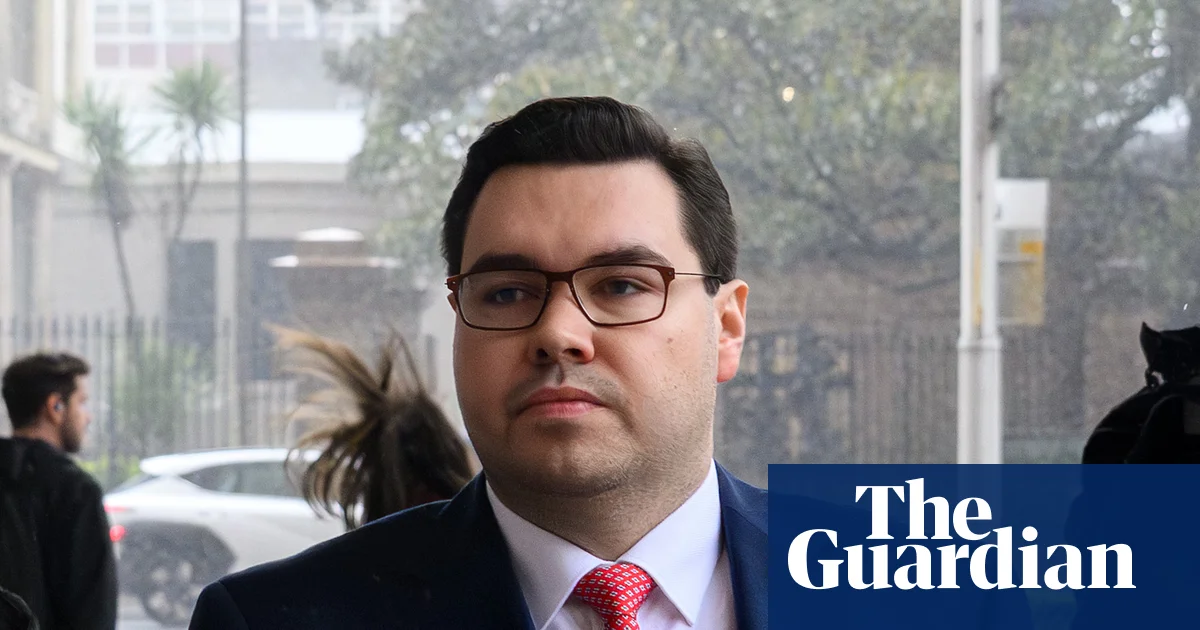
Bruce Lehrmann claims government should pay legal costs for anti-corruption raid over 'James Bond-style' claims in NSW
Bruce Lehrmann claims government should pay legal costs for anti-corruption raid over ‘James Bond-style’ claims in NSW

The Echoes of Domestic Turmoil and Their Global Geopolitical Impact

In a narrative increasingly becoming common in Western democracies, the domestic legal battles of disgraced political figures are now spilling beyond national borders, shedding light on how internal governance issues ripple out with far-reaching consequences. The recent case of Bruce Lehrmann, a sacked political staffer embroiled in scandal in Australia, exemplifies this trend. His legal disputes—centered on accusations of misappropriating sensitive documents related to French submarine deals—are more than a matter of local justice; they are a reflection of the unstable political terrain that the Indo-Pacific region now navigates.

Amid ongoing investigations, Lehrmann’s unresolved dispute over government funding for legal representation highlights how fragile political institutions have become. Justice Brigitte Markovic’s decision to order mediation by December 1st emphasizes a strategic attempt to avoid prolonged legal conflicts that could undermine public confidence in government processes. Yet, the underlying issues—such as Lehrmann’s claims of being denied funding despite assurances—highlight a broader crisis of transparency and accountability, both domestically and in the context of international perceptions of Australia. Analysts warn that such internal fissures risk eroding the trust in democratic institutions and complicate Australia’s diplomatic posture, especially in a strategic environment dominated by the United States, China, and Russia.

Adding an international dimension, Lehrmann’s legal saga is intertwined with other sensitive issues like his accusations involving his colleague, Brittany Higgins. The case touches on deeper concerns about political accountability and the handling of power within Parliament. While Lehrmann has dismissed allegations of rape—which are yet to be conclusively tested in a criminal court—the 2024 ruling by Justice Michael Lee finding the claims probable on the balance of probabilities escalates into a broader debate about justice, credibility, and the rule of law in Australia. His appeal against a defamation loss signals how these domestic issues could influence regional perceptions of legal integrity and policy stability.

From an international perspective, the distraction of internal scandals serves as a cautionary tale for European and Asian policymakers alike, emphasizing how domestic discontent can be exploited by external actors to weaken alliances. It raises questions about the geopolitical ramifications—particularly as China and Russia continue to scrutinize Western democracies’ internal divisions. Institutions like the European Union and ASEAN are watching closely, cognizant that internal instability can undermine collective security and influence regional rivalries.

Indeed, the Lehrmann case is a microcosm of a larger, tempestuous global landscape where internal power struggles and legal disputes may seem isolated but are in fact part of a wider narrative. These unfolding domestic dramas expose the vulnerabilities within democratic systems, which external powers are eager to observe and analyze. As historians and security analysts warn, the way nations handle these internal conflicts will determine their geopolitical fate in an era marked by strategic rivalry and shifting alliances. With history’s pen whirling, the story of Lehrmann and similar figures remains an enduring testament to the fragile fabric of modern democracies—threads that, if broken, could unravel the very global order upon which the future depends.


US plans to deport 11 to Eswatini amid legal and NGO backlash

The ongoing wave of authoritarian-driven deportations orchestrated by the United States under the Trump administration marks a significant shift in international migration policy—one that poses profound geopolitical impacts across Africa and beyond. This movement, characterized by accelerating efforts to send migrants to third countries such as Eswatini, is viewed by critics as a dangerous departure from international norms and human rights standards. The decision to deport at least 11 migrants to Eswatini—an economically fragile, landlocked kingdom—raises urgent questions about the morality and legality of such actions, with implications far beyond the immediate recipients.

Since early 2022, the US has engaged in a controversial strategy that involves striking deals with third nations like Rwanda, Uganda, El Salvador, and South Sudan. These agreements aim to circumvent traditional asylum pathways, effectively outsourcing the “problem” of migration to nations with questionable human rights records. Analysts warn that this approach shifts responsibility onto countries that are often unequipped or unwilling to uphold basic protections for migrants. It’s a clear manifestation of how geopolitical leverage is being wielded in service of right-wing political goals, portraying immigration as a threat to national sovereignty and security.

Significantly, these deportations have already led to alarmingly inhumane conditions for migrants. For example, five men from Cambodia, Cuba, Jamaica, Vietnam, and Yemen were deported in July and initially placed in a maximum-security prison in Eswatini—an institution ill-equipped to meet international standards for humane treatment. Critics contend that such actions demonstrate a blatant disregard for … human rights, as many of these migrants face fears of torture, persecution, or other forms of inhumane treatment upon return. The case of Orville Etoria, who served 24 years in US prisons before being deported to Jamaica, exemplifies the complex and often tragic outcomes of this driven—yet morally ambiguous—migration policy.

Meanwhile, the international community, including ethics-focused organizations and legal advocates, has voiced alarm over what they see as a blatant abdication of moral responsibility. Amnesty International and other NGOs have called on governments to respect international treaties, such as the 1951 Refugee Convention, emphasizing that mass deportations with little regard for individual circumstances violate the very core of international human rights law. Meanwhile, legal proceedings in Eswatini are tangled in delays, with NGOs challenging the legality of these deportations and pressing for transparency. The ongoing legal battles underscore how these government actions threaten to destabilize the fragile legal frameworks designed to protect migrant rights.

In the backdrop, historians and geopolitical analysts warn that the prevalent trend reveals a broader pattern of authoritarian consolidation and geopolitical realignment. As Western powers fragment their commitment to international law, smaller nations are increasingly caught in the crossfire, forced to serve as pawns in a larger game of geopolitical dominance. The story of Eswatini, under the thumb of Africa’s last absolute monarch, King Mswati III, embodies this dangerous power dynamic—where sovereignty becomes a container for silence, and human rights are sidelined in the pursuit of political expediency.

In the end, the unfolding saga of US-led deportations and the resultant strain on nations like Eswatini reminds us that history is not static; it is fiercely contested and deeply consequential. The decisions made today echo through the corridors of international law and morality, shaping the future of global migration policy. As the tides of political calculation continue to shift, humanity must confront whether the players in this game truly serve justice or merely perpetuate a cycle of cruelty—a narrative still being written on the dark pages of history.

Lola Young Takes Legal Action Against Messy Co-Producer Carter Lang Amid Industry Buzz

In an age where the collision of art and commerce has become an all-too-familiar battlefield, the recent dispute involving Lola Young over her hit single Messy highlights a fundamental truth: culture is more than mere entertainment—it is the embodiment of identity, tradition, and societal values. As Young, a rising star fueled by her authentic voice, takes legal action against producer Carter Lang over songwriting credits, we are reminded that the struggle to preserve integrity and authenticity is at the heart of modern cultural discourse. Her fight is not merely about a song; it’s a confrontation over the soul of artistry itself, echoing the perennial tension between creative truth and commercial interests that has persisted since the dawn of civilization.

Historically, the concept of culture has served as a vessel for collective memory, passing down the essence of a people through art, music, and tradition. As Ortega y Gasset remarked, “Society is a horizon, a horizon which one cannot reach, but which one must strive to approach.” Today, in an era dictated by digital streams and viral virality, the very nature of that horizon is under assault. The controversy surrounding Young’s dispute underscores the importance of defending cultural authenticity in the face of commodification. Her assertion that her songwriting was genuine reflects a broader resistance—a statement that true cultural production springs from individual’s inner truths, not just contractual obligations or superficial collaborations. She embodies the modern torchbearer of a tradition that values societal memory and identity over fleeting fame, a trait shared with figures like Chesterton who championed the importance of cultural roots in shaping a nation’s character.

Yet, the dispute also signals a deeper issue: the erosion of cultural sovereignty under the weight of industry interests. As Tocqueville warned, democracy’s greatest challenge lies in maintaining the delicate balance between individual freedom and societal cohesion. In the realm of music—a vital expression of collective identity—the ongoing struggle for rightful recognition reflects the fragile fabric of cultural integrity. When the legal battle extends into the public eye, it prompts a broader reflection on the importance of protecting creative rights, for the preservation of authentic art is akin to safeguarding the soul of a society. Young’s battle is more than personal; it is emblematic of a cultural imperative to honor the contributions of individual artists and uphold the values that make their work resonate with the spirit of their community.

In this ever-evolving landscape, where the echoes of tradition meet the relentless march of innovation, the role of culture remains as vital as ever. Like T.S. Eliot’s poetic refrain that “the past is never dead; it’s not even past,” our cultural memory persists through struggle, renewal, and resistance. It is both a memory—an echo of who we once were—and a prophecy—an aspiration for who we might become. As young voices like Lola Young’s refuse to let their stories be rewritten by others, they remind us that authentic culture is the cornerstone of societal identity and resilience. In the end, perhaps it is through these battles that we glimpse the true horizon—a future shaped not by fleeting trends but by the enduring spirit of those who dare to preserve and forge their cultural legacy amidst the tumult of change. A true culture is a human constellation, forever shifting yet anchored in the eternal dance of memory and prophecy, guiding humanity through the shadows towards the dawn of enduring authenticity.

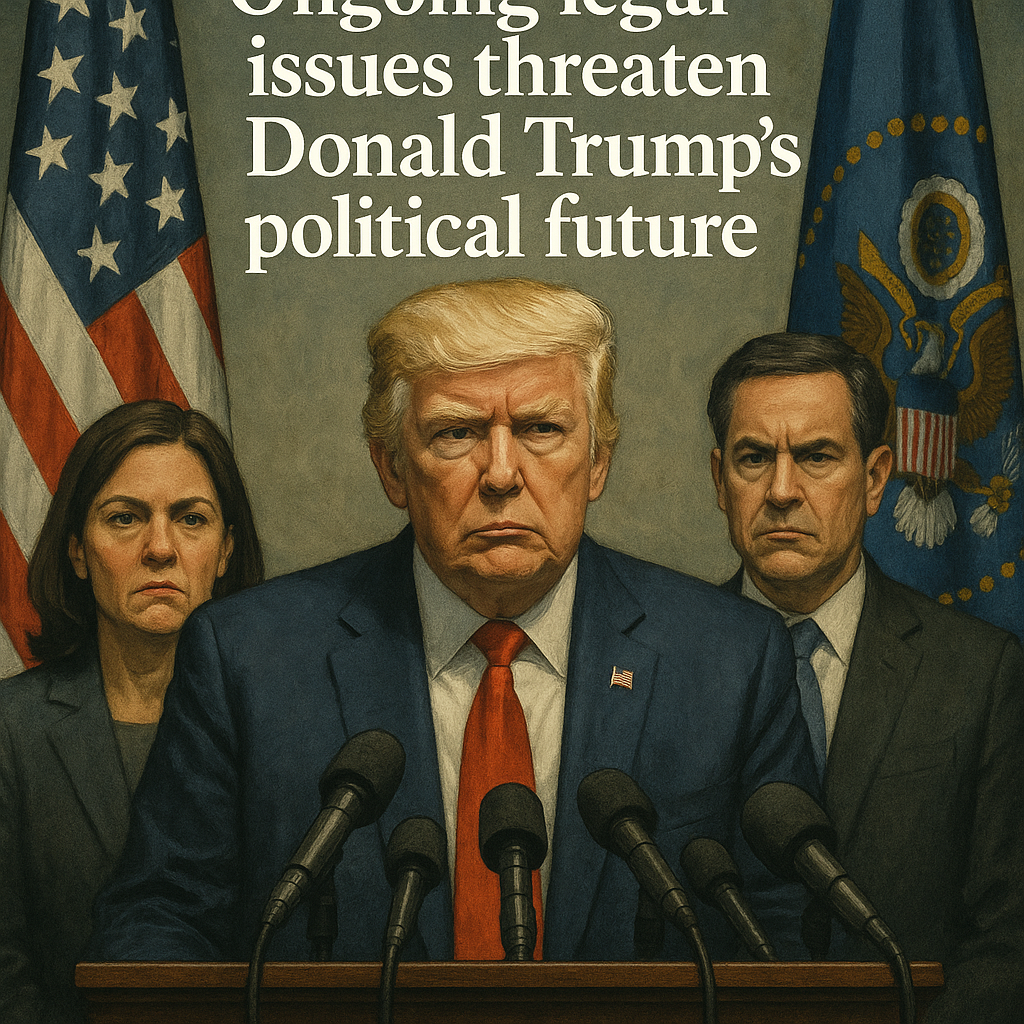
Ongoing legal issues threaten Donald Trump’s political future

In the ever-evolving theater of American politics, former President Donald Trump once again emerges as a central figure, announcing his bid for the White House amid a landscape rife with power struggles, ideological clashes, and constitutional debates. This move signals a potential reset of the Republican Party’s trajectory, emphasizing a return to core conservative principles that have galvanized his base. Yet, it also underscores an intense competition for influence within the party’s future, where who controls the narrative could determine the electoral outcomes and policy directions of the nation.

This renewed campaign-place has starkly illuminated intra-party tensions, highlighting the ideological cleavages among conservatives and libertarians, and the influence of populist rhetoric. Navigating this terrain demands an understanding of the power dynamics at play. Critics argue Trump’s return signals a resistance to the political establishment, a drive to reclaim populist sovereignty rooted in traditionalist values, and an unwavering belief in the notion that the government’s role is to serve the people, not bureaucrats. However, entrenched party elites and mainstream media outlets push back, framing his bid as disruptive — a challenge to the bipartisan consensus that often blurs patriotic priorities with entrenched interests.

Historically, political power struggles have always centered on who controls the levers of influence and how decisions impact the populace. The current landscape echoes the volatile shifts seen during the Gilded Age or the tumultuous 1960s, where the contest for American identity was fought on the battlegrounds of policy, culture, and constitutional authority. Critics of Trump’s campaign highlight the constitutional tension surrounding executive authority, free speech, and election integrity, with some legal scholars raising concerns about the implications of his rhetoric for democratic stability. Yet, his supporters argue that he embodies an authentic voice of frustration among the American electorate—an agent challenging the status quo and reaffirming their belief that politics is about shaping the destiny of a nation.

Echoing the words of political philosopher Lord Acton—“Power tends to corrupt, and absolute power corrupts absolutely”—these battles over influence are not merely about personalities or policies but are strategic chess moves that determine the contours of American sovereignty. Whether Trump’s bid will alter the balance of power, or whether new trajectories emerge from within the party itself, remains uncertain. However, what is clear is that the stage is set for a decisive clash—where every decision, every rally, and every legislative push rewrites the very narrative of the nation’s future. Political destiny, after all, is written in the crucible of conflict, where the true power lies not in the office held, but in the vision for the country’s soul.

Social Media Auto Publish Powered By : XYZScripts.com