
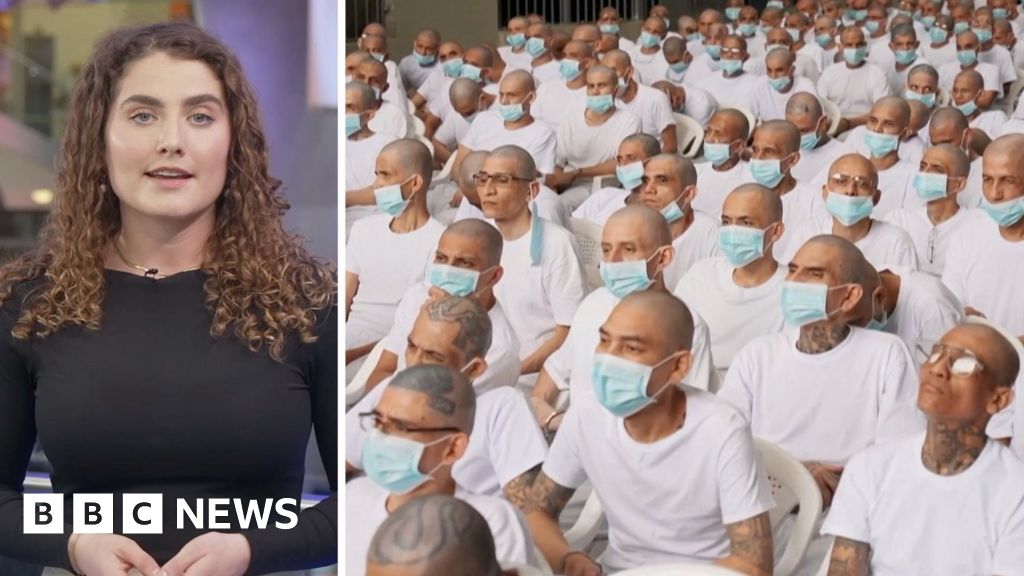

In a decisive move that underscores El Salvador’s relentless campaign against organized crime, the country’s authorities have initiated a mass trial involving 486 suspected members of the MS-13 gang. This unprecedented judicial effort marks a pivotal chapter in the nation’s ongoing struggle to reclaim stability and safety amidst years of violence and criminal dominance. The attorney general’s office revealed that the accused collectively stand accused of over 47,000 crimes spanning a decade—including murder, extortion, drug trafficking, and arms smuggling—highlighting the brutal scale of the gang’s influence within the country.
Footage from the trial, broadcast via video link, shows large groups of detainees in prison, illustrating the size and scope of law enforcement efforts. *Such mass proceedings, however, raise *serious concerns among international observers and human rights advocates.* The United Nations experts have criticized these tactics, asserting that mass trials “undermine the exercise of the right to defence and the presumption of innocence of detainees.” This critique points to a broader debate: can swift, severe justice truly justify the potential erosion of fundamental rights? El Salvador’s government remains resolute, asserting that they possess “compelling” evidence capable of imposing “maximum penalties” on those convicted, emphasizing their commitment to justice over international criticism.
Historically, the push for aggressive anti-gang measures in **El Salvador** reflects a wider ideological shift within parts of the global south—favoring tough-on-crime policies that prioritize security over process. Analysts argue that the Salvadoran government’s approach is a response to the failure of softer policies and a recognition that criminal corporations like MS-13 wield significant socio-economic power that can only be countered with assertive action. Nevertheless, critics warn that such strategies risk setting dangerous legal precedents, potentially sacrificing due process for short-term security gains. The United Nations and numerous human rights organizations highlight the danger of overlooking civil liberties in the pursuit of order, arguing that the long-term social costs of undermining legal safeguards could prove disastrous.
- El Salvador’s government defends its crackdown as essential in dismantling deeply entrenched criminal networks that threaten civil order.
- International bodies express concern over the fairness and legality of mass trials, cautioning against setting a precedent that could be exploited elsewhere.
- The global perception of **El Salvador** as a nation willing to sacrifice constitutional protections raises profound questions about the balance between security and liberty.
As global analysts analyze this turbulent chapter—where justice and human rights seem to collide—the situation underscores a broader geopolitical impact: increasingly, **Latin American** nations and others plagued by similar crises are contending with the limits of sovereignty versus international standards. The actions of **El Salvador** are watched carefully, not just for the immediate results but for what they portend for the future of law and order in fragile democracies. With international organizations sharpening their critiques and rights groups mobilizing, the specter of a new paradigm—one where security trumps process—looms large. In this intensity, history remains unwritten, edging toward an uncertain future, as **El Salvador**’s government transforms its response into a test case with implications for the entire Western Hemisphere.






