Matox News

Truth Over Trends, always!

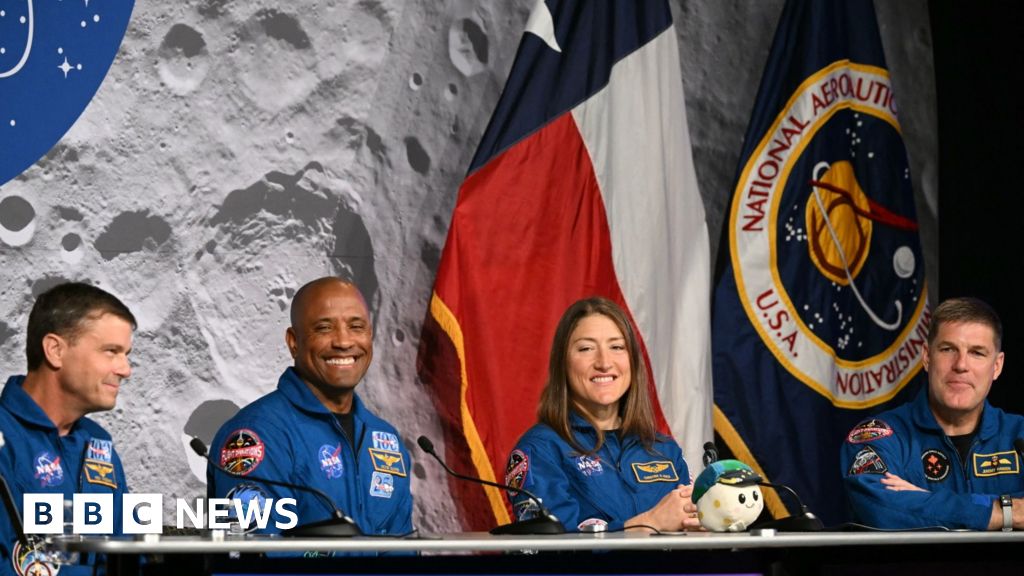
Artemis Crew Shares Bold Moon Mission and Splashdown Experience

Historic Artemis Mission Marks a New Era in Space Exploration and Geopolitics

In a groundbreaking achievement that underscores the relentless drive of the United States to maintain its leadership in space exploration, the crew of the Artemis mission convened for their first press conference after completing a 10-day orbital expedition around the Moon. Launching on April 1 from NASA’s Kennedy Space Center in Florida, the crew embarked on a journey that took them beyond the far side of the lunar surface — a feat that not only highlights technical prowess but signals a cultural and geopolitical statement of intent. The mission’s objectives are ambitious: to rekindle human presence on the Moon, establish a permanent outpost, and ultimately, lay the groundwork for manned missions to Mars.

The Artemis program is more than just a quest for scientific discovery; it signifies a strategic shift in international power dynamics. As noted by numerous analysts and geopolitical strategists, the renewed U.S. push to dominate lunar space is a response to the rise of China and Russia in extraterrestrial exploration. China’s recent lunar activities and Mars ambitions, along with Russia’s renewed interest in space, threaten to fracture what was once a mostly American-dominated field. The Artemis mission, therefore, underscores a broader geopolitical contest over the future of space as the new frontier for economic and military advantage.

International organizations and foreign governments are watching closely. The European Space Agency (ESA), India’s ISRO, and others have expressed interest and have begun aligning themselves with lunar and Martian initiatives. Yet, experts warn that this renewed focus on celestial exploration could exacerbate existing international tensions and lead to a new space race. Historians cite the Cold War-era space race as a cautionary tale and emphasize that, how nations choose to collaborate or confront in space will set the tone for global stability in the decades to come. The Artemis mission, with its symbolic return to human lunar exploration, is thus imbued with profound geopolitical impact.

As the world’s eyes turn skyward once more, the unfolding chapter of lunar exploration is determining who will hold sway over the future’s final frontier. Will this herald an era of international cooperation or a new epoch of competition centered around territorial claims, resource control, and technological supremacy? The decisions made today echo beyond the vacuum of outer space— they shape the destiny of nations and societies grounded firmly on Earth. As history’s pen continues to write the story of mankind’s quest among the stars, one thing remains clear: the outcome of this new space race may very well define the geopolitical landscape of the 21st century, leaving humanity to confront the question of whether space can be a shared horizon or a battleground for dominance.”


Artemis II Crew Gears Up for Epic Pacific Splashdown After Historic Mission

United States space agency NASA has concluded its historic Artemis II mission, a pioneering flight around the moon that signifies a critical pivot point in humanity’s quest to explore beyond Earth. As the Orion capsule made its gentle splashdown in the Pacific Ocean—precisely as planned—on Friday night, it not only surged past the boundaries of human spaceflight since 1972, but also reaffirmed U.S. leadership in deep-space exploration amid rising international competition. The successful test flight, with four astronauts aboard—three Americans and one Canadian—marked a formidable step forward in what experts describe as a new “golden era” of lunar and extraterrestrial endeavors, setting the stage for a future human moon landing in 2028.

Additionally, the mission carried profound symbolisms and a message of unity in a fractured geopolitical landscape. The crew’s journey extended farther from Earth than any previous human—more than 252,000 miles—and included groundbreaking milestones, such as Christina Koch becoming the first woman to orbit the moon and return, as well as Jeremy Hansen representing Canada for the first time, and Victor Glover marking the first person of color to undertake such a voyage. These historic firsts have resonated globally, captured in images and video footage that have inspired countless viewers worldwide. As analysis from international space analysts highlights, the Artemis II mission exemplifies a renewed commitment among Western nations to space dominance, with implications for geopolitical influence, economic opportunities, and national prestige.

  • Key events included Orion’s lunar flyby, which provided high-resolution imagery and scientific data on the moon’s surface—information vital to constructing future lunar bases.
  • The mission successfully tested critical systems, including radiation shielding, life support, and next-generation spacesuits, laying the groundwork for the arduous journey to a sustained presence on the moon and beyond.
  • Despite technical hiccups—such as Orion’s malfunctioning toilet—the crew demonstrated resilience and adaptability, emphasizing human tenacity in these perilous environments.

Experts from institutions such as the European Space Agency and Roscosmos have noted this achievement’s geopolitical impact. It signals that America and its allies are intent on not ceding space supremacy to China or Russia, both of whom have accelerated their own lunar and planetary ambitions. The Artemis program, with its heavy investment—estimated at $20 billion—aims not only to revisit the moon but to establish a sustainable human presence, redefining frontiers and pushing the boundaries of technological innovation. This fosters a new global power dynamic, where access to outer space is now as crucial as control over key maritime chokepoints or energy corridors—an ongoing contest of influence.

As the Artemis II crew prepares to reunite with loved ones and reflect on their historic voyage, the course for humanity’s future in space remains uncertain yet undeniably compelling. Their journey underscores how decisions made today in space policy, international cooperation, and technological development will echo through the corridors of history. With each new milestone, the world witnesses the unfolding narrative of human ambition—an epic charted among stars, forever poised on the brink of a new era. The next chapter will define whether humanity’s pursuit of the cosmos will become an age of collaboration or conflict—remembering, always, that the weight of history is carried not only in the stars but in the choices of those who reach for them.

Middle East Tensions Flare: Iran Reports 5 Killed in US-Israeli Strikes During Rescue Mission

Unfolding Crisis in the Middle East: A Turning Point with Global Consequences

The recent escalation of violence in the Middle East has sent shockwaves through the global geopolitical landscape, revealing a region on the brink of a protracted and devastating conflict. Iran, under the leadership of its central military command, has decisively rejected Donald Trump’s demands for a swift deal within 48 hours, warning that such threats are futile and dangerous. Meanwhile, a war that ignited with US and Israeli strikes targeting Iranian military facilities has rapidly spread, with the region’s stable geopolitical balance disintegrating in a matter of weeks.

Reports indicate that early Sunday morning, Iran’s forces launched missiles and drones, striking targets in Kuwait and Israel—an unmistakable sign of a comprehensive regional conflict. The Israeli prime minister, Benjamin Netanyahu, confirmed that Israel responded with attacks on Iran’s petrochemical infrastructure, including a strike on the Mahshahr plant, where Iranian media reported casualties. The Iranian military has responded with retaliatory strikes, including missile and drone attacks on Kuwaiti water desalination plants and the UAE’s energy facilities. This ripple effect of hostilities has upended international trade routes, notably the strait of Hormuz, which Iranian forces tightly control. The disruption of this vital conduit for nearly twenty percent of global oil supplies has sent shockwaves through energy markets worldwide, prompting fears of a global energy crisis that could drag economies into chaos.

Expert analysts and historians, including former UN nuclear watchdog Mohamed El-Baradei, warn that the escalation risks transforming the Middle East into “a ball of fire.” El-Baradei’s recent appeals, alongside statements from international organizations, highlight the peril of quick, aggressive military responses that could ignite a regional war with unpredictable, potentially catastrophic consequences. As Iran insists on a permanent security guarantee and rejects Trump’s ultimatums, the potential for a wider conflagration intensifies, with neighboring Gulf countries caught in the crossfire. How nations and societies respond to these threats in the coming days will determine whether the region slips further into chaos or finds a fragile path toward de-escalation.

  • The US and Israeli militaries targeted multiple strategic sites in Iran’s capital, including Shahid Beheshti University, with reports of civilian casualties.
  • Hezbollah claimed to have targeted a nascent Israeli warship off the Lebanese coast, an assertion which remains unverified, yet underscores Iran’s proxy ambitions and regional proxy conflicts.
  • In the broader conflict, Lebanon’s death toll exceeds 1,400, with Israeli strikes killing dozens in recent days, a tragic toll that exemplifies the war’s devastating human cost.
  • Meanwhile, aid organizations report severe disruptions in their efforts to deliver food and medicine, citing the cutting off of vital shipping lanes and blockade of supply routes—an unfolding humanitarian crisis that compounds the violence.

As regional powers—Egypt, Turkey, Pakistan—push for diplomatic backchannels to rebuild stability, the global community remains watchful. The United Nations, as well as international leaders, warn that the escalation could spiral into an all-out war, threatening to engulf not just the Middle East but also to destabilize global markets and fuel geopolitical upheaval. Will diplomacy prevail, or will the region become an indelible scar on the map of the 21st century? The course is only beginning to be written, and history’s pen hangs heavy, awaiting the verdict of future generations—whether to be heralds of peace or witnesses to the abyss.

Crowds Bullish on Artemis II Launch, Catch Historic NASA Moon Mission

On the space coast of Florida, a monumental event is poised to reignite humanity’s quest for exploration. The scheduled Artemis II mission marks a historic return to crewed spaceflight beyond low Earth orbit since Apollo 17 in December 1972. As NASA prepares to launch a fully crewed rocket with up to 400,000 spectators on the ground, the event symbolizes more than just a technological milestone; it embodies a renewed geopolitical drive for dominance in a rapidly evolving era of international space competition.

The U.S. space agency’s ambitious project involves astronauts from America, Canada, and international partners, highlighting the strategic importance of scientific collaboration. The crew, including Christina Koch and Victor Glover, will reach farther from Earth than any human in history, pushing the boundary of exploration to nearly 253,000 miles. This mission serves as a critical testbed for hardware and life support systems necessary for subsequent missions, specifically the long-planned Artemis IV, which aims to land humans on the lunar surface by 2028. Here, NASA aims to establish a sustainable presence on the moon, with plans for a $20 billion moon base—a strategic move to cement U.S. leadership in space amidst fierce international rivalry.

Beyond technological and exploratory objectives, the Artemis II mission reflects a broader social and political narrative. The inclusion of the first woman and the first person of color in such historic spaceflights signals an effort, at least rhetorically, to promote diversity and inclusion—yet, recent policy shifts, such as the removal of diversity recognition from NASA’s websites, suggest an ongoing debate within the U.S. about the role of identity politics in science. Despite these controversies, the mission’s emphasis on “dreams achievable by all” resonates globally as a metaphor for opportunity and progress. As analysts observe, the real impact of these missions extends far beyond the stars—they influence societal perceptions of what is possible when nations leverage technological prowess for geopolitical leverage.

The global landscape is watching with intense curiosity and strategic concern. Historic rivals Russia and China have markedly accelerated their own space programs, seeking to establish lunar outposts and claim strategic footholds on the moon. International organizations and foreign leaders recognize that control of lunar resources could redefine economic and military power for decades to come. The United States aims to maintain primacy, asserting that the advancements made through Artemis are not just about scientific discovery but also about asserting economic and geopolitical dominance. The underlying message from NASA and its allies is clear: the path to space is a new arena for international influence, sovereignty, and resource control, with the moon serving as the next frontier of strategic contest.

As history unfolds on this pivotal day, the world is reminded that explorations beyond our planet are as much about securing national strength as they are about inspiring future generations. The outcome of this launch could well shape the balance of power in space for decades, leaving the echo of humanity’s ambitious dreams intertwined with the cold reality of geopolitical competition. With every countdown, the weight of history presses upon those astronauts confined within a tiny capsule, as they venture into uncharted territory—their journey a stark reminder that the future of human civilization may very well be written among the stars, in the relentless pursuit of discovery and dominance.

As Co-Founders Exit and IPO Nears, Musk Sets Sights on Moon Mission

Elon Musk’s xAI Targets Lunar Manufacturing as Next Technological Frontier

In a surprising pivot towards extraterrestrial innovation, Elon Musk revealed during an all-hands meeting that xAI, his burgeoning artificial intelligence enterprise, aims to establish a manufacturing facility on the Moon. This marks a significant escalation in spatial-based AI development, emphasizing the disruptive potential of leveraging lunar resources and space-borne infrastructure to accelerate technological growth while circumventing Earth’s limitations. Musk’s vision involves deploying AI satellites via a lunar catapult, a concept that underscores a radical rethinking of how industry, AI power, and space exploration intersect. Such a move signals the onset of a new era where disruption is no longer confined to terrestrial markets, but extends into space itself, charting a course for what industry analysts are already calling <the most ambitious space-centric AI initiative to date>.

The implications for the global tech ecosystem are profound. Industry leaders, including SpaceX and AI disruptors, are fueling a paradigm shift centered on off-planet manufacturing and data processing. The recent merger of xAI and SpaceX has further accelerated this trajectory, positioning Musk’s empire at the forefront of innovation—an inevitable challenge to legacy tech giants. According to Gartner, such advancements in space-based AI infrastructure are likely to catalyze Gross Domestic Profit rather than just GDP, as companies unlock unprecedented access to computing power and resource utilization beyond Earth’s constraints. Elon Musk’s confidence in his rapid technological progress underscores how disruption is becoming an essential strategy for maintaining competitive advantage—especially when competitors like China and Russia have no legal hurdles in challenging U.S. dominance in space.

Adding to the industry’s uncertainty is a wave of strategic personnel shifts within xAI, with half of the company’s original founders departing amid reports of the impending SpaceX IPO. While Musk maintains that the company is in flux and moving at an unparalleled pace, these departures highlight the inherent risks of pushing beyond traditional boundaries. As the urbanization of space continues to evolve, legal and regulatory frameworks—such as the 1967 Outer Space Treaty and the 2015 U.S. law permitting resource ownership—will undoubtedly shape what is feasible for private firms. The legal ambiguity surrounding lunar sovereignty and resource rights presents both an opportunity and a complication in Musk’s quest to turn planetary borders into cash flows—a strategic game changer for the future of space commerce.

Central to Musk’s renewed focus on the Moon is his assertion that colonizing Mars—long deemed the logical next step—is now a distant goal, with lunar development offering a faster, more practical alternative. This shift underscores a broader trend among aerospace innovators toward near-term lunar infrastructure investments, driven by the belief that a self-sustaining lunar city could outperform Mars in both time and economic viability. Industry experts anticipate this approach could unlock a “new gold rush“—not only in raw materials but in technological advancement, military leverage, and global influence. As MIT researchers and Elon Musk warn, the race for space-based AI and manufacturing is accelerating at an unprecedented clip, demanding not only technological ingenuity but also strategic agility. The next decade may well define whether humanity’s space ambitions will be a technological utopia or a geopolitical battleground.

Social Media Auto Publish Powered By : XYZScripts.com