
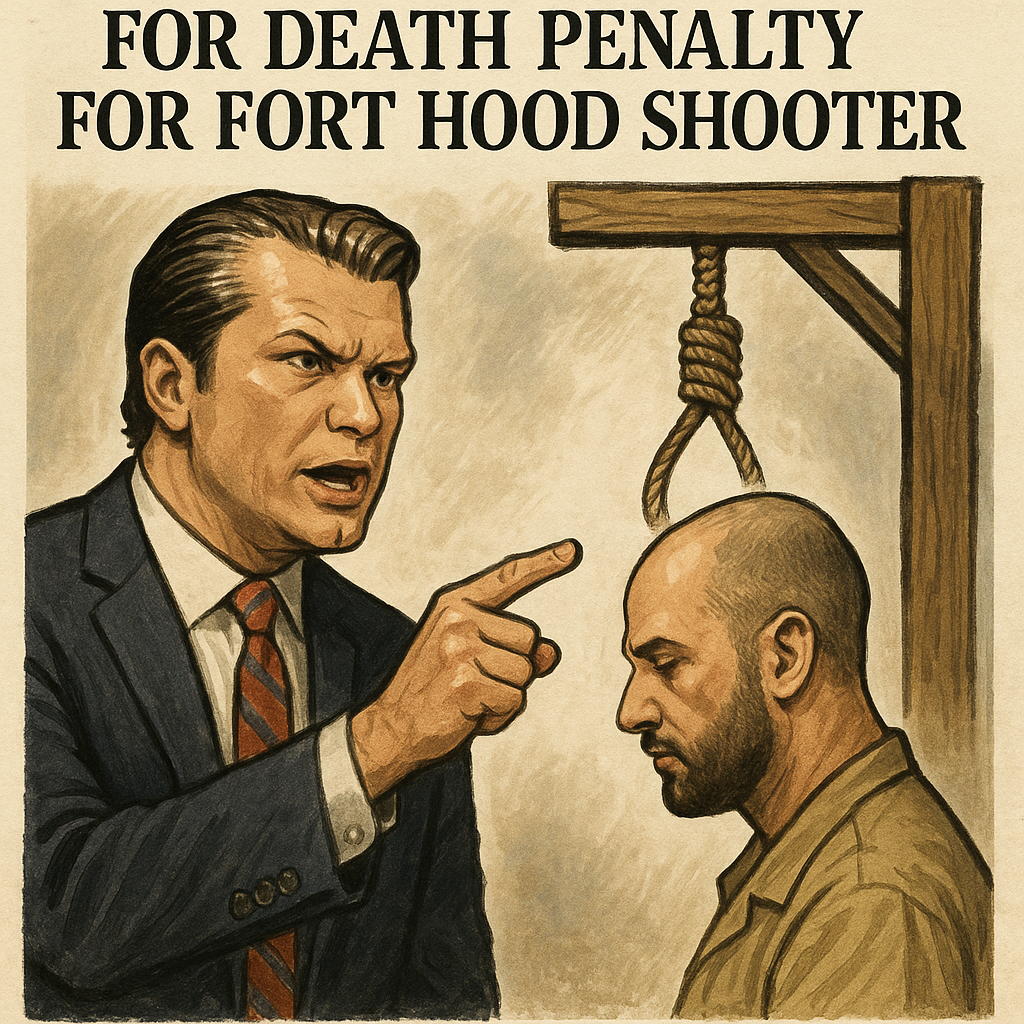

The ongoing saga of justice and authority within the United States military continues to unfold with high-profile certainty. Defense Department Secretary Pete Hegseth is actively pursuing the imposition of the death penalty for former Army Major Nidal Hasan, whose heinous act at Fort Hood nearly 16 years ago left 13 dead and dozens injured. This case’s significance extends well beyond its immediate tragedy, revealing in stark terms how power struggles in the corridors of authority influence both the public conscience and the intricate machinery of justice.
At the heart of this debate lies the question of how justice is delivered in a nation founded on the rule of law yet riddled with conflicting interpretations of morality and authority. Hegseth’s push for the death penalty is not just about retribution; it underscores the assertion of military discipline and national security over individual rights. He is seeking President Trump’s final approval for military execution. Historically, such decisions echo the constitutional debates sparked by early American theorists like Alexander Hamilton, who championed a strong federal authority to uphold order. Today, the very fabric of constitutional boundaries is tested by the intersection of martial justice and civilian rights, illustrating how power struggles shape the ideological landscape of justice in the post-9/11 era.
The case also exemplifies the strategic how decisions echo through communities and national consciousness. Critics argue that the pursuit of the death penalty for Hasan risks fueling polarizations, while proponents emphasize the necessity of demonstrating unequivocal national resolve. These tensions reflect the enduring debate over the role of the state—whether as an arbiter of mercy or an agent of relentless justice. The military tribunals, uniquely insulated from civilian oversight, serve as battlegrounds where the boundaries of authority are redefined. Such decisions ultimately reflect a broader political narrative about who holds the moral and judicial power to shape the future of American society.
As the drama finalizes in the corridors of power, it serves as a reminder: politics is where destiny gets written, often in ink of blood and conviction. The enforcement of capital punishment within the military context demonstrates that controversial, decisive actions are integral to the enduring tension between authority and liberty. This case, much like historical parallels such as the Nuremberg Trials or the moral quandaries faced during the Civil War, reminds us that the exercise of power in justice often defines national character. As citizens watch these proceedings unfold, it becomes clear: in the theater of politics, every decision, every ruling, writes a chapter in the larger narrative of where this nation is headed, and what it stands for.






