Matox News

Truth Over Trends, always!

Ben Smee, Guardian Australia, scores Queensland Journalist of the Year — a win for fearless reporting

Investigative Journalism Shines a Light on Human Rights Violations in Australia

Recently, Guardian Australia and SBS journalists garnered significant attention at Queensland’s prestigious media awards, the Clarions, securing the coveted Journalist of the Year accolade. Their groundbreaking investigation, “In the Box: Inside the Isolation Cells where Australian Kids are Imprisoned,” not only captivated public interest but also exposed alarming conditions faced by vulnerable children in Queensland police custody. This journalism exemplifies the crucial role media play in holding governments accountable and exposing systemic failures that threaten societal values. The investigation’s detailed footage and extensive research shed light on children as young as 11 held in tiny, freezing cells designed for adult detainees, often with no access to basic necessities such as toilets or bedding. Such revelations have ignited a debate that transcends national borders, highlighting how human rights abuses can quietly persist under the guise of law enforcement.

The geopolitical impact of this investigative work goes beyond national borders, emphasizing the importance of transparency and accountability in governance—principles fundamental to stable societies worldwide. Experts and international watchdogs have long warned against the normalization of systemic mistreatment of marginalized groups, especially in institutions intended for public safety. The exposure of these conditions in Queensland has prompted calls for reform from advocates across the globe who argue that such practices undermine not only human dignity but also the legitimacy of state authority. International organizations, including UN human rights agencies, continuously monitor similar issues elsewhere, and the Australian case reasserts the need for comprehensive oversight mechanisms that prevent the escalation of systemic violence. As analysts suggest, the decisions made today in Queensland could influence reforms in comparable jurisdictions worldwide, reinforcing the fact that unchecked power fosters environments where human rights can be easily trampled.

Within the broader context of international shifts in public accountability, this case underscores a turning point—an era where investigative journalism is serving as a vital check against governmental overreach. Historians of media and policy highlight that such stories can catalyze meaningful reform, forcing authorities to face their shortcomings amid mounting public pressure. The awards attributed to Smee’s work exemplify how dedicated reporting can shape societal perceptions and influence policy change. The judges commended the investigation for its compelling storytelling and meticulous research, which not only illuminated the plight of detained children but also showcased the enduring importance of fearless journalism in safeguarding democratic principles. As such, the case from Queensland stands as a stark reminder: the weight of history is still being written, with citizens and journalists alike playing pivotal roles in shaping the future of justice and human rights.

As the world watches, the revelations from Australia serve as a powerful narrative illustrating that justice is a continuous struggle against complacency. The ongoing debate over child detention policies echoes across continents, stirring international pressure for reform. Ultimately, this story reminds us that the decisions governments make in the shadows today may either protect or doom future generations. In a world where power can easily corrupt, the vigilant watchdogs of truth ensure that history remembers the lessons learned—however painful they may be.


Illinois Governor scores $1.4M victory in Vegas—big win for the state’s leadership

United States politics remain deeply intertwined with global influences, with recent revelations highlighting the complex web of power, wealth, and policy. In Illinois, Governor JB Pritzker, a scion of the Hyatt Hotel fortune and a prominent Democrat, made headlines after his tax filings disclosed a $1.4 million windfall from gambling in Las Vegas. While Pritzker plans to donate the winnings to charity, the incident spotlights ongoing debates over wealth, privilege, and the role of affluence in governance. It also underscores the influence of individual actors within the broader framework of American political and economic power, which continues to be scrutinized by international analysts seeking to understand the prevalence and impact of the ultra-rich in shaping policy directions.

This incident occurs against a backdrop of escalating tensions between the Biden administration and former President Donald Trump, whose critics accuse him of undermining the rule of law and national cohesion. Pritzker himself has positioned as a critic of federal policies, particularly regarding the deployment of national troops to cities like Chicago, which Trump labeled as “authoritarian” efforts. Such political discord echoes beyond national borders, affecting international perceptions of democratic stability and the United States’ role as a global leader.

  • Critical questions are being asked about how the wealth of the American elite influences governance and policy-making.
  • Developments in Illinois exemplify a broader trend where state-level actors become focal points in an ongoing ideological struggle.
  • International organizations and geopolitical analysts argue that internal divisions in the United States have tangible consequences for global stability, especially amidst rising challenges from China and Russia.

Global institutions and historians warn that this internal turmoil, fueled by egocentric power plays, threatens to undermine the consensus needed to address pressing international crises—be it climate change, economic instability, or regional conflicts. The decision of one wealthy governor to indulge in high-stakes gambling may seem trivial, but it symbolizes the broader cavalcade of personal wealth and political influence shaping America’s future. As Pritzker seeks a third term in 2026, questions abound about whether such figures will prioritize the people’s interests or continue to navigate a landscape dominated by privilege. At a time when the world watches, the unfolding narrative of US internal politics remains a pivotal chapter in the story of how nations coalesce—or fracture—in an era of unprecedented global upheaval, leaving history to judge whether these choices herald renewal or impending chaos.

India’s Airbound scores $8.65M to launch rocket-inspired drones for ultra-cheap deliveries

Airbound’s Disruptive Drone Innovation Promises to Revolutionize Last-Mile Delivery

In a move that could redefine last-mile logistics, Indian startup Airbound has secured $8.65 million in seed funding, led by Lachy Groom, co-founder of Physical Intelligence. The fresh capital infusion signals a growing industry interest in groundbreaking drone technologies capable of achieving one-cent delivery costs, threatening traditional logistics and delivery models globally. As the company embarks on pilot programs with Bengaluru’s Narayana Health and eyes expansion into the U.S., its innovations are poised to challenge entrenched delivery paradigms, emphasizing efficiency, lightweight design, and autonomous operation.

Key to Airbound’s disruptive edge is its ultra-light, blended-wing-body aircraft, the TRT drone, engineered explicitly for small payload deliveries. Pushp, the startup’s founder and CEO, emphasizes that current drone efficiency benchmarks are fundamentally broken, citing that “drone-to-payload weight ratios” are far from optimal. “You need four kilograms of drone to lift one kilogram of payload,” Pushp explains, highlighting the critical need for innovation in aerodynamic efficiency. By focusing on reducing drone weight — the initial prototype weighs around 3.3 pounds — and improving energy usage, Airbound intends to slash energy costs by 20 times, making one-cent delivery not just aspirational but practically achievable.

This strategic focus on technological innovation and cost reduction has broader business implications. Airbound plans to vastly expand manufacturing capacity, aiming to produce over 100 drones daily by 2027 and scaling deliveries to a million daily within two years. Such ambitious growth demands a paradigm shift from traditional delivery fleets towards autonomous, highly efficient drone networks. Industry experts from institutions like MIT and analysts at Gartner recognize this trajectory as part of a broader wave of disruption, which could eventually render legacy last-mile logistics providers obsolete or force them into strategic pivots. As Pushp underscores, “logistics is intrinsically a physics problem”—emphasizing that success hinges on minimizing weight and maximizing efficiency.

The implications are profound: if startups like Airbound harness this disruptive innovation, they could accelerate a global transformation in sectors beyond medical logistics—spanning quick commerce, food delivery, and other last-mile services. This rapid evolution demands regulatory agility; Airbound is already engaging with authorities such as India’s Directorate General of Civil Aviation (DGCA) and planning to expand into the U.S., a market highly receptive but heavily regulated. Such efforts align with broader trends where regulatory technology and industry standards evolve alongside breakthrough innovations, fueling accelerated deployment. As Elon Musk and Peter Thiel have noted, the future belongs to those who innovate faster and challenge traditional industries, and Airbound’s trajectory exemplifies this ethos.

Looking forward, the race for drone supremacy is intensifying, with startups and established giants alike vying for dominance. Airbound’s strategic focus on lightweight design, energy efficiency, and cost effectiveness positions it as a frontrunner in this high-stakes arena. In the coming years, the deployment of thousands of autonomous, low-cost drones could reshape entire logistics ecosystems, forcing incumbents to adapt or risk obsolescence. As the industry approaches the cusp of mainstream adoption, it’s clear that innovation-driven disruption is here—and acceleration is imperative for those seeking to lead in the future of connected, autonomous delivery networks. The clock is ticking; the future of commerce belongs to those bold enough to harness the power of the skies.

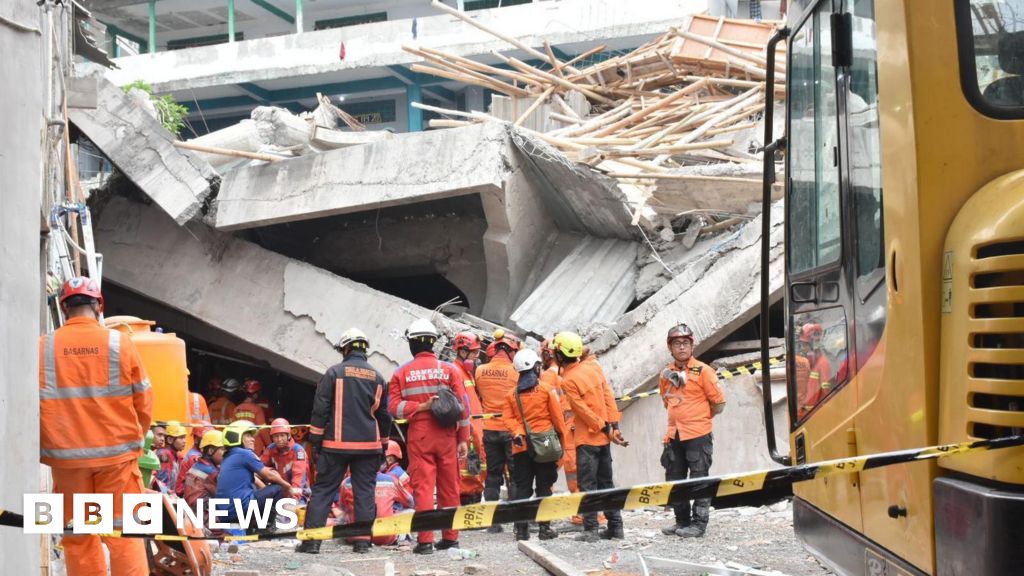
Scores feared dead as school building collapses, authorities warn

The recent tragedy in Indonesia, where a collapsed Islamic boarding school has left at least five students dead and over 100 injured, underscores a critical moment in the nation’s ongoing safety and governance struggles. The incident, centered in the town of Sidoarjo, reveals the dangerous consequences of unchecked construction practices and regulatory failures. The building’s collapse, caused by the addition of two unsafe floors to an under-constructed foundation, highlights the larger issues Indonesia faces in terms of infrastructure development and regulatory oversight, issues that resonate across many developing nations in Southeast Asia.

Despite the international outcry and efforts of rescue teams using thermal drones and heavy machinery, the possibility of finding survivors has diminished. The disaster management agency (BNBP) announced that *no signs of life* were detected in the debris, a heartbreaking entry point into the larger conversation about safety standards and government accountability. Experts and analysts warn that such tragedies reflect deeper systemic flaws—poor enforcement of building codes, corruption, and the prioritization of economic gains over safety—threatening societal stability and the legacy of governance in the region. The incident also serves as a stark reminder of the. *fragility of human life* amidst rapid urban proliferation and construction without appropriate oversight.

On a broader geopolitical level, the incident in Indonesia acts as a clarion call to regional institutions and international partners. While those involved are primarily concerned with immediate rescue operations, critical analysis from organizations like the World Bank and international human rights groups emphasize that long-term safety reforms are necessary for social progress. Such disasters threaten to undermine the legitimacy of local authorities and fuel public distrust in state institutions, which are often seen as ineffective or corrupt. These events have repercussions beyond national borders; they feed into regional narratives about governance, sovereignty, and the need for vigilant oversight as urban populations swell. How nations respond—by tightening regulations, improving safety standards, and ensuring transparency—will determine their standing on the global stage.

Historian and policy analysts stress that this incident is no isolated event but part of a broader pattern affecting many countries committed to rapid development amid legacy issues of governance and accountability. The tragic collapse in Indonesia symbolizes a moment where history is still being written—where the choices to reform or ignore safety standards could have lasting consequences. As rescue teams turn their tools towards removing debris, the world watches and waits, acutely aware that the true test lies ahead: whether this tragedy will catalyze meaningful change or become yet another chapter of neglect in the overarching narrative of progress and safety. In this unfolding history, every decision, every policy, and every effort to secure the safety of the vulnerable will leave an indelible mark on the fabric of society.

Social Media Auto Publish Powered By : XYZScripts.com