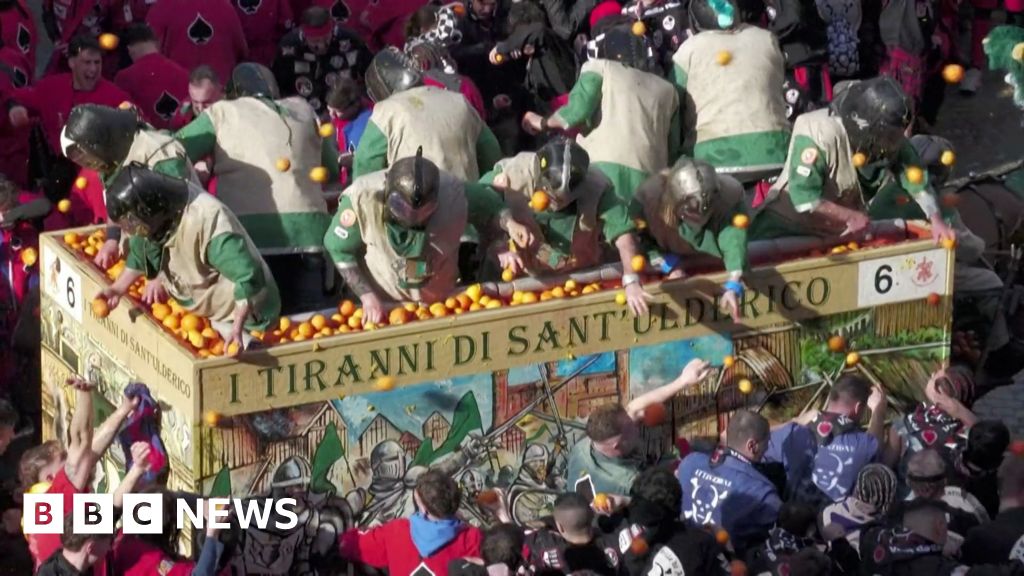

In a display of vibrant tradition and historical resilience, Ivrea, a northern Italian town near Turin, continues its annual Battle of the Oranges, an event that preserves a centuries-old legend of uprising and liberation. This spirited celebration, rooted in medieval history, is more than just a riot of color and fruit; it symbolizes the enduring spirit of society against tyranny. As participants hurl oranges at each other, they reenact the legendary defiance of Violetta, a miller’s daughter who confronted an oppressive tyrant and helped unshackle the town from despotism. Such cultural expressions are vital in reinforcing national identity in a time when global events increasingly threaten local traditions.
The Battle of the Oranges features nine teams representing the townspeople who once revolted to overthrow feudal oppression, with the oranges themselves symbolizing the fruits of their victory. The spectacle involves intricate choreography—teams on foot face off against horse-drawn carriages loaded with oranges—demonstrating the historical conflict between the oppressed and their overlords. According to organizers, the oranges are not meant for consumption; rather, they are collected and repurposed as fertilizer afterward, highlighting an environmentally conscious dimension to the event. Historians and cultural analysts emphasize that such festivals serve to reinforce community cohesion and cultural pride, especially amid mounting international uncertainties.
In the broader context, Italy’s tradition of carnival celebrations reflects a society keen to preserve its cultural uniqueness despite the homogenizing forces of globalization. Countries across Europe, from Spain to France, maintain their own versions of festive resistance—each emphasizing historical narratives that bolster national pride. International organizations acknowledge that these events contribute positively to local economies and regional identities, but they also serve as subtle acts of cultural defiance against the tides of global conformism. The resilience of such traditions underscores the importance of protecting local histories from being overshadowed by international commercial interests.
As global powers navigate a landscape of shifting alliances, economic upheavals, and ideological clashes, the significance of maintaining national stories like Ivrea’s is more crucial than ever. Decades from now, historians may see these festivals as the quiet acts of rebellion that kept a culture alive amidst a rapidly changing world. In a time where international institutions and diplomatic treaties often threaten sovereignty and cultural autonomy, the defiant spirit embodied in the Battle of the Oranges reminds us that history, much like the fruit hurled in jest, can be a potent symbol of struggle and resistance. The question remains: in an era of globalization, who will be the custodians of national identity, and at what cost? The story of Ivrea’s carnival suggests that the answer lies not just in diplomacy but in the collective memory of communities that refuse to be silenced, weaving their stories into the very fabric of history itself.