
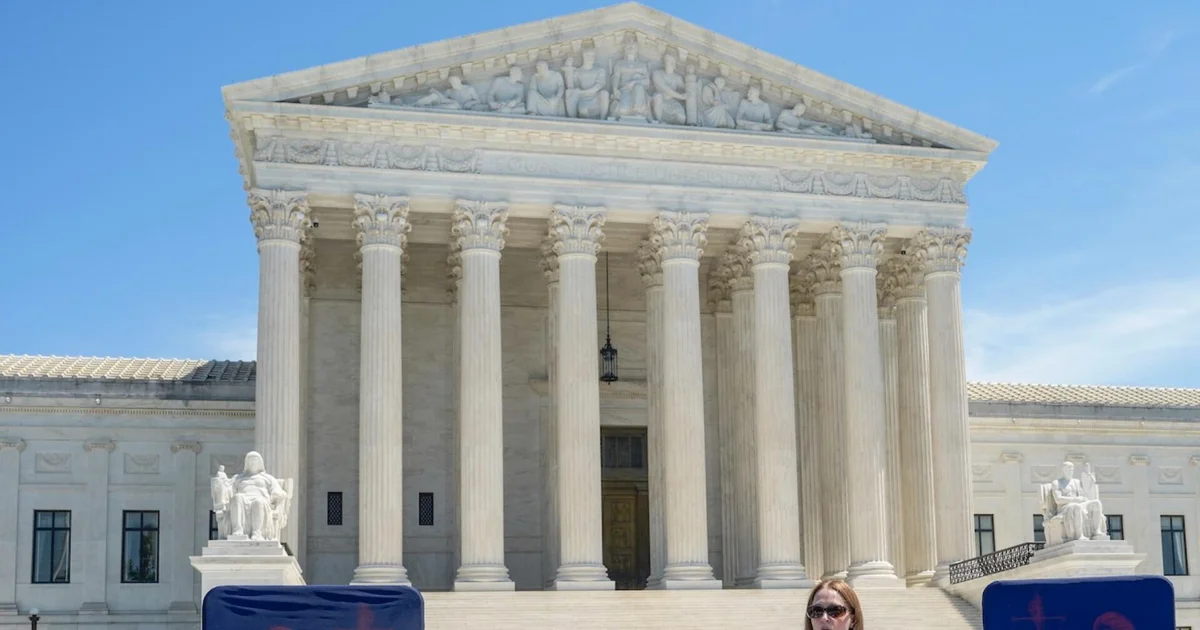

In the wake of a pivotal Supreme Court decision that further weakens the Voting Rights Act of 1965, Alabama and Tennessee are moving swiftly to redraw their congressional districts. This development exemplifies the ongoing power struggles between entrenched political entities and the constitutional frameworks that purportedly safeguard democratic fairness. As states realign their political maps, the core question arises: whose voices will be amplified, and whose will be marginalized?
The Supreme Court ruling has served as a catalyst, emboldening Republican-led state legislatures to assert greater control over electoral boundaries. Historically, the Voting Rights Act represented a landmark effort to combat racial gerrymandering—a practice that dilutes the voting power of minority populations through strategic district delineations. Yet, recent judicial decisions suggest a redefinition of permissible political mapmaking, emphasizing partisan advantage over voter representation. This shift echoes the fears of constitutional scholars who warn that the judiciary’s diminishing role in protecting minority rights could lead to an erosion of electoral fairness, reminiscent of the troubling gerrymandering strategies that aimed to undermine the civil rights advancements of the 1960s.
In Alabama and Tennessee, the political reaction is illustrative of a larger ideological battle. Conservative policymakers argue that their goal is to restore electoral integrity and uphold state sovereignty, framing the redistricting efforts as a necessary correction against alleged federal overreach. Conversely, critics—often aligned with Democratic interests—claim that these state-level moves are blatant attempts to entrench Republican dominance and suppress minority voters’ influence.
- Alabama’s new district maps are being challenged for potentially diluting African American voting strength in the pivotal Birmingham and Montgomery areas.
- Tennessee’s redistricting efforts threaten to consolidate rural and suburban districts, skewing representation in favor of conservative constituencies.
This dynamic reflects a broader power struggle concerning who ultimately determines the political destiny of American communities. The decisions made in state legislatures in response to the Supreme Court’s ruling echo historical parallels with the “Southern Strategy,” where political and racial boundaries were manipulated to maintain conservative dominance. Renowned political theorists like James Madison and Alexander Hamilton argued that the integrity of the republic depends on balanced representation; today, that debate is being redefined as maps are manipulated to favor partisan interests, risking the erosion of democratic legitimacy. As constitutional law experts warn, these tactics threaten to turn the ballot into a mere façade, where the outcome is predetermined by the shape of a district rather than the will of the people.
As the tapestry of American politics continues to be woven through redistricting disputes, it becomes clear that these decisions are more than administrative adjustments—they are strategic moves in a long-standing fight for control over electoral power. The question of how district boundaries are drawn directly impacts how policies are shaped, who is heard, and which communities gain or lose influence. Beneath this surface lies the profound reminder that in politics, as in history, the arena is where the battle for destiny is fought—each map a blueprint not only of representation but of the future itself.






