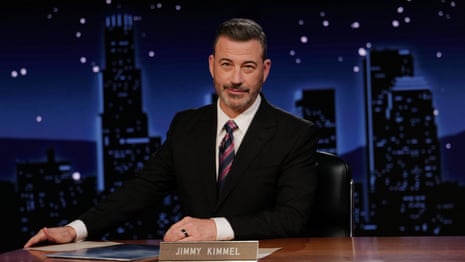
In an era where the pulse of culture often seems dictated by controversial headlines and fleeting trends, the fundamental role of culture as both a mirror and a molder of society remains undiminished. This recent flurry of media spectacle surrounding Jimmy Kimmel’s return to television underscores an enduring truth: culture is the custodian of tradition, identity, and societal values. As his monologue garnered record-breaking viewership—over fifteen million in just 16 hours—what emerges is not merely a spectacle of celebrity but a reflection of the collective consciousness grappling with freedom of expression, political pressures, and the visceral desire for authentic voice. It is a clarion call that, even amidst the cacophony of modernity, our cultural artifacts continue to serve as a battleground for the principles that define us.
Kimmel’s return was marked not solely by ratings but by the symbolic significance of a voice unshackled from censorship. His decisive stance against the recent suspension—an act driven by political and corporate interests—pays homage to the classical understanding of cultura: the cultivation of societal morals through art and dialogue. Such moments remind us of thinkers like Ortega y Gasset, who argued that culture is the collective memory which guides us through chaos, and also the prophecy of what we might yet become. In defending free speech, Kimmel echoes the sentiments of Chesterton, who saw humor and critique as the vital arteries of a truly free society, asserting that to silence voices is to stifle the very soul of democracy.
Moreover, the incident unveils the delicate nexus between media, public discourse, and tradition. Disney’s initial suspension, followed by the swift pushback from cultural advocates—Hollywood stars, free speech defenders, even political figures such as Senator Ted Cruz—reflects an underlying tension: the struggle to preserve the role of entertainment and commentary as custodians of societal integrity. Drawing parallels with the revolutions of thought during the Enlightenment, the confrontation underscores an essential truth: culture is not merely entertainment but a moral instrument, shaping the fabric of society and challenging the boundaries of political power. When these boundaries are threatened, it is not just a show that is suspended; it is the moral and intellectual shield that culture provides to a free society.
As the dust settles, the narrative of Kimmel’s resilience emerges as a testament to the enduring importance of cultural memory. His references to icons like Lenny Bruce, George Carlin, and Howard Stern evoke the long lineage of comedians who recognized their role as societal harbingers—challenging the establishment and pushing the frontiers of free thought. In this light, culture becomes both the archive of our collective experiences and the prophecy of our future. It reminds us that the act of creating, questioning, and even mocking is rooted in a profound desire to carve out space for the human spirit—a spirit that refuses to be subdued by censorship or manipulation. The echoes of T.S. Eliot’s call for poetry to carry the ‘distances of history’ and the ‘intimacies of today’ resonate in this ongoing battle for cultural authenticity.
In its essence, culture is the memory of humanity—layered with stories, struggles, triumphs, and follies. Yet it is also prophecy: a luminous beacon guiding us towards a future where truth, vitality, and individual sovereignty remain unyielded. As the great critic and thinker Chesterton observed, you cannot maintain a vibrant society without a lively culture—one that laughs, criticizes, and dares to dream beyond the constraints of superficiality. For in that dance of memories and prophecies, the human soul finds its voice, echoing through time as both witness and herald. And so, culture persists—not merely as the reflection of who we are, but as the silent architect of what we might become, whispering to each new generation that within the creative act lies the very hope of human destiny.