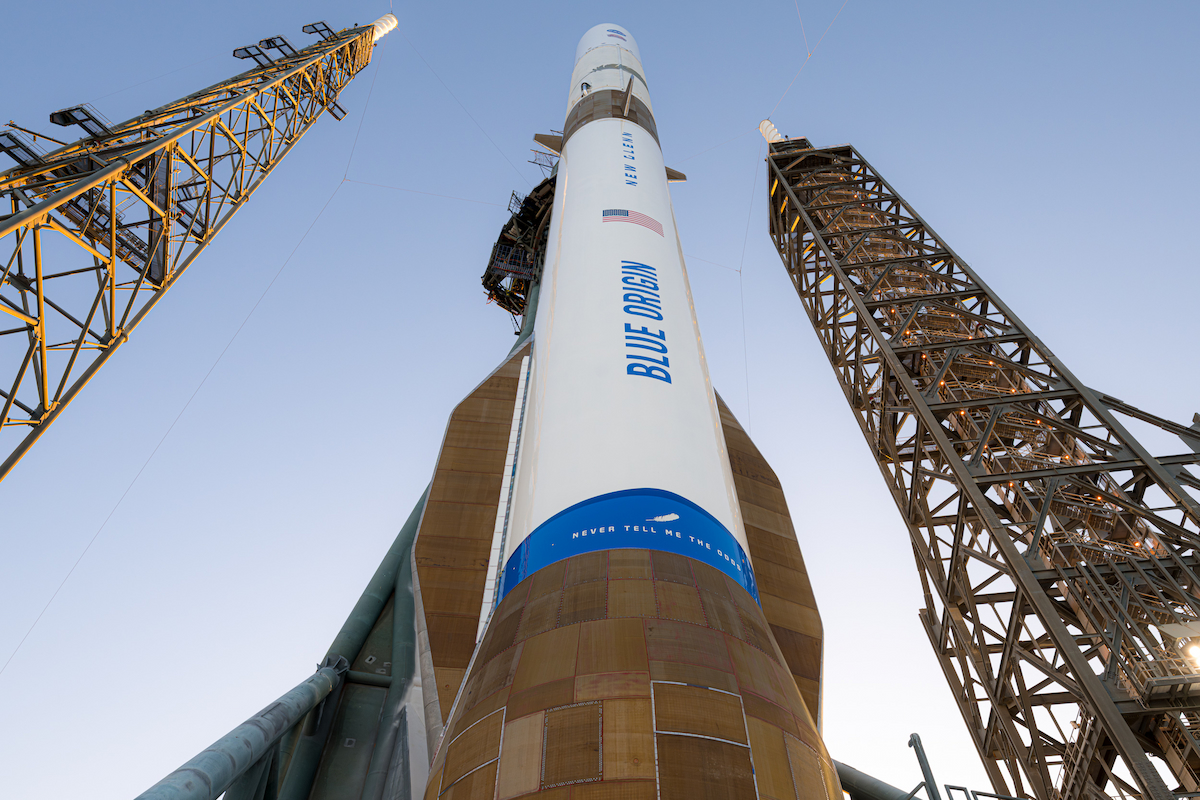
In a notable display of disruption in space launch technology, Blue Origin has faced setbacks but remains steadfast in its pursuit to revolutionize the commercial space sector. The company’s latest attempt to launch its groundbreaking New Glenn mega-rocket, scheduled for last Sunday, was scrubbed due to a confluence of weather conditions, minor launch pad equipment issues, and the unexpected intrusion of a cruise ship into the flight path. Despite the setback, the company announced a rescheduled launch for Wednesday, November 12, signaling its resilience and commitment to innovation amidst operational hurdles. According to Blue Origin’s official updates, the FAA’s recent restrictions—stemming from the ongoing government shutdown—have complicated launch permissions, illustrating the delicate regulatory environment that emerging space enterprises must navigate.
This mission is a pivotal moment for Blue Origin as it seeks to demonstrate complete reusability of the New Glenn booster — a critical benchmark for reducing launch costs and disrupting traditional space industry economics. In its inaugural orbital attempt in January, the New Glenn reached orbit but was lost upon impact in a booster explosion. The current mission aims to test the booster’s ability to land for the first time, a feat that could significantly undermine Elon Musk’s dominion with SpaceX. As industry analysts like Gartner highlight, reusability is no longer a mere innovation but an industry standard that distinguishes a sustainable, scalable space business. The successful recovery of the booster would not only validate Blue Origin’s technical capabilities but could also recalibrate the competitive landscape—ushering in lower-cost, frequent, reliable launches that challenge space monopolies.
Beyond proving reusable technology, this mission also signals a shift towards more ambitious commercial payload deliveries. The New Glenn is tasked with carrying NASA’s ESCAPADE spacecraft, aimed at Mars exploration, and a tech demonstrator for Viasat. This aligns with a broader trend of privatization and commercialization of space, where firms like Blue Origin aim to become indispensable partners in government and commercial projects. The venture’s success will carry substantial business implications: scaling new spaceflight economies, fostering innovation ecosystems, and accelerating the transition into a weaponized, commercially driven space age. Industry leaders and analysts, including those at MIT’s Space Systems Laboratory, anticipate that the next decade will determine whether private firms like Blue Origin become long-term players—or fall prey to the harsh realities of space-scale disruption.
Looking ahead, the unfolding developments epitomize the urgency with which space enterprises must adapt to an era of rapid technological change and intense competition. As industry dynamics shift, Blue Origin’s perseverance in tackling technical, regulatory, and environmental challenges underscores a crucial takeaway: _disruption in space is no longer hypothetical_; it is happening now, and the pace will only accelerate. Tech investors and policy stakeholders must monitor these milestones closely, as the success or failure of New Glenn will likely influence the trajectory of the entire space economy—from satellite networks to lunar mining and beyond. The next few years could redefine global competitiveness in space endeavors—making the coming launch attempt more than just a routine test; it’s a critical inflection point that may dictate the future frontiers of the commercial space age.