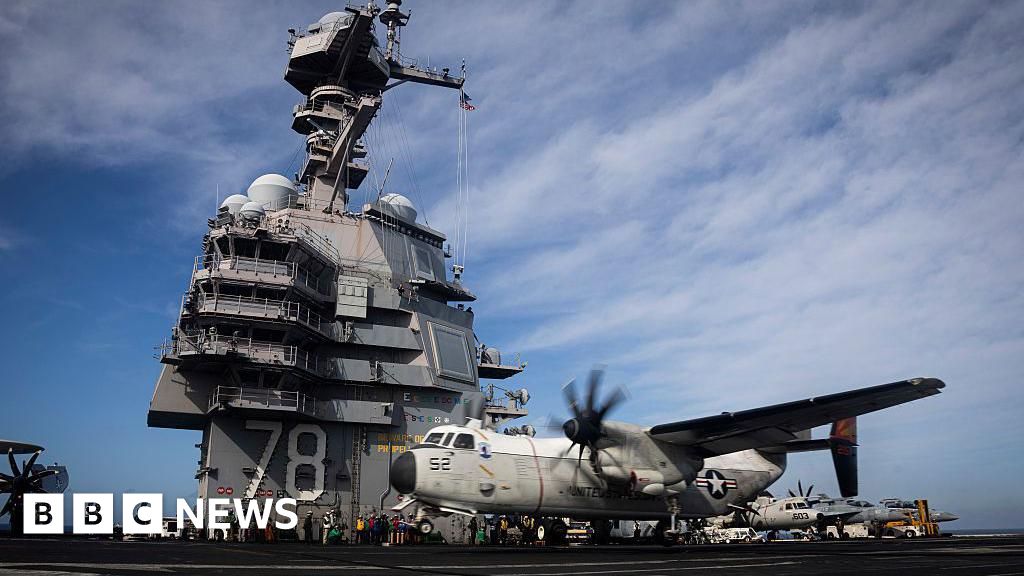
The recent deployment of a formidable US naval strike force to the Caribbean signals a significant escalation of America’s military posture in Latin America. Led by the USS Gerald R Ford, the world’s most advanced aircraft carrier, this deployment underscores Washington’s commitment to asserting its dominance in a region increasingly targeted by both illegal trafficking and political crises. The inclusion of guided-missile destroyers and a nuclear submarine among other vessels marks the largest US military presence in Latin America in decades, signaling a strategic pivot that many analysts argue is designed to control regional instability and assert influence amidst rising geopolitical competition.
According to Pentagon officials, this deployment aims to bolster capabilities to “detect, monitor, and disrupt illicit activities,” specifically targeting narcotics trafficking networks and criminal enterprises. However, critics and international observers warn that these operations are more than mere anti-drug initiatives; they are part of broader efforts to contain and influence the political landscape of the region, particularly in Venezuela and Colombia. Venezuelan President Nicolas Maduro and his government have long accused the US of attempting to provoke regime change under the guise of fighting crime, labeling US actions as “fabricated crises” meant to destabilize their socialist government. Such accusations highlight how military maneuvers are often intertwined with political motives, affecting the stability and sovereignty of regional nations.
Indeed, this intensified military presence comes at a time of heightened tension and ongoing conflicts. The US has conducted at least 19 strikes against alleged drug boats in the Caribbean and eastern Pacific, killing over 76 individuals. While the Trump administration defended these as necessary actions to prevent drug flow into the United States, many regional leaders and human rights groups have raised alarms over possible violations of human rights and due process. The escalation has also strained relations with Colombia and Venezuela, where governments have voiced concern over sovereignty infringements and the potential for these actions to provoke broader regional destabilization. Such developments are carefully scrutinized by historians and international bodies, who warn that unchecked military escalation risks igniting conflicts that could spiral beyond diplomatic control.
Some analysts suggest that these demonstrations of force are not just about regional security but also part of how international powers shift influence amidst a changing global order. The deployment coincides with rising power competition involving China and Russia, both of whom are expanding their footholds across Latin America. This move by the US can be viewed as an attempt to reassert dominance and contain the growing influence of rival powers in a strategic corridor vital for maritime trade and regional stability. History teaches us that such military gamesmanship often precedes larger conflicts or systemic shifts, with the region serving as a critical battlefield for influence between major global actors.
As the international community watches with cautious concern, the true impact of this military build-up remains uncertain. The coming weeks and months will reveal whether these show-of-force tactics will stabilize or exacerbate the ongoing crises across Latin America. The weight of history presses heavily on today’s decisions, with the specter of future conflict hanging in the balance. As the world’s eyes remain fixed on the Caribbean and beyond, one thing is clear: the unfolding geopolitical chess match is shaping the future of nations and societies, potentially rewriting the regional order for generations to come.