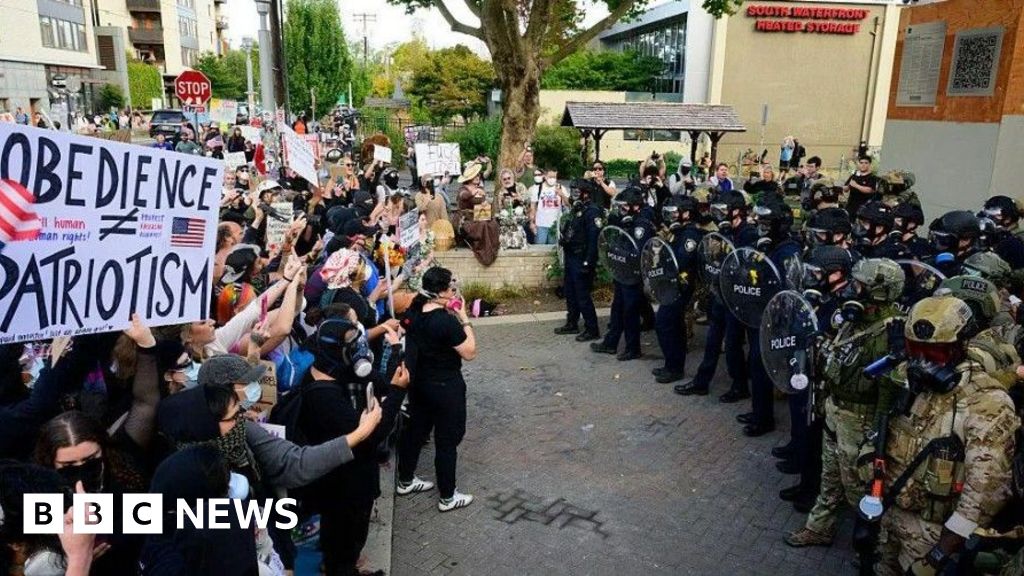
In an unprecedented turn of events, United States federal judiciary has stepped into a contentious battle over the deployment of National Guard troops across domestic borders, marking a significant moment in the ongoing struggle between federal authority and state sovereignty. The recent decision to temporarily block the Trump administration from dispatching troops from Texas and California to Portland, Oregon underscores the deepening cracks within American federalism. The ruling, delivered by US District Judge Karin Immergut, signals a notable restraint on executive power, emphasizing the importance of local consent and constitutional boundaries in deploying military force domestically. As tensions escalate, this judicial intervention warns of the delicate balance required when confronting chaos and unrest. It also raises crucial questions about the limits of presidential authority, especially when political disputes threaten to spiral into military occupations, altering the social fabric of cities already strained by protests and crises.
The controversy centers on the Trump administration’s effort to use the National Guard as a tool to quell protests linked to immigration enforcement and leftist activism, with Portland becoming the focal point of these efforts. The administration’s assertion that troop deployments are necessary to restore order clashes with legal interpretations that argue such actions infringe on state rights and could set dangerous precedents for federal overreach. The judge’s decision to authorize a temporary restraining order until at least October 19 reflects concern over the potential for militarized responses to inflame social tensions and undermine the sovereignty of local governments. Analysts warn that resorting to military force in urban centers risks transforming peaceful protests into battlegrounds, with lasting impacts on civil liberties and community trust.
This legal tussle reveals a broader geopolitical impact—a nation struggling to resolve internal divisions while its leaders attempt to project strength through military deployments. International organizations and historical experts have cautioned against the normalization of military interventions in American cities, warning that such actions could destabilize the domestic landscape and inspire similar strategies amidst other democracies facing unrest. The White House’s outspoken denouncement of the judge’s ruling, coupled with rhetoric portraying legal limits as “constitutional violations,” signals an alarming willingness to bypass judicial oversight in pursuit of a law-and-order agenda. Meanwhile, the proliferation of lawsuits from states like Illinois and the vocal opposition from state officials exemplify the intense federal-state power struggle, echoing historical conflicts over control, authority, and the rights of citizens.
As the situation unfolds, the spectacle of political tit-for-tat, legal battles, and security measures leaves a nation on the precipice of a pivotal chapter in its history. The decision to deploy or restrain military force amidst civil unrest will have profound and lasting consequences—not only for America’s social order but also for its global image. Today’s internal conflicts threaten to redefine the boundaries of power between state and federal authorities, shaping the course of democracy itself. The weight of history presses heavily on this moment, as the world watches from afar—will the United States uphold its founding principles or succumb to a new era of militarized governance? Only time will tell, but one thing remains certain: the unfolding saga is a stark reminder that the true battleground lies not only in the streets but also in the very fabric of national sovereignty and the enduring quest for constitutional justice.