DJI Launches Transparent Romo RoboVac: A Landmark in Cleaning Tech Disruption
In an unexpected move that underscores the relentless pace of technological innovation, DJI, the renowned drone and camera manufacturer, has entered the competitive robotic vacuum market with the release of the DJI Romo. Debuting in Europe this week after its initial launch in China, the Romo represents a bold reimagining of home cleaning—fusing drone-level navigation tech with an eye-catching transparent design. This product signals a significant shift, revealing industry ambitions to disrupt traditional appliances with transparency, advanced sensors, and integrated AI, set against a backdrop of mounting market disruption.
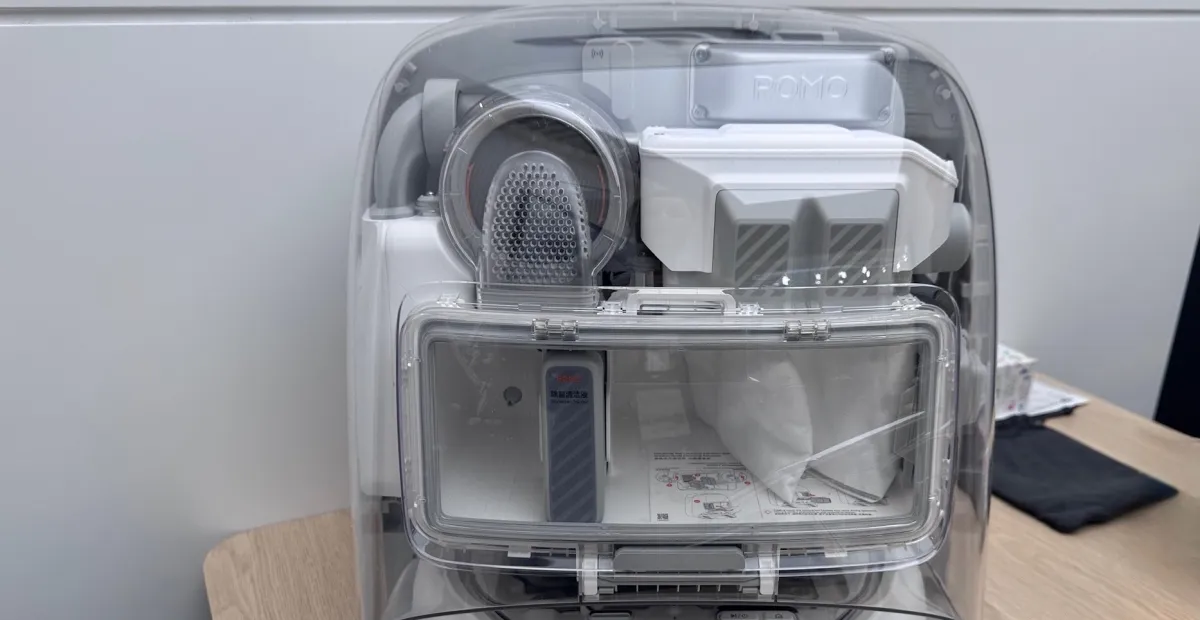
The Romo’s release is notable not only for its innovative aesthetics but also for its combination of advanced navigation systems. Utilizing dual fish-eye vision sensors alongside solid-state lidar derived from DJI’s drone lines, it pushes the envelope in ground-based robotics. Vision experts and leading institutions like MIT have long emphasized lidar’s role in improving navigational precision in autonomous systems, and DJI appears committed to setting new standards here. The robot’s capacity to detect objects as thin as a 2mm cable exemplifies hardware engineering that prioritizes meticulous environment mapping, promising to elevate smart home automation to new heights. Its see-through design offers a peek inside the workings—akin to a hardware manifesto emphasizing transparency as a feature, turning a mundane appliance into a statement of tech prowess.
Market implications of DJI’s entry are profound. The Romo line comes in three models, with the flagship Romo P starting at €1,899 (~$2,200). Despite its premium pricing, the device’s disruptive features—such as a self-cleaning dock with a deodorizer slot, high-pressure jet cleaning for mops, and hot air drying—aim to redefine customer expectations for durability, convenience, and luxury in robotic home appliances. Its incorporation of mixed sensory modalities signals an industry-wide shift, challenging established brands like Roborock and IKEA, which have offered less sophisticated navigation tech. This disruption could force competitors to innovate or risk obsolescence, especially as younger consumers increasingly prioritize sophisticated gadgetry integrated seamlessly into their living spaces.
Technology analysts like Gartner and industry veterans warn that such innovation demands rapid adaptation from market players. The Romo’s design, which is substantially larger and heavier to house its advanced sensors, demonstrates DJI’s commitment to pushing technological barriers, bolstering the trend towards fully autonomous, context-aware cleaning solutions. As Peter Thiel and Elon Musk have suggested, the future belongs to firms that leverage cutting-edge sensors and AI to redefine ordinary tasks, transforming them into high-tech experiences. For now, DJI’s entry into this space confirms that the era of ordinary vacuum cleaners is ending, replaced by intelligent, disruptive devices capable of not only cleaning but also enhancing home environments through sophisticated sensors and AI-powered navigation. With no current US release plans, anticipation is high; an industry that once dismissed robotic vacuums as mere gadgets now faces the reality of a high-stakes innovation race.