
Matox News

Truth Over Trends, always!

Roommates Review: Netflix’s Breakup Comedy Delivers a Bold Blend of Heart and Humor

In an era where the relentless surge of streaming platforms has inundated the cultural landscape, the role of genuine storytelling remains paramount. The recent rise of filmmaker Adam Sandler exemplifies a broader, more profound truth: culture is not just entertainment but a vessel of our collective identity, tradition, and moral compass. As Sandler matures from juvenile humor to more textured, meaningful narratives, his evolution underscores a vital cultural truth—that art’s greatest function is to reflect and shape the soul of society. The transition from hollow comedies to films that engage with real human complexities demonstrates that, even amidst the noise, authentic culture persists as a guiding light, reminding us of who we are and who we aspire to become.

Throughout history, critics and philosophers have recognized the formative power of culture in shaping our societal structures and personal identities. Ortega y Gasset, for instance, emphasized how the mass culture of a society channels its values and aspirations. Today, amidst a landscape saturated with superficial content, the importance of cultivating stories that deepen our understanding of human nature becomes an urgent necessity. In this context, films like Sandler’s “You Are So Not Invited to My Bat Mitzvah” serve as vital cultural artifacts that honor the complexity of youthful experience, actively resisting the trivialization that often accompanies teen-oriented media. These narratives, by recognizing the intelligence and dignity of younger generations, reaffirm the enduring importance of tradition and moral responsibility. They remind us that culture is both a memory that anchors us and a prophecy that guides us forward.

Moreover, the current tendency among studios to obscure imperfect works—such as the baffling concealment of Sandler’s “Roommates”—reveals an industry anxiety that echoes historical distortions. As Tocqueville observed, democratic societies tend to prefer sanitized versions of reality, often sacrificing authenticity for conformity. Yet, it is precisely within imperfect, often unruly works that the true pulse of society can be discerned. “Roommates,” despite its flaws, offers a genuine, relatable tableau of friendship’s disintegration, steering clear of cliches and embracing the messy, nuanced reality of human relationships. It challenges the Hollywood tendency to prioritize spectacle over sincerity, insisting instead that our culture thrives when it remains rooted in the authentic, imperfect stories that mirror our true selves. As Chesterton argued, truth and beauty often dwell in the modest and overlooked, serving as the foundation for meaningful cultural discourse.

In contemplating the role of culture, it is as T.S. Eliot suggested that “the purpose of art is to draw our attention to the mystery of life itself.” Today’s filmmakers and creators serve as custodians of that mystery, offering us narratives that both recall our origins and prophecy our future. These stories, woven from the fabric of memory and hope, forge an enduring bridge connecting generations. As we look forward to the stories yet to be told, let us remember that culture is the collective memory of humanity, an ongoing dialogue with what has been and what will be—a melody of remembrance and promise that sustains the soul of society, guiding us through darkness into dawn, where every new story becomes both a reflection of our past and a prophecy of our future.”
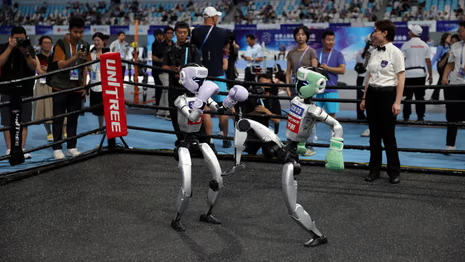
Robot Takes the Mic: Melbourne Innovator Turns AI into Comedy Gold for the Next Gen

In an era where **technology** continues to reshape every facet of **lifestyle** and **entertainment**, a groundbreaking initiative from the University of Melbourne is probing the very limits of **artificial intelligence** (AI) in the realm of **comedy**. Led by Dr. Robert Walton, a dean’s research fellow in the **Faculty of Fine Arts and Music**, this project seeks to determine whether **robots** can go beyond mere **physical mishaps** and develop a genuine sense of **humor**. Unlike the stereotypical clumsiness that often elicits laughter at robots’ expense—think of those viral clips of Boston Dynamics’ malfunctioning machines—Walton’s goal is to explore the potential for **AI** to *intentionally* make us laugh, tapping into the core skills of **timing**, **reading the room**, and **visual humor**. Thanks to a substantial Australian Research Council grant of roughly $500,000, Walton will train a team of ground-based **robots**, ranging from 40 centimeters to two meters tall, to hone their *visual* comedic skills alongside human collaborators.

This initiative marks a conscious departure from memetic AI humor derived from language models like **ChatGPT**, which often mirror *underwhelming* jokes, reminiscent of those found in **Christmas crackers**. Instead, Walton emphasizes that humor rooted in **non-verbal communication**—such as **physical comedy** and **timing**—may be the key to unlocking believable **machine humor**. By observing how **robots** sense movement, establish **connection**, and respond to gestures like **head tilts** or **laughter**, Walton aims to understand how machines might eventually *adapt* to mimic human **behavioral cues**. The project’s ultimate aim isn’t merely to entertain but to garner insights on how **human-robot interactions** can evolve, with all their **risks and benefits**.

Indeed, this investigation touches on profound questions about **authenticity**, **creativity**, and the very essence of **humanity**. Notable **cultural figures** like comedian and musician **Tim Minchin** have pointed out that what makes **comedy** truly compelling is the **flaws**—the imperfections and **agency** of **the artist** behind the act. Human **comedians** bring their **personal experiences**, **struggles**, and **mistakes** into their routines, crafting a moment of **authentic connection** that technology has yet to replicate convincingly. The **Melbourne comedy festival** director, Susan Provan, echoes this sentiment, emphasizing that **originality** arises from **lived experiences** and **spontaneous interactions**—elements that many believe define the **soul** of **comedy**. Walton’s project recognizes these facets, exploring whether **robots** can simulate this **authenticity** or if they will simply be **clumsy imitators**, providing humor through their **failures** rather than their **intentions**.

  • Reflect on the blend of **technology** and **lifestyle** as an avenue for **self-improvement** and **well-being**;
  • Consider how **training** in **humor** could be applied in fields like **caregiving** or **public interaction** to foster **empathy** and **connection**;
  • Embrace the idea that **innovation** must be paired with **ethical caution**—exploring both empowering potential and **threats** associated with **AI** transforming **entertainment** and **personal interaction**.

As Walton’s work unfolds, it invites us to reflect not just on what **technology** can do but what it **should** do. The journey from **robots fall** to the potential of a **believable** comedian embodies a broader societal quest: fostering a **lifestyle** that balances **innovative progress** with **authentic human essence**. This pursuit underscores an enduring truth—**the human spirit** thrives in spontaneity, mistakes, and the genuine **connection** with others. While AI may someday learn the **timing** and **gestures**, it remains to be seen whether it can truly emulate those **imperfections** that make us *laugh*, *cry*, and *feel alive*. Perhaps, in the end, the most profound comedy—like life’s richness—resides in embracing our **flaws** and the **journey** of perpetual discovery.

Social Media Auto Publish Powered By : XYZScripts.com



