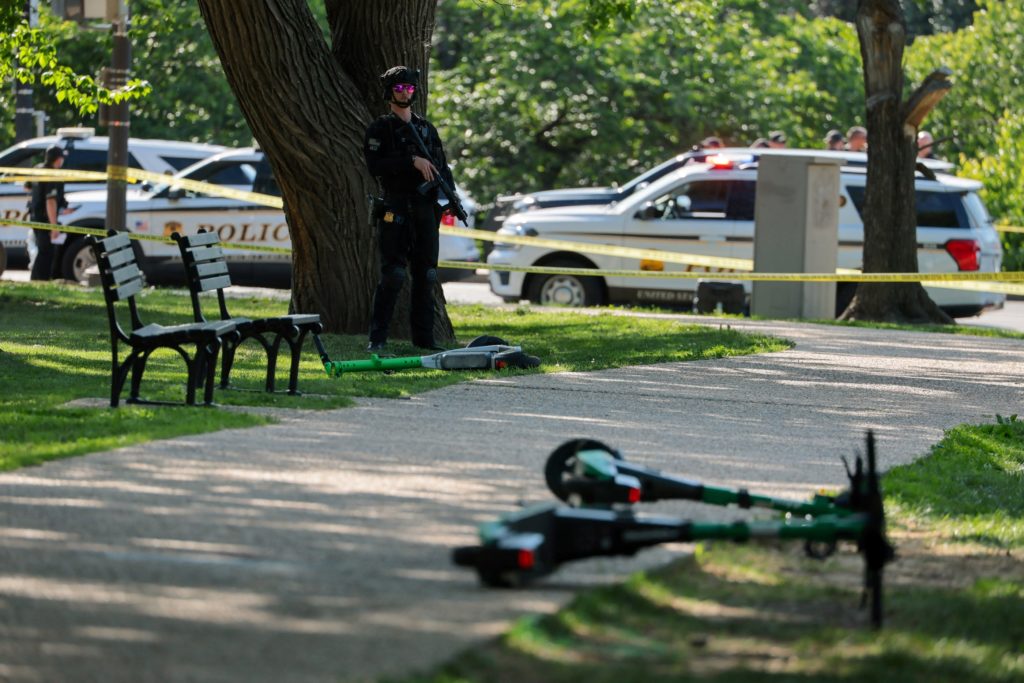

In a development that underscores the persistent volatility within the nation’s capital, U.S. Secret Service agents were involved in an alarming incident wherein firearms were discharged at an armed suspect in close proximity to the symbolic heart of American power, less than a mile from the White House. This second incident within a matter of weeks reflects a broader narrative of security breaches and the ongoing challenge to safeguard the seat of democracy from both external threats and internal chaos. As agents responded to what they described as an armed individual, the incident quickly escalated, resulting in the injury of a juvenile bystander—a stark reminder of the borderless dangers facing law enforcement and the unpredictable terrain of political conflict.
This event is more than a mere security report; it highlights a power struggle that extends beyond physical confrontation into the realm of political legitimacy and public trust. The Secret Service, an agency entrusted with protecting national leaders, is grappling with a landscape where freedom and security are in increasingly precarious balance. Such incidents prompt questions about the adequacy of current protocols and whether policy reforms—often touted by conservative advocates—are sufficient to address the evolving threats. Critics argue that policies must adapt swiftly to the shifting security paradigm, emphasizing strengthening law enforcement’s capabilities to prevent such incidents. Conversely, reform advocates sometimes push for broader discussions around civil liberties and the limits of state power, complicating the political debate and fueling a fierce clash over the very core of constitutional order.
From a historical perspective, this upheaval echoes the profound debates of the early 20th century concerning the delicate balance between liberty and authority. The Constitutional scholars remind us that the founders’ vision was predicated on a system where power is deliberately distributed and checked, yet in moments of crisis, the state’s role often expands—sometimes at the expense of individual freedoms. Today, the power struggle manifests as a contest over the definition of security and how it should be deployed in a society brimming with ideological divisions. As political theorist Carl Schmitt noted, the sovereign is he who *decides on the state of exception*, and in Washington, D.C., that decision is increasingly influenced by unresolved conflicts over who holds ultimate authority over security measures.
Ultimately, the ongoing sequence of violent incidents and policy debates exemplifies how decisions made in the corridors of power ripple outward, consequentially shaping the lives of ordinary citizens. The battle lines are being redrawn, not just over political ideologies, but over the core principles that will define the American republic going forward. In this theatre of struggles and reforms, the future of liberty and order is written by those wielding power today. As history has demonstrated, in the arena of geopolitics and domestic governance, destiny is carved by the decisive actions of enough brave or reckless actors to alter the course of our collective narrative. The stage is set—what remains to be seen is which forces will emerge victorious in sculpting the enduring contours of American sovereignty.