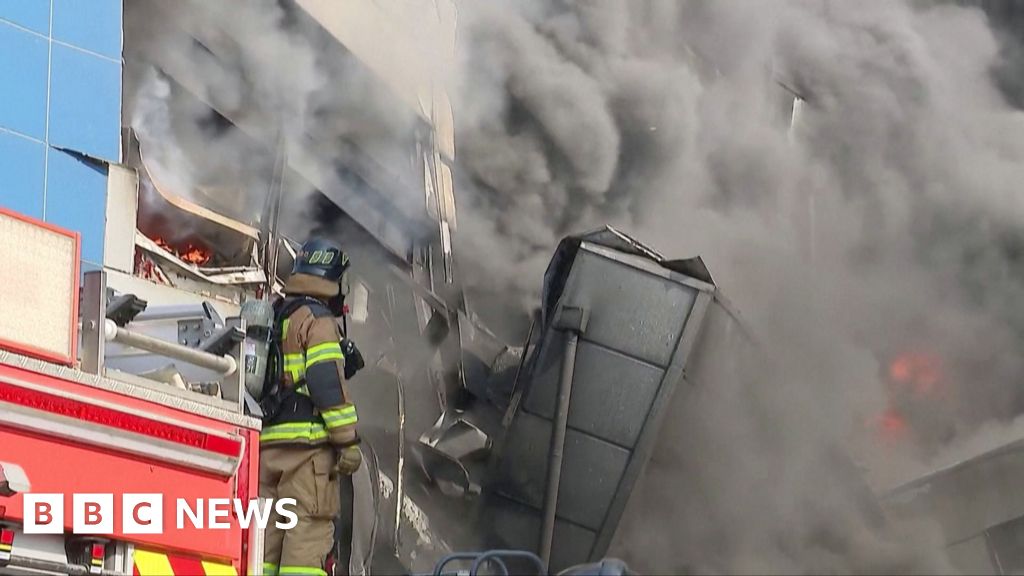

In a devastating incident that underscores ongoing safety concerns within South Korea, authorities reported that a tragic fire at a car parts manufacturing plant in Daejeon resulted in at least 10 confirmed fatalities and left four individuals still unaccounted for. The blaze, which raged through the facility, not only caused significant loss of life but also injured 59 others, highlighting vulnerabilities in industrial safety protocols amidst rapid economic growth and technological advancement. Local responders faced immense challenges, with videos revealing towering flames and thick smoke consuming the structure, rendering firefighting efforts arduous and dangerous.
The firefighting team revealed that their initial inability to enter the burning building was primarily due to fears of imminent collapse, a decision that speaks volumes about structural safety standards and emergency preparedness within the country’s industrial sector. Overnight, responders shifted towards a cautious but relentless search for survivors and victims, as authorities confirmed that the fire had spread rapidly and was difficult to contain. While the cause of the fire remains under investigation, preliminary assessments suggest it could be linked to equipment failure or lapses in safety measures—a recurring concern in many of the region’s manufacturing zones. Such tragedies often force international observers, including analysts and safety experts, to question whether South Korea’s rapid industrialization has come at the expense of workers’ safety and working conditions.
- Globally, this incident illustrates the persistent risks inherent in modern supply chains, which are heavily reliant on factories in nations like Korea.
- It has reignited debates about the adequacy of safety regulations in countries that are pivotal to global manufacturing, especially as South Korea remains a linchpin in the international electronics and automotive sectors.
- Furthermore, critics point out that such tragedies could lead to increased calls for stricter regulations, which might impact operational costs and global competitiveness of South Korean firms.
International organizations and industry watchdogs have issued statements warning that this incident exposes the vulnerabilities of globalized manufacturing networks. The International Labour Organization and regional safety agencies emphasize that, amidst economic ambitions, *worker safety and infrastructural integrity must remain a top priority*. Historians like Dr. Han Soo-Young warn that repeated industrial accidents unveil a pattern of superficial compliance and reveal a deeper need for systemic reform. The incident in Daejeon serves as a stark reminder that, in the relentless pursuit of economic growth, societal costs such as lives lost and communities shattered often go unnoticed until tragedy strikes.
As South Korea grapples with this disaster, the international community watches with a mixture of concern and anticipation. Will the government enforce more rigorous safety standards? Or will economic imperatives continue to overshadow the imperative to safeguard lives? This event symbolically echoes the broader geopolitical landscape, where nations are judged not solely on their economic achievements but on their ability to protect the most vulnerable within their borders. The legacy of this fire, like the smoldering remnants of the destroyed plant, is a haunting reminder: in the course of history’s relentless march, human lives are the ultimate measure of progress. And as the ashes settle over Daejeon, the world waits—uncertain of the fateful balance between industrial ambition and human safety, knowing that history’s next chapter is yet to be written.