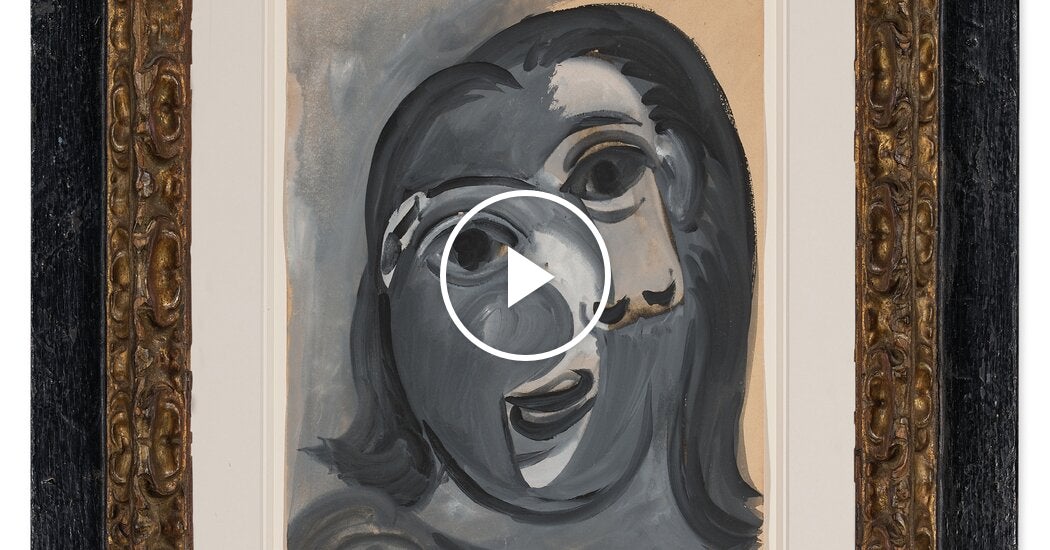

In the grand theater of cultural legacy, few moments capture the essence of enduring human creativity as profoundly as the recent triumph of chance over history’s most transformative artworks. A 58-year-old Parisian man, whose story exemplifies the intersection of luck, philanthropy, and cultural appreciation, secured Pablo Picasso’s Tête de Femme, a hallmark of Cubist innovation from 1941, in a charity raffle that raised nearly $11 million for Alzheimer’s research. The man’s two tickets, purchased for a modest 100 euros each, transformed an ordinary act of participation into a moment of cultural significance, enabling him to walk away with a piece valued at approximately $1.2 million. This event underscores a vital truth: culture remains a living force, shaping identity and society, capable of transforming individual lives and collective destiny.
This extraordinary transaction is more than a mere lottery win—it is a resonant reminder that art continues to serve as the symbolic memory of humanity, as well as its prophetic voice. Picasso’s cubist explorations, with their fractured yet cohesive visions, challenged traditional perceptions of form and perspective. As Ortega y Gasset famously argued, cultural artifacts like Picasso’s work do not merely decorate history; they actively shape the worldview of generations. In an era of rapid technological change and cultural flux, these masterpieces stand as anchors that connect us to our past while inviting an optimistic gaze into the future—reminding us that our cultural endeavors are an ongoing dialogue between memory and possibility.
Furthermore, this event highlights the profound connection between cultural patrimony and societal progress. The funds raised through this innovative form of philanthropy—an imaginative twist on an age-old tradition—will advance vital research on Alzheimer’s disease, a scourge that threatens the collective mind of society. This synergy of art, charity, and scientific pursuit echoes Tocqueville’s insights into the vital role of civic engagement in fostering community resilience. It exemplifies how cultural heritage and societal well-being are inherently intertwined, reinforcing the idea that the preservation and celebration of our cultural landmarks are essential to maintaining the moral fabric of civilization.
In defending our cultural traditions—be it through visual arts, literature, or other creative expressions—we affirm G.K. Chesterton’s notion, that culture is not merely a superficial embellishment but the very core of our identity and a beacon guiding us through times of uncertainty. As society navigates the tumult of modernity, it finds itself in a shared landscape where the transcendent power of art and tradition channels collective hope and resilience. It is this sacred trust in the cultural that fuels our desire for continuity, tradition, and the constant rebirth of meaning.
In the poetic tapestry of human history, culture emerges as both a treasured memory and a prophecy—an echo of the triumphs and struggles that have shaped us, and a vision of what we might yet become. As T.S. Eliot eloquently observed, “Human kind cannot bear very much reality,” yet through the art we cherish and the stories we tell, we forge a resilient fabric where memory and prophecy intertwine. This event, where chance elevates Picasso’s masterpiece into the realm of personal destiny and societal hope, serves as a reminder that culture is both our inheritance and our divine calling. It is, ultimately, the ongoing symphony of human soul—mute witnesses to the past and heralds of the future, whispering that as long as we remember and create, the human spirit will endure.