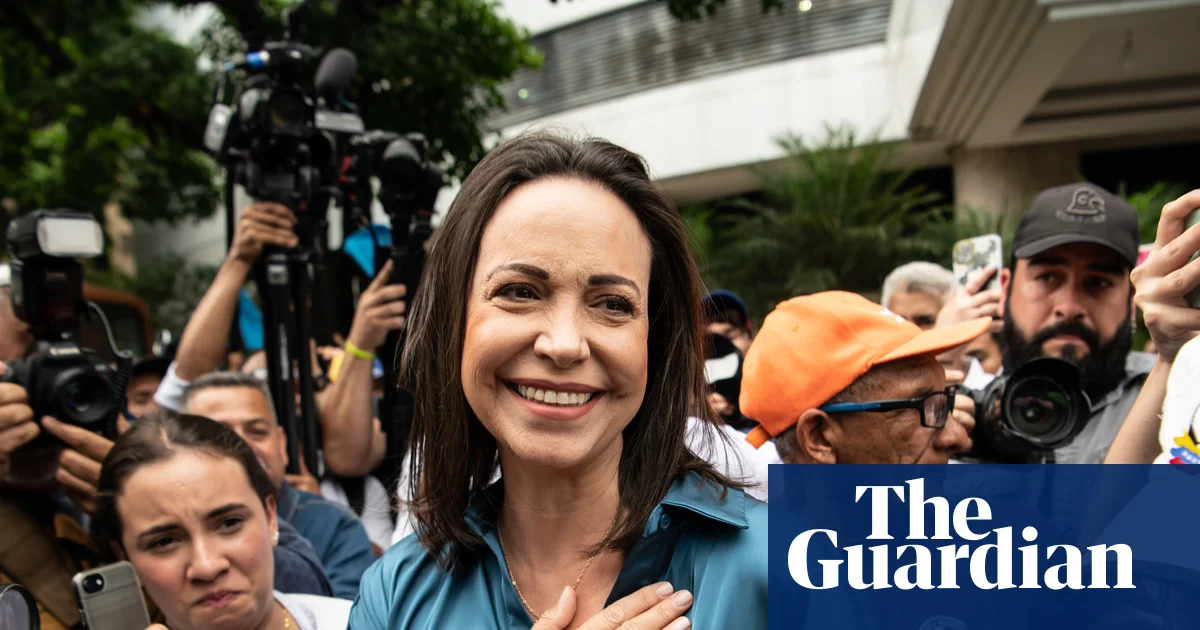
In an extraordinary development that underscores the fierce struggle for democracy against authoritarian regimes, María Corina Machado, the revered opposition figure from VENEZUELA, has been awarded the Nobel Peace Prize. Celebrated globally as a symbol of resilience, Machado’s advocacy for freedom and democratic principles exemplifies the vital role of civilian courage in South America’s ongoing political turmoil. Her recognition by the Nobel committee not only elevates her personal fight but also spotlights the broader geopolitical repercussions of Venezuela’s protracted crisis—a nation once proud of its prosperity, now suffering under the shadow of dictatorship.
The background to Machado’s pivotal ascent is rooted in the controversial July 2024 presidential election, fiercely contested and widely regarded as a decisive moment in Venezuela’s democratic backslide. The opposition, led by Machado’s ally Edmundo González, claimed to have won decisively, a victory nullified by Nicolás Maduro, who refused to cede power. The subsequent crackdown—marked by arrests, exile, and underground resistance—symbolizes the intensified, brutal grip of Maduro’s regime over Venezuela’s political landscape.
Despite her exile and living in hiding, Machado’s symbolic presence remains a rallying point for opponents. Her recent Nobel accolade has ignited hope among Venezuela’s dissident community and international allies, especially the United States. The U.S. has responded with increased military posturing, with reports of a significant naval buildup off Venezuela’s Caribbean coast—an ominous sign that some factions may be preparing for regime change. While such plans remain covert, the potential for external intervention raises profound concerns regarding sovereignty and regional stability, fueling fears of a broader conflict rooted in U.S.-Latin American relations. Analysts from institutions like Chatham House warn that this move could escalate tensions in a nation already torn apart by economic despair and social unrest.
The international community’s stance on Venezuela’s crisis continues to evolve. The United Nations and numerous human rights organizations have condemned Maduro’s government for systematic repression, citing the displacement of nearly 8 million Venezuelans—a staggering exodus driven by poverty, violence, and political persecution. As Machado’s efforts garner global recognition, her Nobel victory illuminates the stark contrast between the hope of democracy and the oppressive reality beneath Maduro’s rule. This recognition is also interpreted as a message to Venezuela’s military and elites: the world is watching, and the legacy of Maduro’s brutalism will be scrutinized in the court of history.
Within Venezuela, Machado’s narrative of courageous resistance continues to inspire widespread protests and civil disobedience. Her decades-long involvement in politics, from confronting Chávez to mobilizing citizens in the current struggle, has cemented her as a symbol of hope. Still, critics point out her controversial calls for foreign military intervention, which some interpret as bordering on reckless and potentially destabilizing. Historians and international observers urge cautious judgment, emphasizing the importance of defending sovereignty, yet acknowledging the profound desire among Venezuelans for justice and renewal. As the world watches each new twist in this saga, the weight of history presses heavy upon the shoulders of both those who fight for freedom and those who seek to maintain order at all costs.