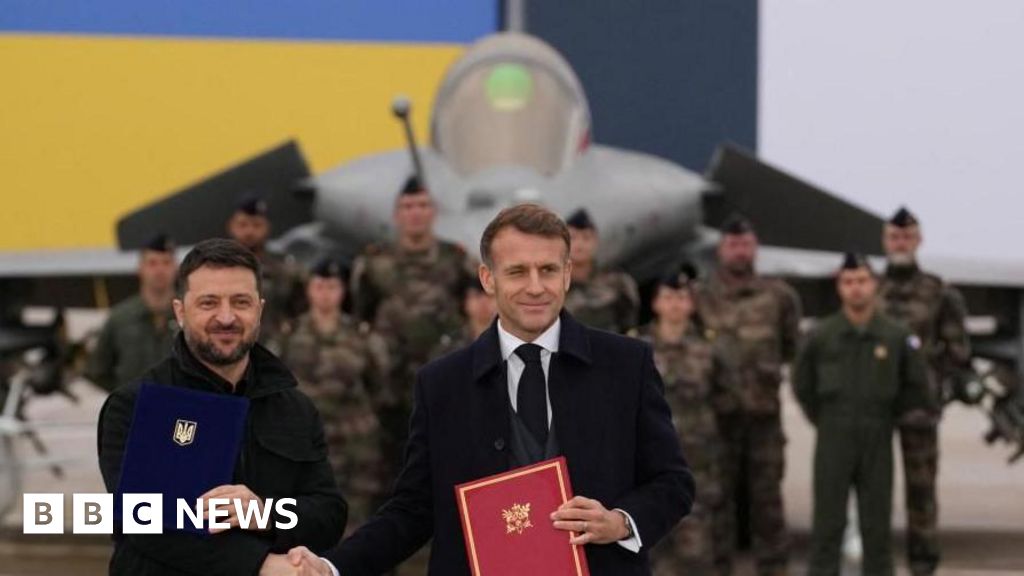
In a move that signals a significant shift in the ongoing Ukraine-Russia conflict, Ukraine has secured a historic agreement with France to receive up to 100 Rafale F4 fighter jets along with advanced air defense systems. This agreement, signed by Ukrainian President Volodymyr Zelensky and French President Emmanuel Macron, marks a strategic milestone in Kyiv’s efforts to bolster its military capabilities amidst relentless Russian assaults. The delivery timeline, set to conclude by 2035, underscores the long-term nature of Western military support—a crucial factor for Ukraine’s battle to defend its sovereignty.
This development must be understood within the broader context of the increasingly volatile geopolitical landscape. Russian President Vladimir Putin has escalated drone and missile attacks targeting vital infrastructure—energy grids and railroads—causing widespread blackouts and civilian casualties. The recent strike in Balakliya, which left three dead and fifteen wounded, exposes the brutal toll of Moscow’s strategy to undermine Ukraine’s resilience. Western analysts and organizations, such as the Royal United Services Institute (RUSI), emphasize that the effectiveness of these advanced Western arms—like the Rafale jets—will depend heavily on training, logistics, and sustained support, revealing the complex, long-term nature of such military aid.
Moreover, the agreement’s financial underpinnings reflect a broader controversy and geopolitical tug-of-war. France reportedly plans to leverage EU financing and access frozen Russian assets—an initiative that has stirred debate within the 27-member bloc. While some nations, particularly those wary of provoking Russia or violating international law, balk at the move, others see this as a necessary step to sustain Ukraine’s military efforts. The debate over seizing and reallocating Russian assets underscores the profound shift in international legal and economic norms responding to the Ukraine crisis. The stakes are high: whether these funds will support Ukraine’s defense or fuel diplomatic discord back home will shape Europe’s cohesion and resolve.
Kyiv’s leadership continues to navigate a complex web of geopolitical pressures. Alongside its military modernization, Ukraine is engaging diplomatically with countries like Spain and Greece to secure further support—including upcoming liquefied natural gas imports—highlighting how energy and military strategies are intertwined in the theater of international influence. Yet, the core question remains: how sustainable is this support, and what will be the long-term repercussions for European security and U.S.-led NATO efforts? The Ukrainian conflict has become a litmus test for Western resolve; its outcome will determine not only the fate of Ukraine but also the future stability of the entire region.
As Kyiv braces for what could be a protracted conflict, history still unfolds with relentless momentum. The decision to arm Ukraine with some of Europe’s most advanced fighter jets, while vital, also underscores the fragile and often uncertain path of international intervention. Will this be enough to shift the tides against Moscow’s slow but persistent advances? Or will it serve as a bridge towards an elusive peace? The world watches as Ukraine, Russia, and the West write the next chapters of this defining struggle—where every missile, every diplomatic move, and every treaty bears the weight of history, forging a future that remains perilously uncertain.